


Photography by Fletcher Wold
Patterns in nature rarely resolve into straight lines. They spiral outward, branch unpredictably, ripple, fold, and curve. A shell grows in logarithmic arcs. A river bends and doubles back. Even the structures that feel ordered — honeycombs, crystals — carry subtle variation, a looseness at their edges.
The square grid belongs more to us than to nature. It brings clarity, repeatability, and control. It allows things to be measured, planned, and aligned. Cities snap to it. Paper is ruled by it. Systems depend on it.
LEGO might be one of its most distilled expressions.
Studs and tubes, spaced with exacting precision. Every connection predictable. Every piece designed to align, stack, and hold. A language built on right angles and repeatable units, where stability is the point, and deviation is corrected back into place. It’s a system you trust because it behaves
the way it’s supposed to.
Or so I thought.
There is a moment, standing in front of one of Jeff Sanders’ sculptures, when your brain tries to resolve what it’s seeing into something familiar — a mandala, maybe, or a radar screen, or a section of a cathedral window — and then you realize it’s all LEGO.
Within that precision — in the tolerances, the friction, the tiny allowances built into every connection — something is hiding. A tiny bit of space, a subtle give.
There's more! Continue reading this article by subscribing to BRICKA.
There's more! Continue reading this article by subscribing to BRICKA.
Hept Annulus 44
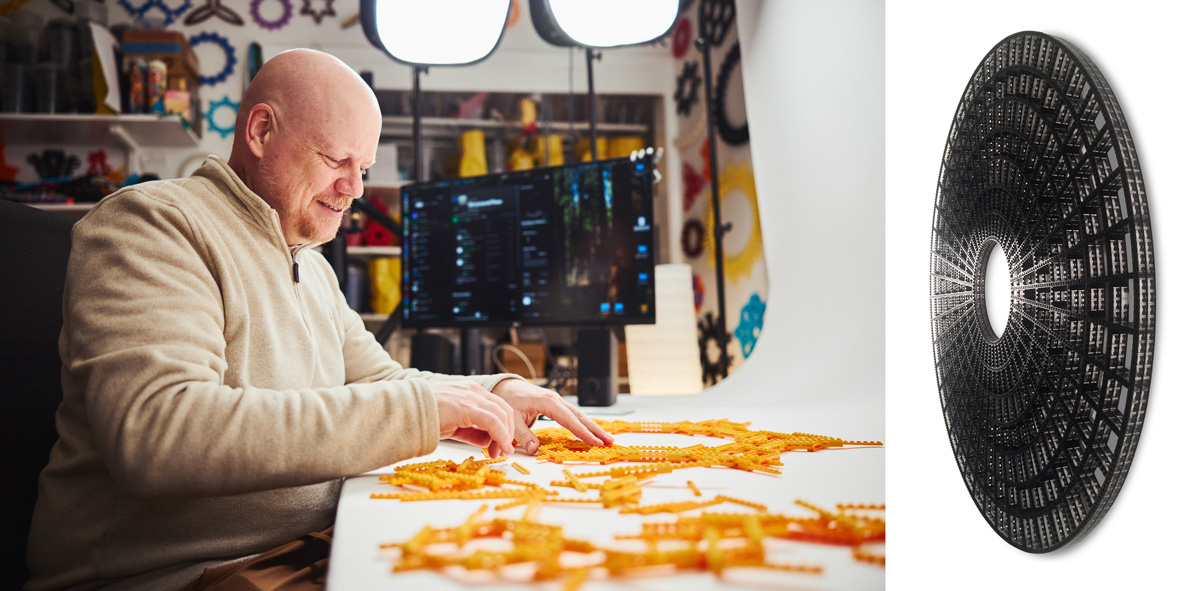
The Hept Annulus 44 hangs on the wall and pulls light into itself like a black hole.
From across the room, it reads as a single dark disc. Move closer, and the surface differentiates: a tight black outer ring, then a web of diagonal lines crossing at angles that your eye wants to call forty-five degrees but that are something slightly stranger — because the bricks forming them are under stress. The bricks are… bent. Each line is an arced string of pieces held in tension against its neighbor. Deeper in, transparent, clear bricks take over, forming a radial grid of small chambers that catch light differently at every angle, giving the interior a sense of depth where there is almost none.
The LEGO grid isn’t designed to bend into a circle — the system wants straight lines and right angles, and a circle introduces a rounding problem that compounds with every ring you add outward. Sanders had to find the specific sizes where that error stays small enough to vanish, distributed invisibly across each ring rather than announcing itself as a warp or a gap. The result: 44 radial lines across concentric circles.
A Corral for Ponies
He wasn’t trying to make art. Looking back, he’s not surprised that play led him there. At the time, he was just trying to keep a fence from looking terrible.
Sanders was on the floor with his daughters — they were eight and five at the time — building a corral for their toy ponies. It was an ordinary Saturday kind of project. He was also, at that time, deep in the middle of graduate school for math, his mind full of college geometry, calculus, and the shape of equations.
He was stringing one-by-two bricks end to end, just trying to make a rough rectangle, when he noticed something. “I saw that there was a little bit of play. You put a bunch of parts together. There’s a little bit of play in there. And I just went, huh.”
He kept going. He and his girls pulled out every one-by-two they could find in the bin and just kept stringing them, not toward a corner this time, but all the way around — into a circle. A real circle, made entirely of rectangular bricks, with no glue, no heat, no modification. Just tension. The accumulated give of dozens of imperfect connections, each one slightly stressed, the whole thing resolved into something that shouldn’t exist.
“I became obsessed with LEGO circles in a way that nobody else is.” The ponies, presumably, gained an excellent corral.
Sunstone
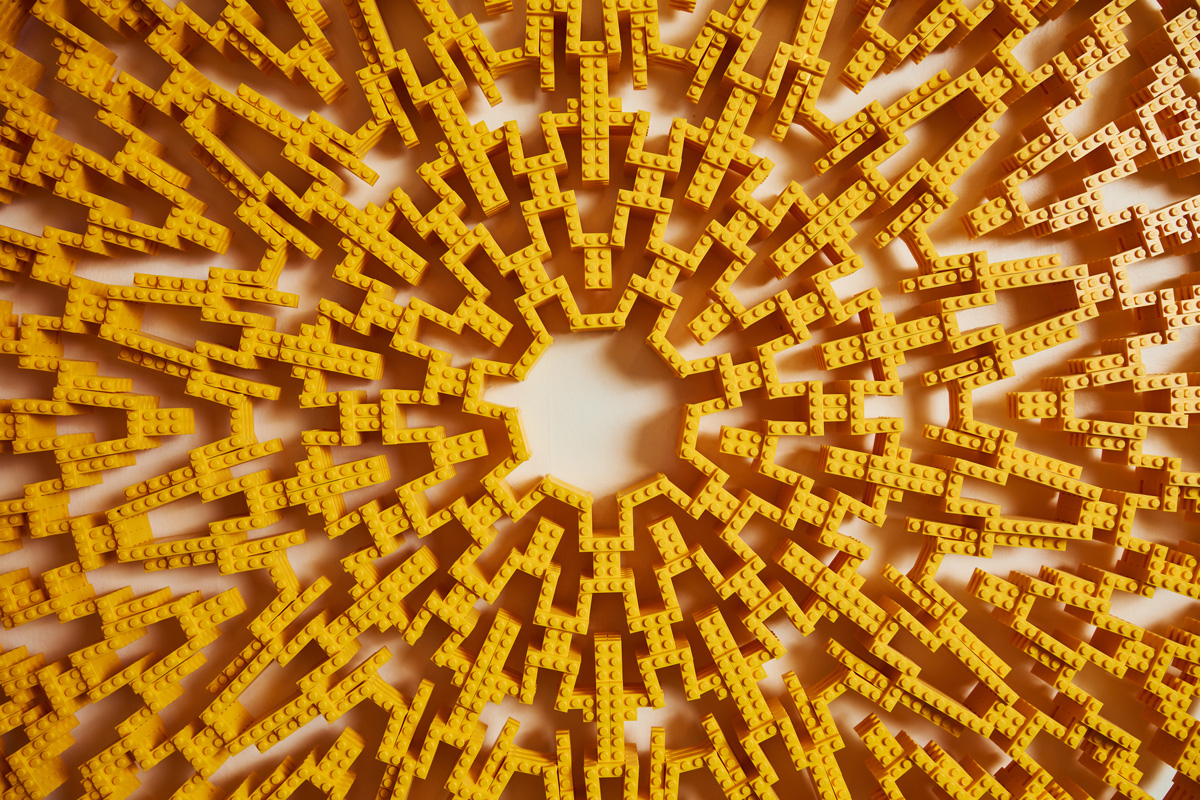
The Sunstone is the yellow of a child’s drawing of the sun, and it radiates accordingly.
It reads like something astronomical — a solar corona, a time-lapse of a flower in one eternal frame. There’s a small geometric void at the center, and from it, interlocking crosses and T-shapes spiral outward in every direction. The individual bricks are visible up close — studs, edges, the slight gaps between connections — but from any distance, the eye stops seeing bricks and starts seeing our closest star.
The piece took months. Sanders built the inner section, lived with it, tore the outer rings apart, rebuilt them, put them away, came back. “It just lived on my dining room table on and off for months,” he remembers. “I iterated on the rings over and over until I found the versions I liked.”
The Long Way Back
Sanders grew up in rural Utah, one of many children in a big family, and his LEGO experience was the classic communal kind — a cardboard box and a shared pile of pieces. Christmas mornings meant building frenzies, pieces mixed together across sets, every kid chasing their own imagined creation. He had older brothers who were always one step ahead. “I was constantly chasing what they built,” he says. “That was my LEGO experience as a kid — endless random builds, very few instructions. I’m kind of old school in that way.”
He loved Transformers, Robotech, Voltron — the animated worlds of the 1980s where everything was mechanical and metamorphic, where shape itself was a kind of story. He wanted to be an astronaut. He built LEGO. Then, somewhere around twelve or thirteen, he stopped. The dark ages, as LEGO fans now call it, though Sanders had never heard the term until years later.
What came after was a zigzag that led to a career in software that took him across cities, in and out of hotel rooms, building up frequent flier miles and a creative restlessness. Then graduate school, a return to math, the strange beauty of proof and pattern, all top of mind and ready to be applied to LEGO.

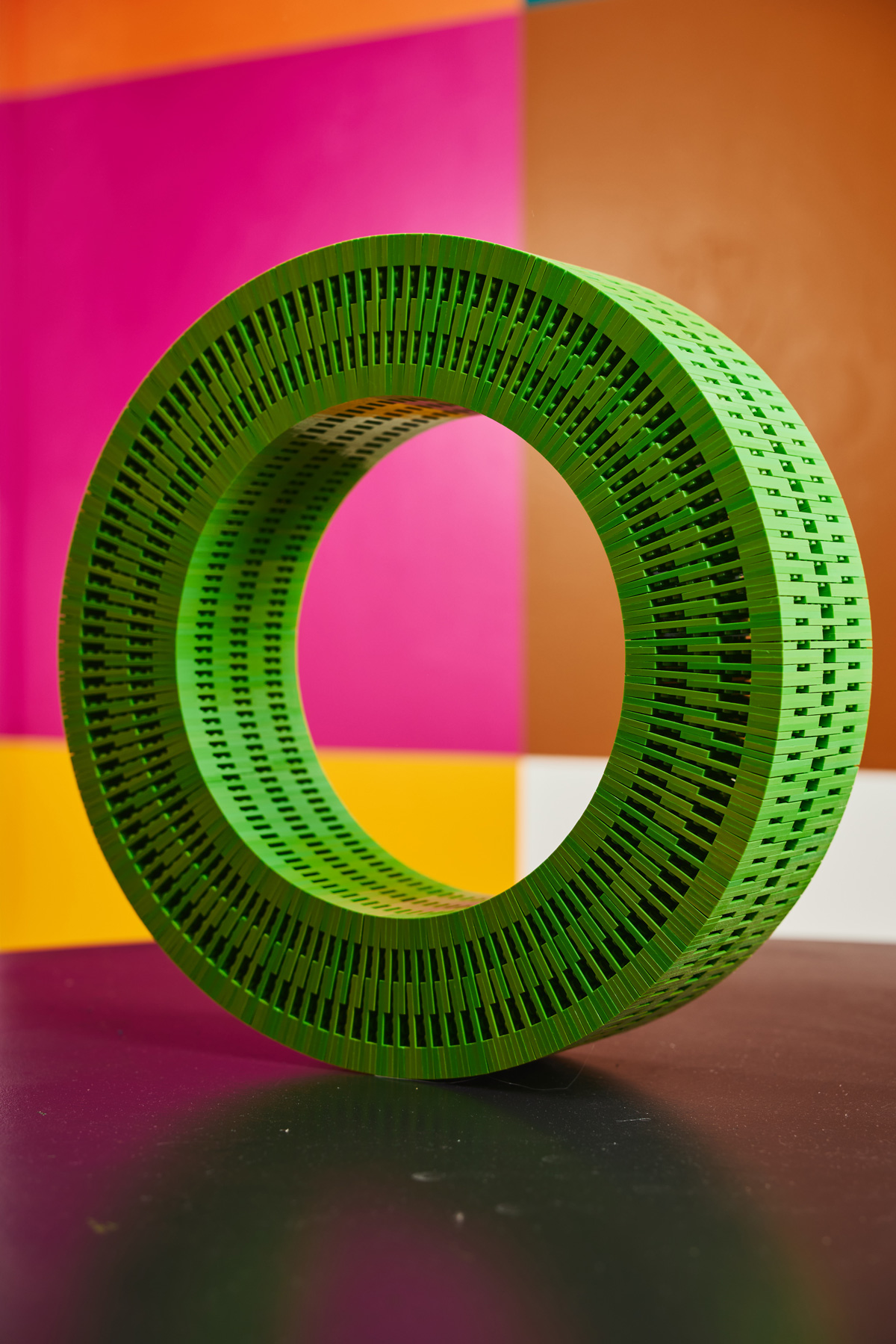
Wedge Plate Ring
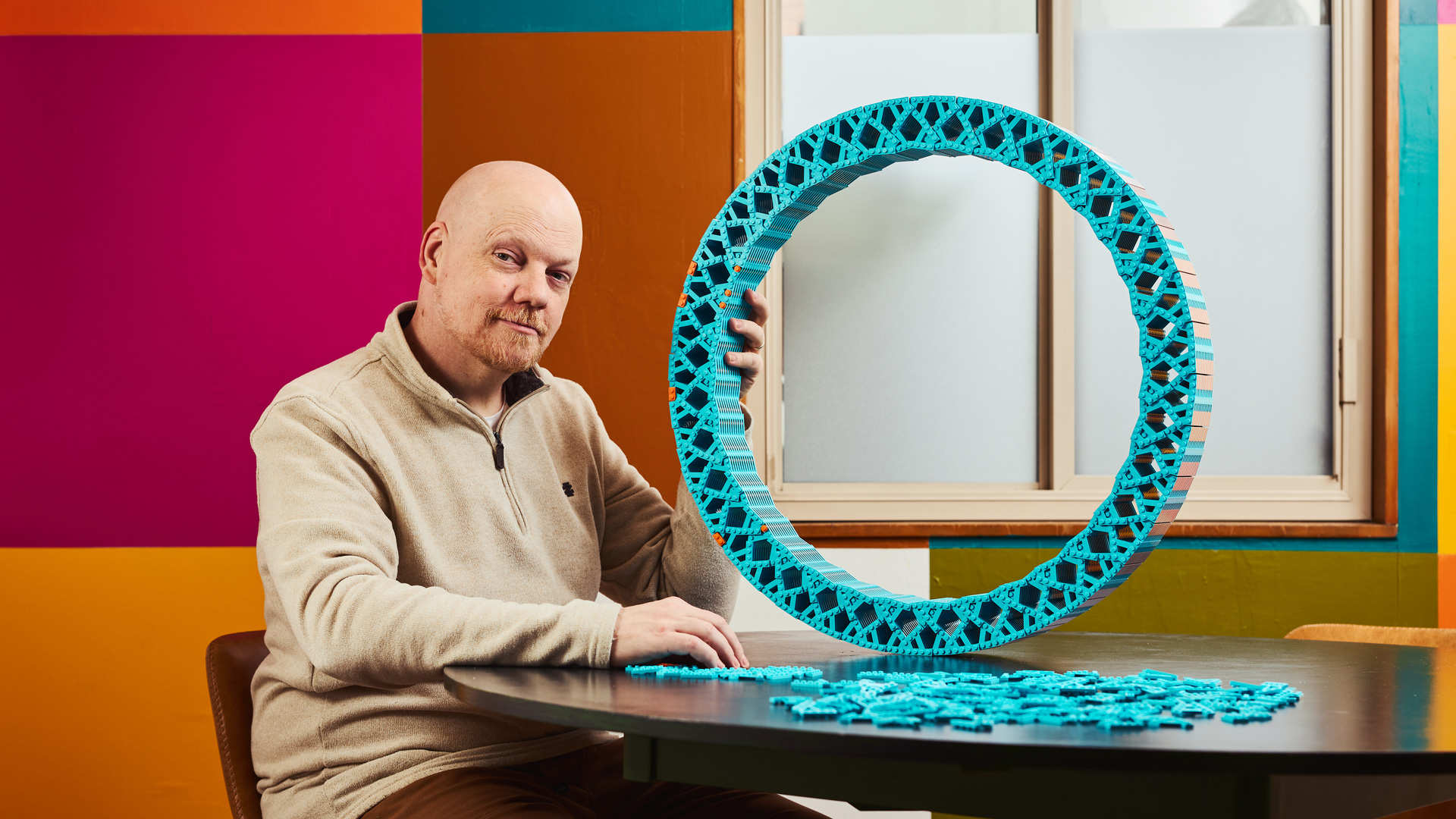
The giant medium azure ring looks like it was grown, not built.
It’s a closed loop of A-shaped wedge plates assembled using complete connections: single studs allow each wedge to pivot into place. Sanders shows me it is indeed strong enough to stand upright on a table — the lattice pattern shifting as my viewing angle changes.
The wedge plate has an angle that doesn’t naturally harmonize with LEGO’s grid, so stringing them together creates a slow, accumulating rotation. The swooping ring doesn’t want to lie flat — it wants to spiral, to keep going. Closing it into a loop resolves the tension. But you can feel the desire to keep moving in the way the pattern shifts as you walk around it.
Going Off Grid On Camera
He wasn’t an artist. He would have told you that back then, firmly and with some embarrassment, for years. “I make things, and I put them on the wall because I like to look at them. That might be art.” He remembers thinking, “I know what an artist is and I’m not one of those.”
But Sanders began experimenting in earnest — circles becoming intersecting circles, circles becoming spheres, spheres surfacing more questions. He was building in his spare hours, cataloging discoveries, trying to photograph the small creations before he had to take them apart for lack of pieces.
The breakthrough came from an unlikely direction: Kickstarter, the crowdfunding site in its earliest days. A friend pointed him to the platform, and Sanders launched what he calls “a crazy ask” — give me money to buy bricks and a camera, and I’ll make videos of what I do. It worked. “I got this giant pile of cash to buy bricks and a camera, and I was just… unleashed for the first time.” He created the online identity, Brick Bending, and went to his local LEGO store in Portland, OR, and bought in bulk.
He was exploring all the ways of putting bricks together that fall outside LEGO’s own official construction guidelines, well outside the square grid. “When I’m told I’m not allowed to do something, I immediately start going, ‘ Why? Why can’t I do that?”
There’s one rule he’s kept, religiously, through all of it: he has never glued a brick. Everything is held by friction, physics, and tension alone. No heat, no adhesive, no magic. Just what the bricks will do.
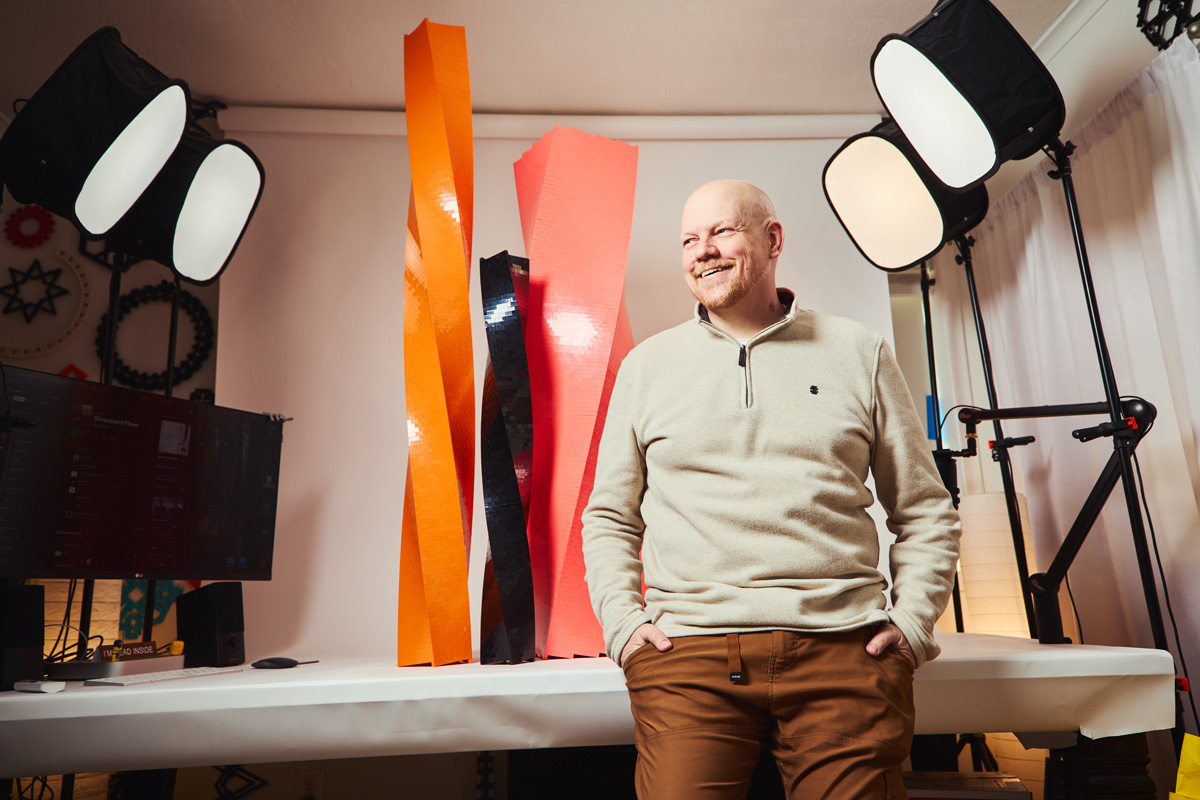
Twisting Towers
Stand these next to a person, and they reach the shoulder. Sometimes higher.
The towers are columns of stacked bricks, each layer offset slightly from the one below, so the surface slowly rotates as it rises. The towers catch the light like a body of water does — different at every point along its height, the gloss of the bricks creating a slow sweep of highlight that moves as you move.
The colors change with the receding face, the shadow side going deep and dark, the lit face going practically electric. The tiny horizontal stepping seams between each layer of bricks are visible all the way up — like tree rings, like elevation lines on a map — confirming the scale. This was built, layer by layer, all the way to the top.
On the Subject of Structure
“I explore structure through little plastic bricks.” He sees it everywhere. He’s been photographing geometric patterns in the world for years: tile-work, shadows, the way light breaks through a lattice. “When I see something, and I think, I want to build that, I can’t. Because that’s not what the bricks want to do.” But the friction of that conversation — what the bricks resist, what they allow, what they suggest instead — that’s where his work lives.
His process is essentially pure play. He’ll spot a brick on BrickLink or at the back wall of the LEGO store, buy five thousand of them, dump them on his desk, and see what happens. No sketch. No plan. Just the pile and the question. “I build something, and then I look at it, and I instantly know whether there’s something there or not.” The speed of that loop — build, look, respond — is something he loves about the medium.
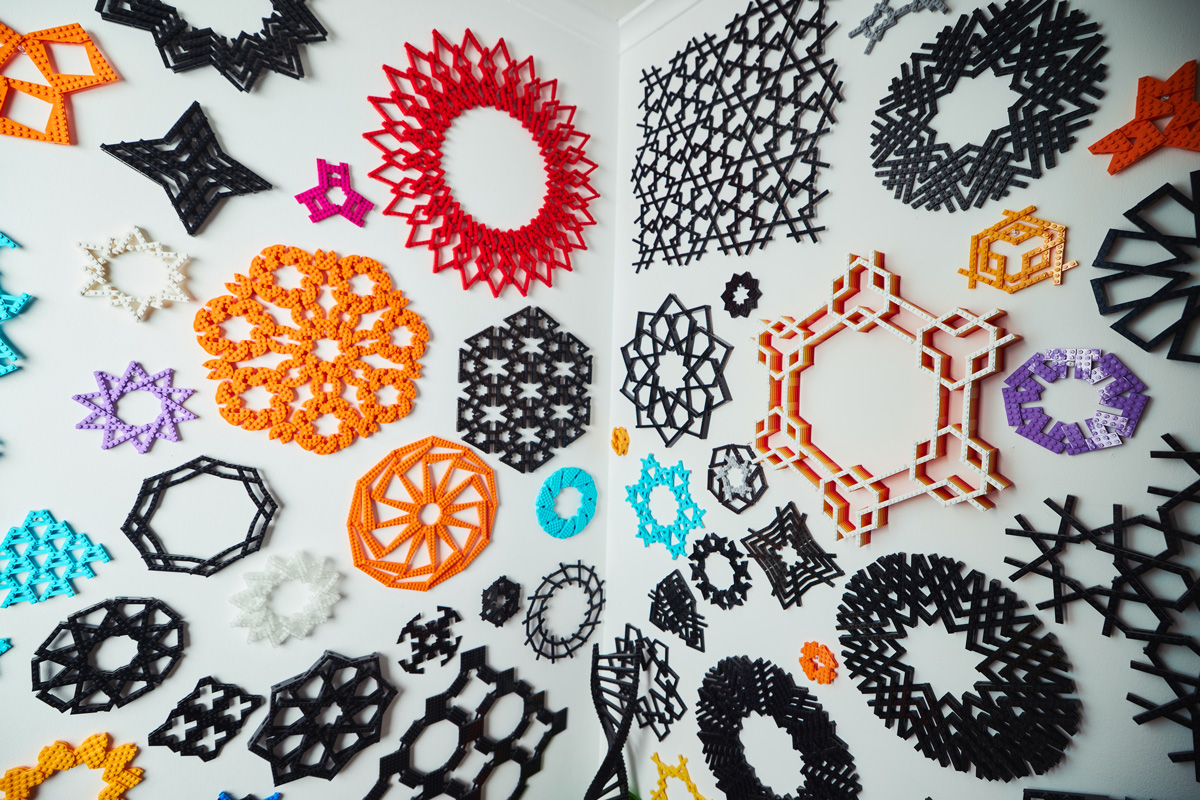
The wall behind his studio workspace is covered in small builds — fragments, experiments, half-finished ideas. It’s not a display, he’ll clarify quickly. It’s an external hard drive. “Most of the little things up there are just a little idea I had that’s not quite ready. It’s still baking. I’ll stick it up there and then one day look at it and go, huh.” Take it down. Play with it. Go further. Or let it go.
The Pattern Family
In 2018, an email arrived from the Sharjah Islamic Art Festival in the United Arab Emirates. Sanders read it the way you read something you’re sure is a scam. He’d received enough suspicious outreach over the years that he’d developed a policy of skepticism. He read it again. Then he reached out to artists he’d connected with on Instagram — people who’d been there — and asked them point-blank, “Is this real?”
Their response: Go. Apply. If you get in, it’ll change your life.
He applied and sent a pitch for seven different patterns arranged across a museum alcove. The festival wrote back. They liked what they saw. But could he do something bigger?
He said yes, of course. Then he went home and figured out how.
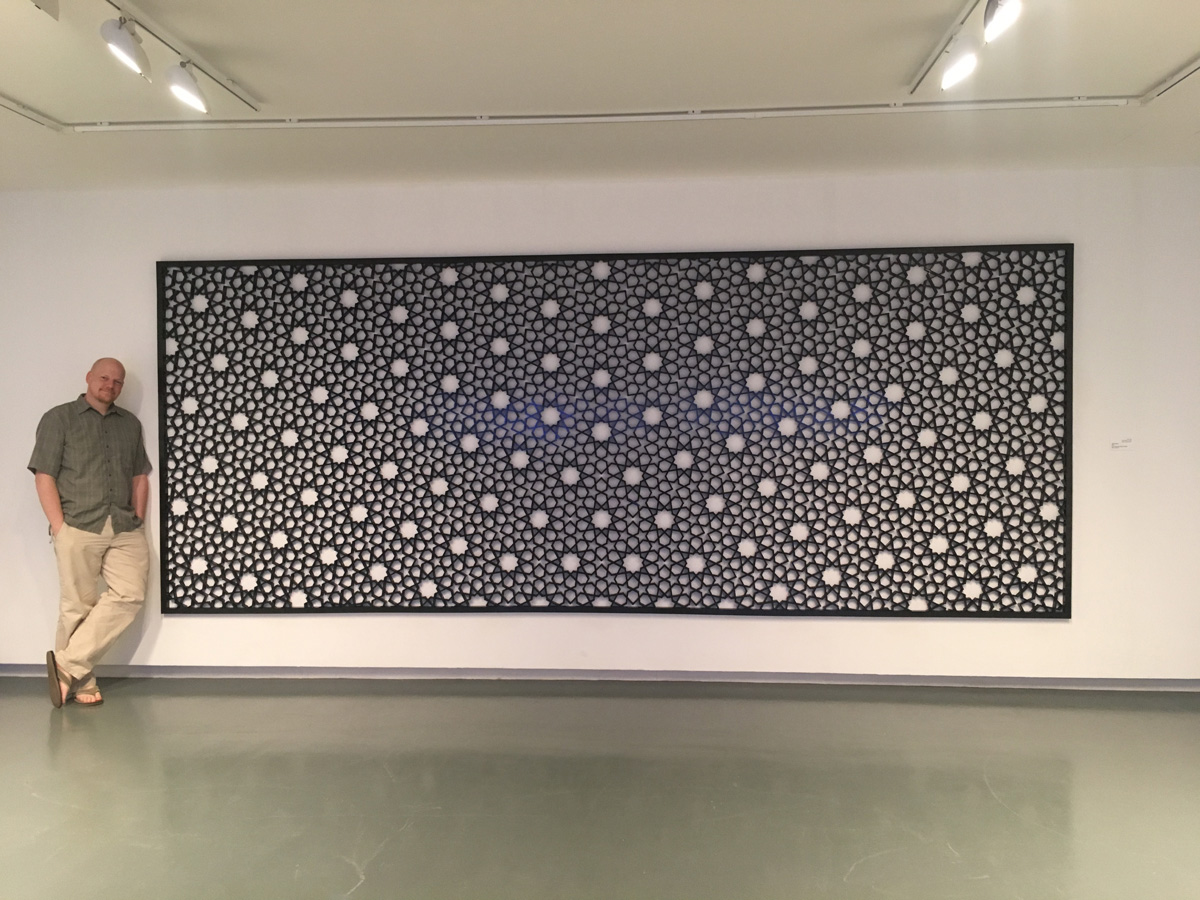
The piece he’d been developing — a ten-point geometric pattern in the tradition of Islamic design — he’d stumbled into almost by accident. He’d been following geometric artists on Instagram, seeing bits of this ancient visual language filtering through his feed, intrigued by patterns he recognized but couldn’t name. What he proposed for Sharjah was a wall. Two meters by five meters, ten square meters total, filling the back of an alcove entirely. Seventy-five thousand bricks. A pattern he’d only ever built to the size of a dining table.
When it went up on the wall for the first time — assembled fully, in the alcove, under museum lights — it had never existed before that moment.
The reaction from the international community of artists assembled at the festival was immediate and warm. Nearly everyone had LEGO somewhere in their childhood, regardless of where they grew up. And the artists who worked in geometric abstraction, in pattern and repetition, recognized something immediately. “Everyone has the same penchant for abstract form, repetition,” Sanders remembers. “I’d suddenly met all these people who were crazy like me in the same way.” They started calling themselves the pattern family. He’s still in contact with many of them.
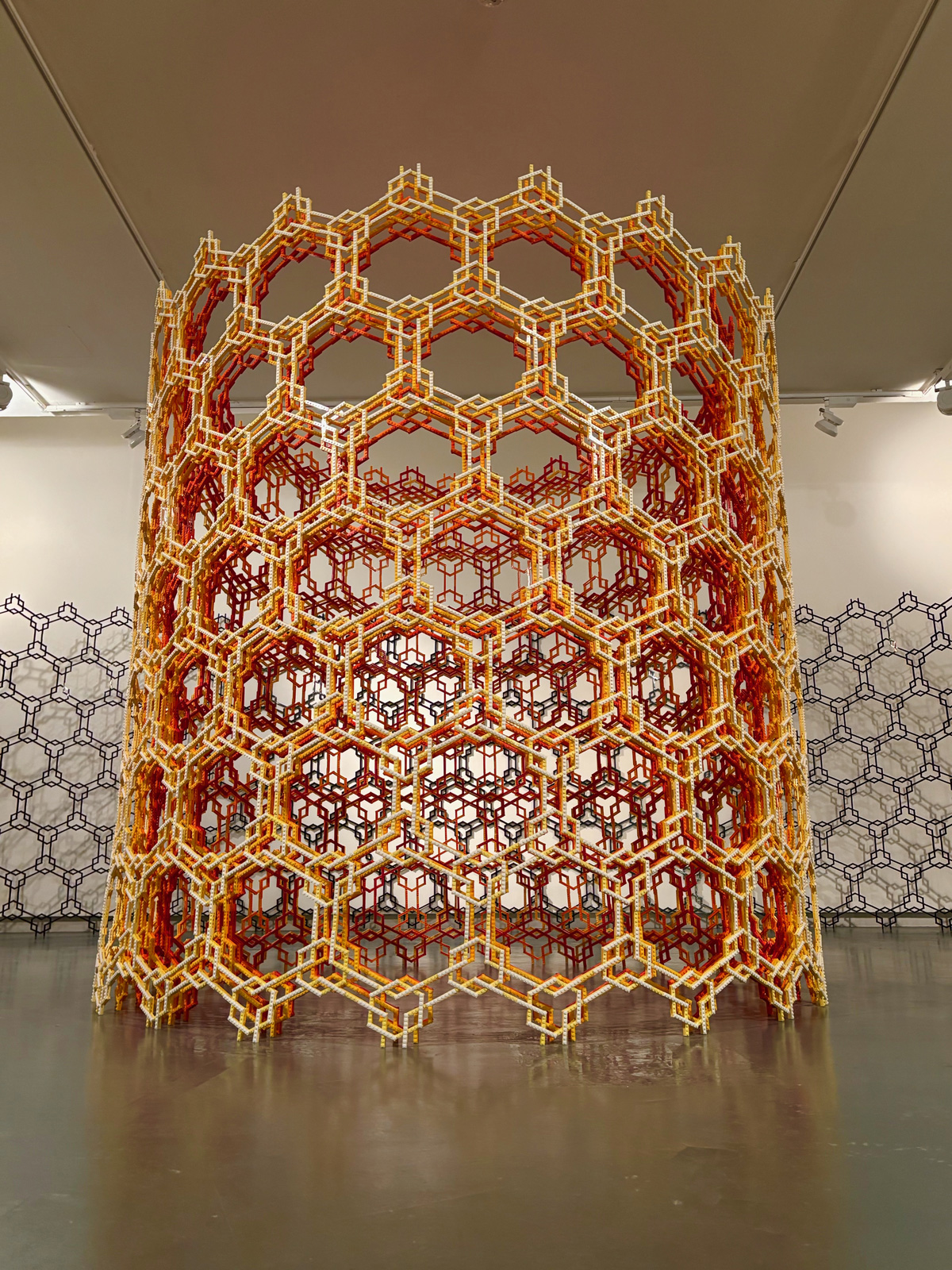
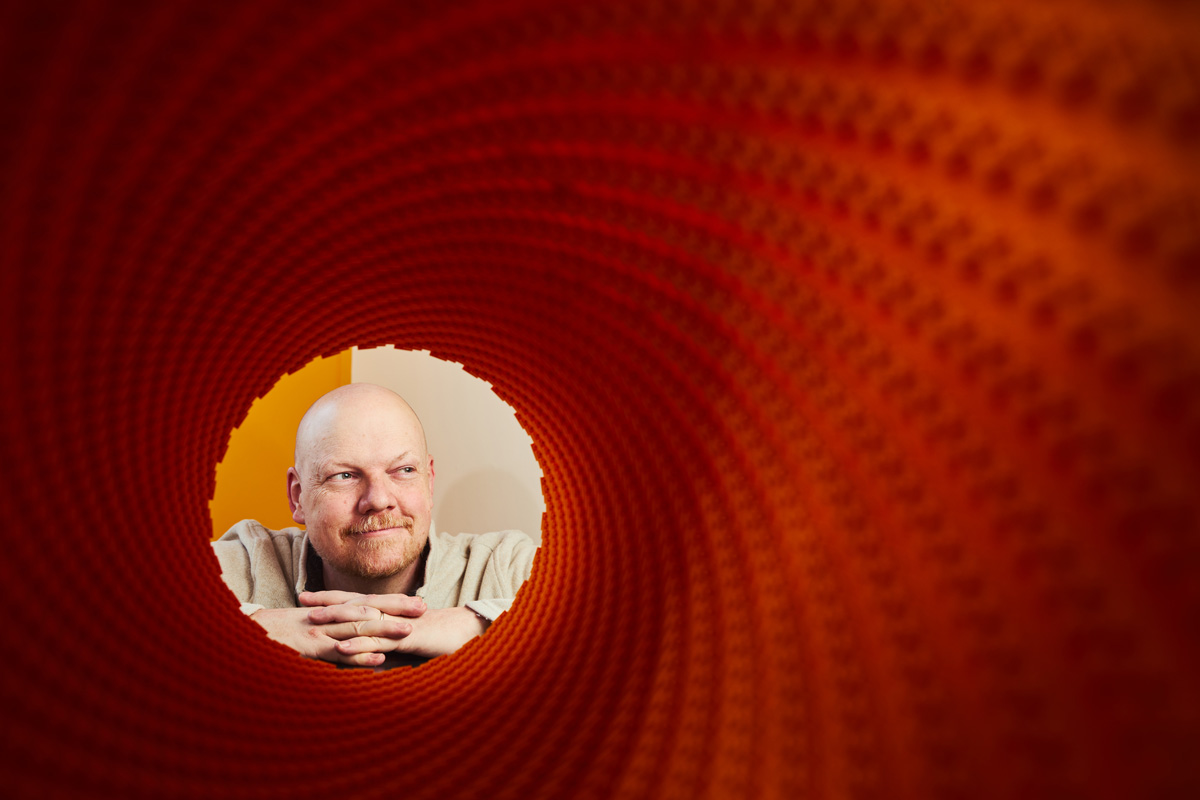
He returned to Sharjah in 2025, this time with even larger ambitions. The second installation, Emanations in Brick, occupied fifty square meters — five times the scale of the first — and included a large freestanding concentric cylinder; actually three tightly nested concentric cylinders built inside the museum alcove. The central piece is like a giant red-orange-yellow hive, or like a huge lantern — the black pattern on the walls around it is like its shadow, the physical result of shining light through the sculpture.
Fifty Thousand Green Bricks and No Rules
Back home in Portland, a different kind of work has begun to take shape alongside the building itself.
Sanders’s wife runs the Northwest Children’s Theater, a children’s theater that’s been a fixture of Portland for over three decades. For years, their creative lives ran on parallel tracks — his solitary and geometric, hers collaborative and live. But she started a festival spotlighting local artists, a weekend of public making, and eventually the two tracks converged.
The format is simple: a large open space, a pile containing fifty thousand green one-by-two bricks, and one rule. You have to build whatever you want. That’s it. “The magic of fifty thousand green one-by-twos is that there’s no scarcity. As many as you can possibly build with are there. There’s no hierarchy. Kids aren’t looking for who’s got what piece.”
Kids jump in immediately — adults take a bit of coaxing. The broader event typically includes two group builds running alongside the pit: one of his twisting towers, accessible to almost anyone once they see the core motif repeat, and a cylinder build that he facilitates personally, more structured, more demanding. There’s something for every level.
Happy Complexity
Sanders’s Brick Bending videos have now been watched more than 250 million times. He came to the format sideways — he couldn’t afford licensed music, the free options were bad, and silence felt wrong at first. Then he discovered the ASMR world, the magnet satisfactions, the woodworking clicks, and started to realize the sounds of building were themselves the content. Bricks sliding across the large white paper backdrop he uses as a seamless surface. The click and snap of connection. The occasional soft explosion when a sculpture loses its equilibrium mid-build.
The videos are highly curated. The bricks doing things that feel like they shouldn’t be possible — slowly, without narration or explanation. Just the thing happening. The anticipation becomes part of the joy.
What the videos capture — and what remains elusive to fully explain — is the quality of attention Sanders brings to his medium. He is watching bricks the way a naturalist watches a tide pool: patiently, curiously, certain that something unexpected is about to surface.
“I build no matter what,” he says. “I’m on a Zoom call, and I’ve got two bricks in my hand, clicking them back and forth. I cannot not build.”
That compulsion is a question he first asked on the floor with his daughters, watching a string of rectangular bricks curve into something impossible. He’s been following that curve ever since: into circles, into spheres, into towers that spiral upward like slow DNA, into walls that fill museum alcoves, into fifty thousand green bricks spread across a theater floor for anyone who wants to find out what their hands can make.
“Simple pattern plus repetition equals complexity,” he says. “But not arbitrary complexity. The complexity that makes me the happiest.”
The grid is still there, underneath everything — precise, rational, repeatable. Sanders keeps finding new ways to bend it.
He picks up two bricks. Clicks them together. Starts looking.