


Photography by Pauline Cany
French Interpretation by Christophe Jamot
From a distance, it resolves all at once.
A face. A watch. A familiar image rendered with surprising clarity — crisp edges, smooth gradients, the kind of visual cohesion your eye accepts without question. It feels finished, almost effortless. Then you step closer.
The image doesn’t disappear, but it breaks. What looked continuous becomes fragmented. Color splits into unexpected pieces — greens that aren’t green, blacks that aren’t black. The surface is uneven, alive like a miniature city. Studs catch light. Edges interrupt each other. The illusion gives way to structure.
You step back again. The image returns. That movement — forward, back, forward again — is part of the work. You’re not just looking at it, you’re finding the LEGO art of M’BricK.
As he describes it, there are multiple ways to read his work. Up close, it is texture — a kind of controlled chaos. From a distance, it resolves into an image. Each version is true. Each one reveals something different.
He watches people do it in real time. “People look like that. They approach, they go back, they approach, they go back,” he says. They lean in, trying to understand what they’re seeing. Then they step back to confirm it. Then forward again, as if the answer might change.
There's more! Continue reading this article by subscribing to BRICKA.
There's more! Continue reading this article by subscribing to BRICKA.

Reinvention
Before any of this — before the portraits, the art, the exhibitions — there was hockey.
M’BricK grew up just outside Paris, where sport shaped the structure of his life from the very beginning. He started playing ice hockey at three years old and turned professional at sixteen, entering a world defined by discipline, repetition, and performance. For nearly two decades, that rhythm held. Training, competing, improving — a clear path, reinforced day after day.
“Sport has always been my first love,” he says. “But I’ve always loved drawing. When I was a kid, I loved playing with LEGO and creating a lot of different things, but I can’t say it was art.”
When his career in professional hockey ended, it wasn’t a clean transition. “I had trouble reintegrating into normal life. Work and all that was really difficult for me.”
Art helped. He enjoyed exploring cities and taking in the street art, thinking, “I could do something like this.” LEGO re-entered his life through exploration — M’BricK was simply experimenting with materials, collage, street art-style, and different ways of assembling images.
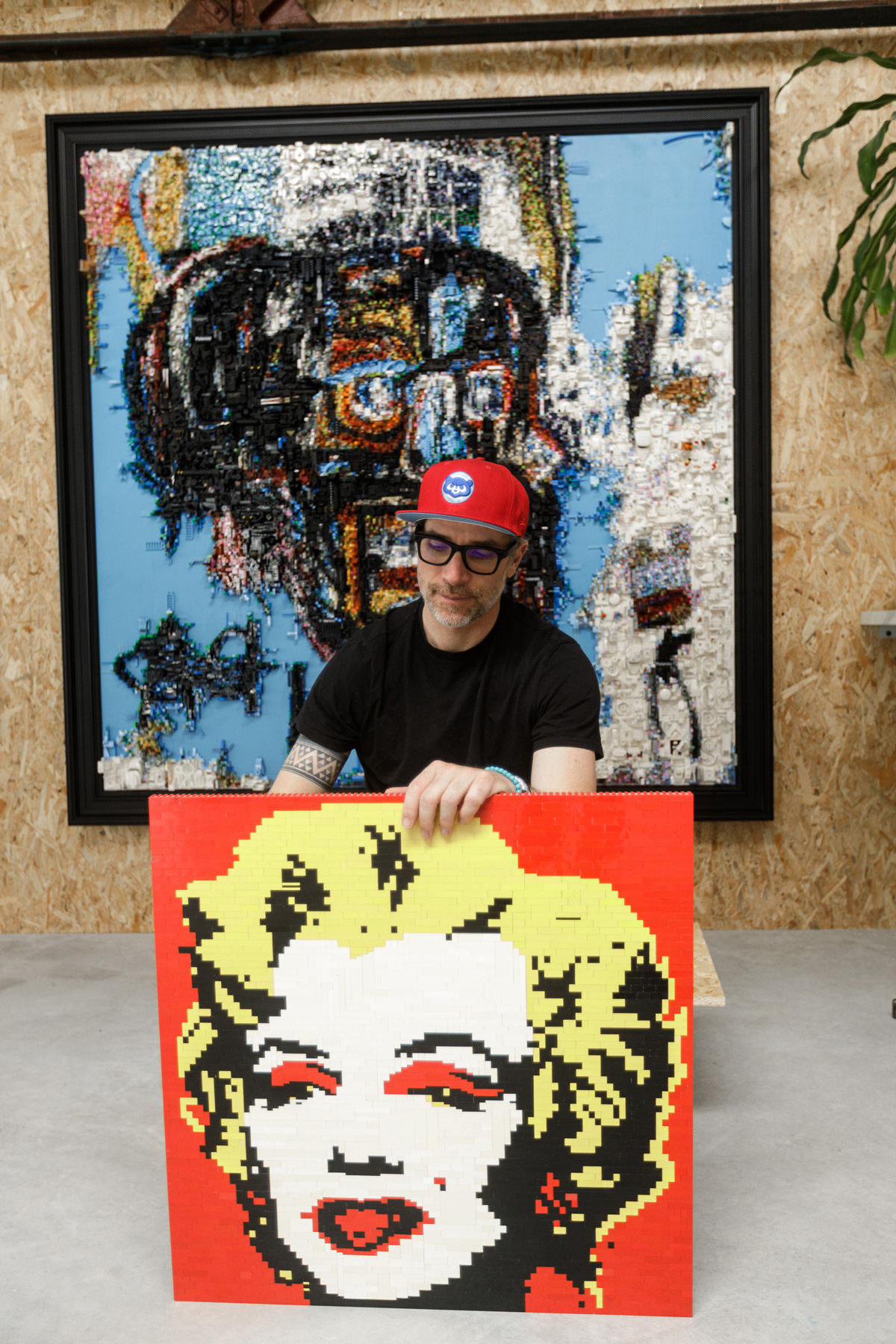
The starting point for his signature style traces back to the same kind of popular culture that continues to shape his work — just from a different era. His wife had long admired Andy Warhol’s Marilyn Monroe from 1967. He set out to find one, or something like it, knowing the original was out of reach. “So I tried to find a solution.”
He thought to himself, “Why not use LEGO?” The result is a direct translation of Warhol’s Marilyn into brick. The composition holds — bold color, sharp contrast — but it’s LEGO. Bricks are stacked so that their side faces become pixels, forming the image as they stack. A double line of red studs runs across the top, a small detail that hints at the system underneath. His Marilyn is more literal than what would follow — a translation, not yet a transformation.
It was during his construction of Marilyn that M’Brick had the realization that would shape his work going forward. As he worked, he started to see the pieces differently — not just as elements that stack, but as units that could be turned, reoriented, layered. A flat surface could become dimensional.
“If I turned the Lego, it was pixels in the other direction, and it gave volume,” he shares. His work moved beyond stacking replication and toward something exploratory: surfaces, portraits, and subjects built through accumulation, where each piece contributes to the collective image.
LEGO as Paint
M’BricK’s artist name mirrors his given first name, Ayermic, and M’BricK loosely alludes to “Love Brick” in French. “The LEGO has really become my painting.” And seeing his Dijon, France studio, it certainly looks that way. The space is raw, filled with natural light — but instead of tubes of paint, there are bins of color-organized LEGO everywhere. He estimates he has millions of LEGO pieces in his space, waiting to be turned into art.
The most prominent piece in his space at the moment is a large re-creation of the 1982 Untitled Basquiat skull painting. From a distance, it looks like the original — one of the most expensive paintings ever — rendered in sweeping black brush strokes with hints of blue, yellow, and red. But even from far back, it feels more than two-dimensional — there are subtle shadows and the slight hint of mosaic.
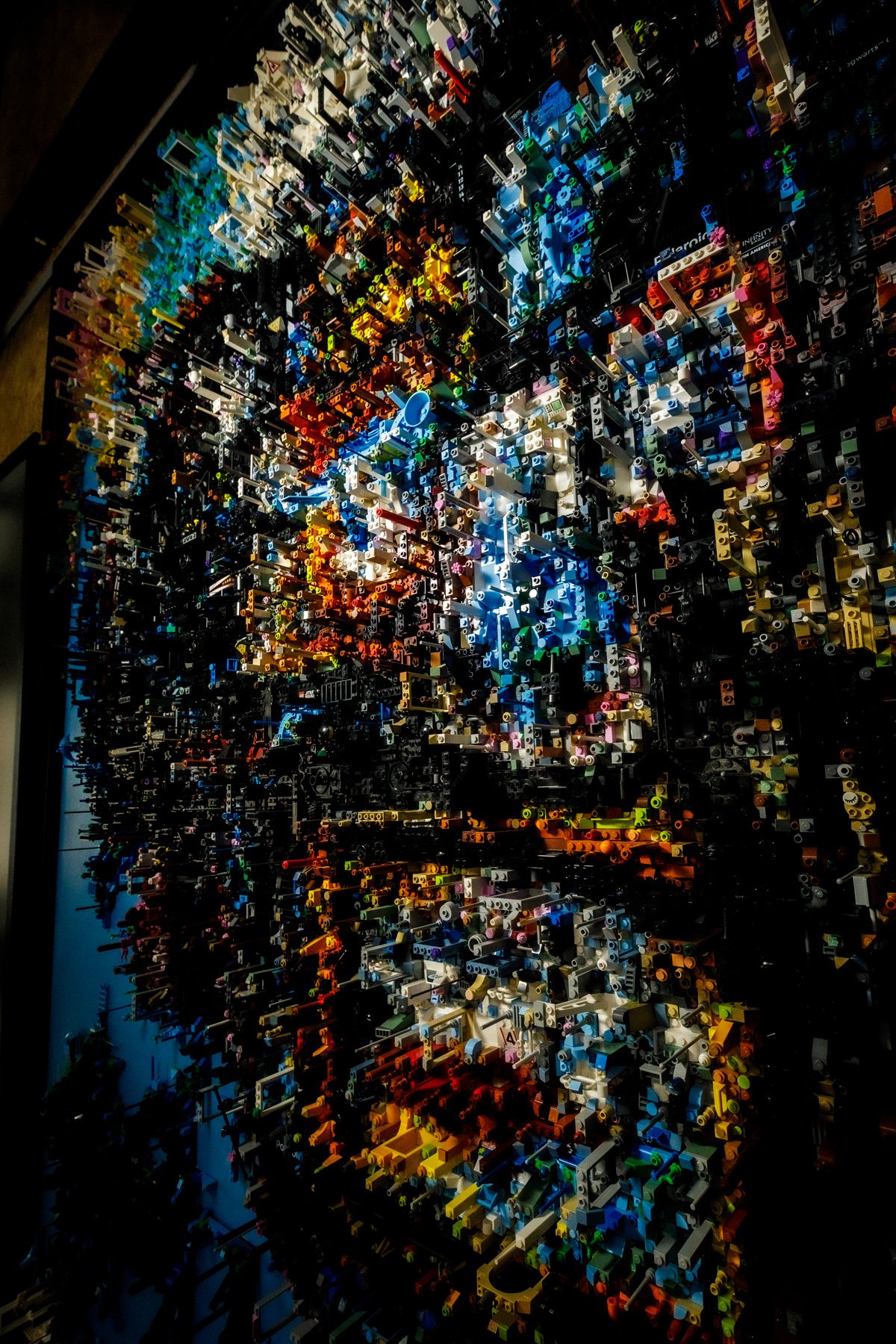
He brings me closer, and his technique is revealed. The piece is made of tens of thousands of individual, varied LEGO elements arranged in what feels like organized chaos up close.
What reads as a brushstroke from across the room fractures into layers of parts pushing in every direction — plates stacked, tiles offset, fragments jutting forward and receding back. There’s no single plane. The surface breathes. Light catches on edges and disappears into gaps, creating shadows that don’t exist in the original painting but feel essential here.
Color behaves differently, too. What felt like a single field of blue is built from dozens of variations — pale, saturated, almost gray — scattered just enough to hold together at a distance. Black isn’t black. It’s a dense field of near-blacks, dark grays, deep blues, all working to create something your eye reads as one.
Nothing is blended. Everything is placed — though not in the way you might expect a LEGO mosaic to be made. There’s a tension in it — between control and release. Pieces intersect in ways that feel almost accidental, but the overall image holds. The chaos is real, but it’s contained.
You start to see the decisions. A slight shift here. A color swap there. Thousands of small calls that don’t make sense on their own, but together, resolve into something unmistakable.
And standing that close, you realize the image isn’t just being viewed — it’s being constructed in your mind, piece by piece, the same way it was built.
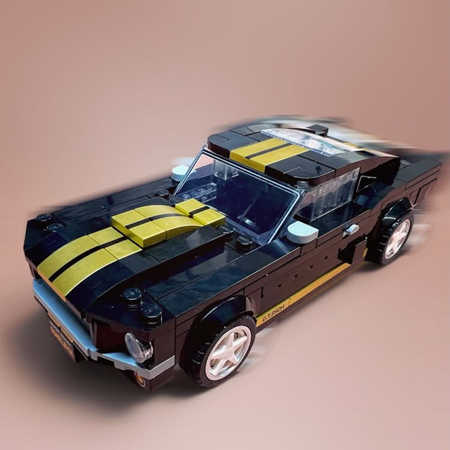
When I comment on the color, he smiles a sly smile, the proud grin of a magician whose trick is about to be revealed. He brings me to another piece, a black Porsche sports car. “This is a black Porsche… but maybe only 5% of the actual pieces are black,” he shares.
And as I get closer, I see it. My brain clicks: color isn’t a single color. A surface isn’t truly flat. What reads as black might be built from deep blues, browns, and purples — the reflection of the sun, the full color spectrum reacting through the clear-coat — all layered together until the eye accepts it as something unified.
There’s no single moment where the image fully settles. It’s always in a kind of balance, held together by distance, by perception, by the accumulation of decisions that never quite resolve into simplicity.
Process Discipline
Behind the finished image — the one that resolves so cleanly from a distance — is a process that is anything but immediate.
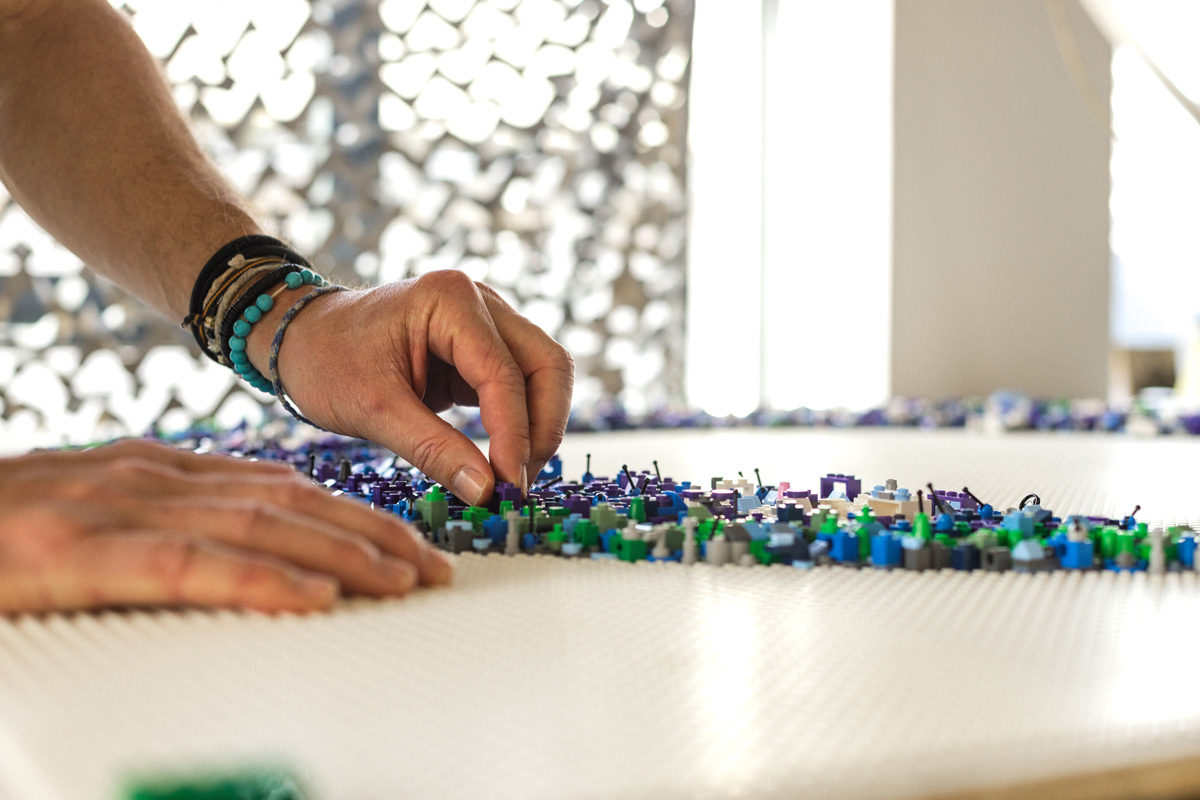
Every piece begins digitally. “I have several software programs that allow me to see the final flat image… and then I give it volume.” Before a single brick is placed, the image is mapped, translated into a flat composition where color, proportion, and structure can be understood at a basic level. It’s a necessary step, a way of organizing the work before it becomes physical. From there, everything changes.
The flat image becomes a guide, not a blueprint. The real work starts when depth is introduced — when each section has to be interpreted, adjusted, and rebuilt through pieces that don’t behave like pixels, but like objects. The translation isn’t exact. It requires constant recalibration.
A smaller piece might contain 6,000 elements. Larger works climb into the tens of thousands, sometimes reaching 25,000 or 30,000 pieces. But even those numbers don’t fully capture the scale of the process, because the pieces used are only a fraction of what’s needed to begin.
“If I have to make an image of 6,000 pieces, I will order 20,000.”
What follows is slow, repetitive, and exacting. Hours spent working across small sections, building up the image without ever fully seeing it. Adjusting one area, then another, always aware that the decisions are connected — that nothing exists in isolation.
“One pixel shifts everything on the board.” A slight misalignment can ripple outward, forcing a section to be undone and rebuilt. A day’s work can disappear into correction. The margin for error is small, and the only way through it is focus — sustained, consistent attention over long periods of time, sometimes months.
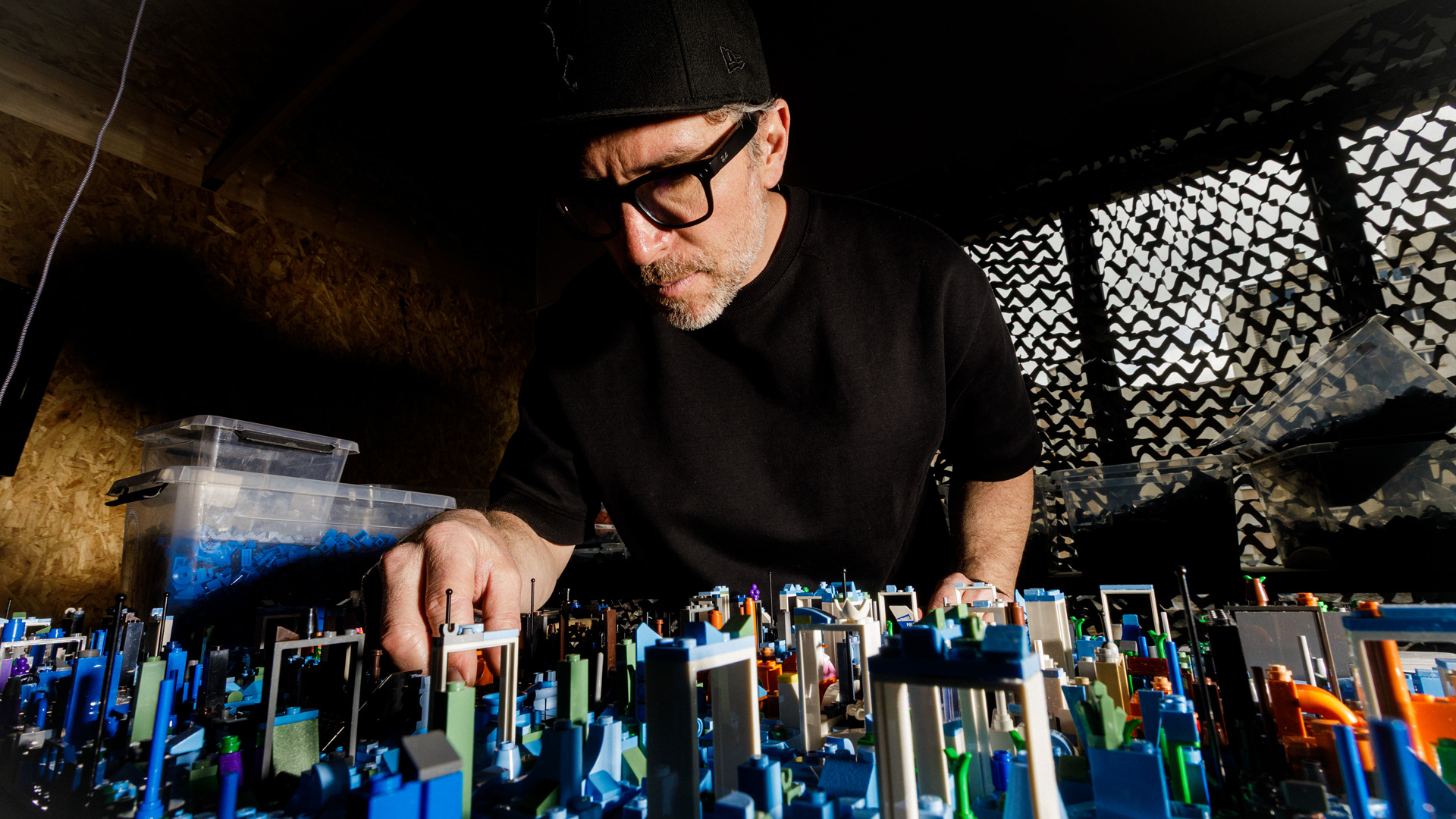
Watching M’BricK place element after element, piece after piece; there’s a physicality to the work. The connection to his athletic career isn’t explicit, but it’s there — the discipline, the repetition, and the ability to work within a structure, yet push against its limits.
Not only is he placing thousands of pieces, but he’s maintaining concentration, holding the image in his mind while working through fragments that don’t yet resolve. But he works with a trust that they will.
The Work Up Close
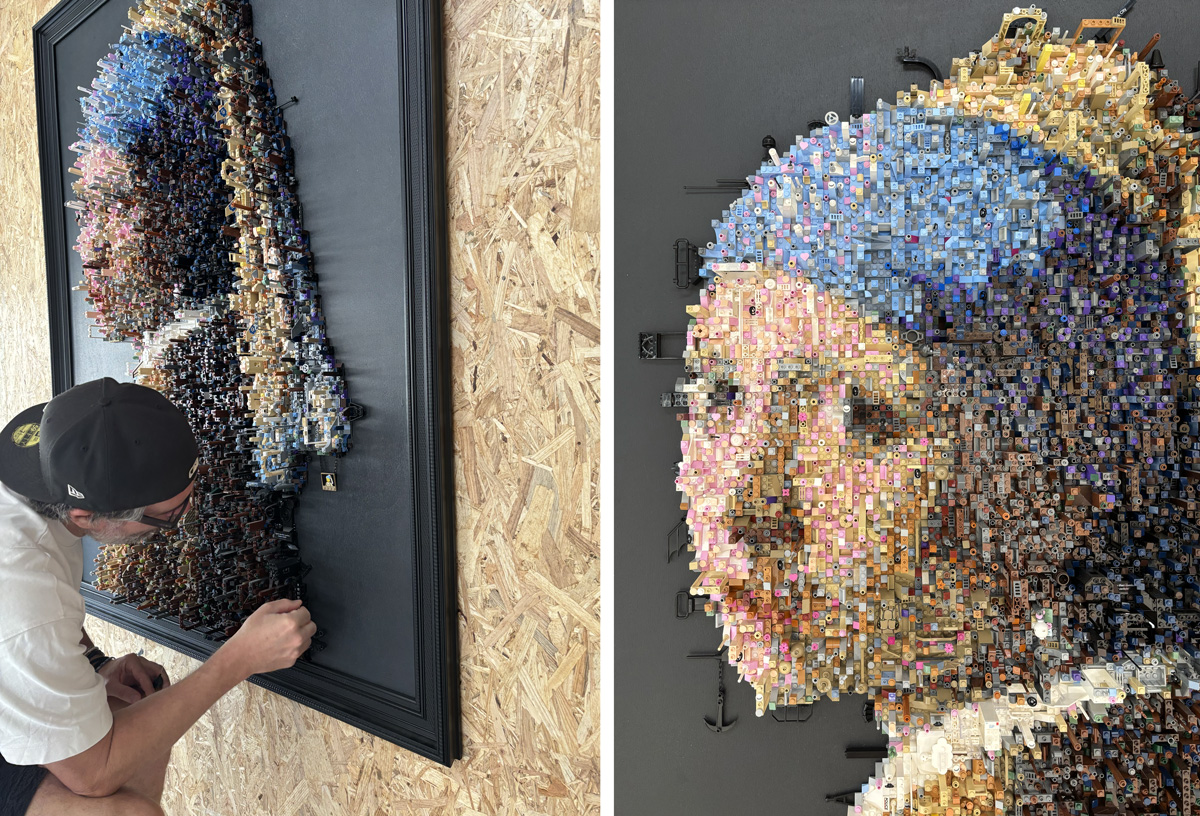
Each piece begins as an image, something recognizable, something the viewer can hold onto. But what makes it compelling is everything that happens underneath — the accumulation of decisions, the small adjustments, the willingness to let the surface remain active rather than resolved.
His rendering of Vermeer’s Girl with a Pearl Earring in bricks is a great example. With the soft light, quiet expression, and subtle turn of the head, M’BricK’s version carries the familiarity, but it’s held together differently. The girl’s skin isn’t smooth; it’s constructed. The shadow along her cheek doesn’t fade — it’s built from dozens of neighboring tones, each one slightly off, working together to approximate something continuous.
The blue of the headscarf breaks into a field of competing pieces — light blues, greys, even hints of colors that don’t seem like they belong there at all. The pearl itself, which feels singular here as one element in a sea of plates, rounds, domes, studs, slopes, and more.
I asked what it was like to hang this one and see it from a distance for the first time. M’BricK doesn’t hesitate, “It was really moving,” as if even he feels the moment of surprise and delight when the image resolves.
On the other side of history, M’BricK re-created an iconic photo of Michael Jordan shooting a jump shot. “I like Jordan a lot, he’s a sportsman I truly admire.”
That connection comes through in how the image is constructed. The reds of the jersey don’t sit quietly. They push forward, layered with intensity. The edges of the figure aren’t clean — they vibrate slightly, as if holding onto a single moment of intense movement — a frame of a film, not a photograph. Even the space around him feels compressed, built from fragments that only settle when you step back.
M’BricK started rendering watches in LEGO bricks to push himself to create glass surfaces through chaotic mosaic. Glass isn’t a material you can easily replicate with LEGO. It doesn’t behave the same way. It doesn’t hold light in a single, predictable way. Instead, it requires layering — tones placed side by side, subtle variations that suggest reflection rather than replicate it.
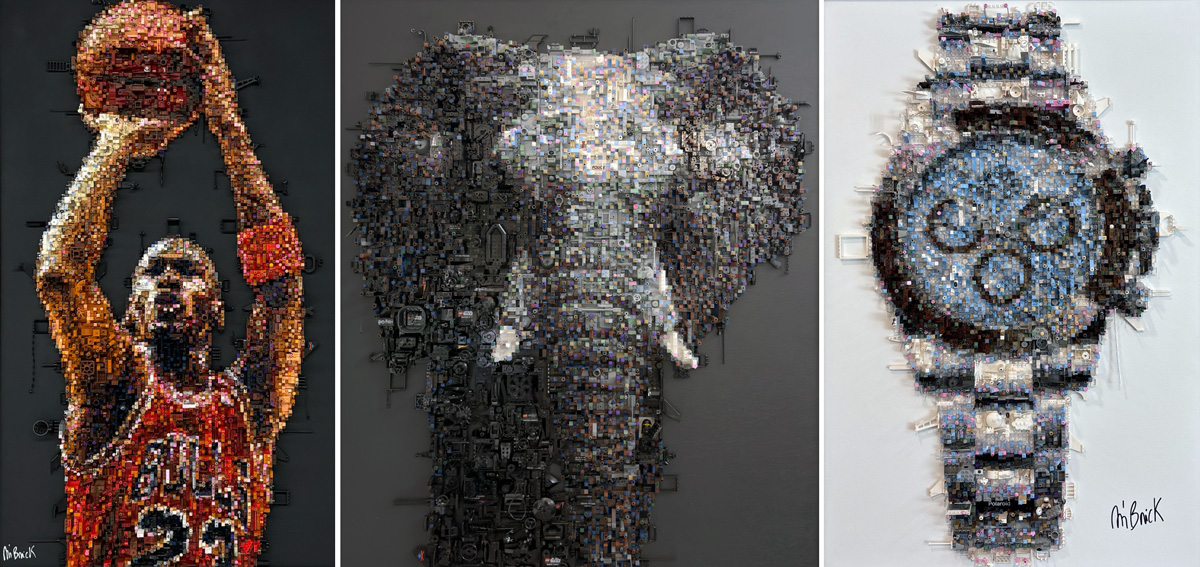
The face of the watch becomes a field of small adjustments. Highlights aren’t smooth; they’re constructed. Shadows aren’t uniform; they’re built from neighboring colors that lean just slightly darker or cooler. I think the result is actually more interesting than a glass watch face — the resulting surface feels reflective because of how it’s assembled, not because it mimics the material directly.
Then there are the animals. My favorite piece of his, titled Defense, is a portrait of an African elephant. It carries the weight and presence not only of its subject but also of the over 250 hours the artist spent creating it. The grey skin surface — constructed from a gradient of colors — isn’t exactly trying to smooth itself out — here he leans into the variation.
Dark areas are dense, almost absorbing. Lighter sections emerge gradually, built from layers that never quite settle into a single tone. The tusks cut through the composition with clarity, but even they are constructed from fragments, held together by contrast rather than continuity. There’s a sense here that complexity is the point. When I comment on this, he agrees, “I prefer to work on faces, I prefer to work on the animals. I want to do very complex, very difficult things.”
Between LEGO and the Art World
M’BricK doesn’t describe himself as a LEGO builder. He doesn’t talk about sets, collections, or the culture surrounding the brick. He isn’t building models. He isn’t recreating scenes. He’s not chasing accuracy in the way a traditional builder might. The pieces aren’t being used to represent something — they’re being used to construct an image, the same way paint might be mixed and used on canvas.
“I would like to be in the art world.” He says it plainly, without qualification. LEGO is what made the work possible — a material he could access, experiment with, push — but it isn’t the identity he’s building toward. The pieces carry a kind of cultural significance, something almost universal. You recognize them instantly. You come to them with assumptions.
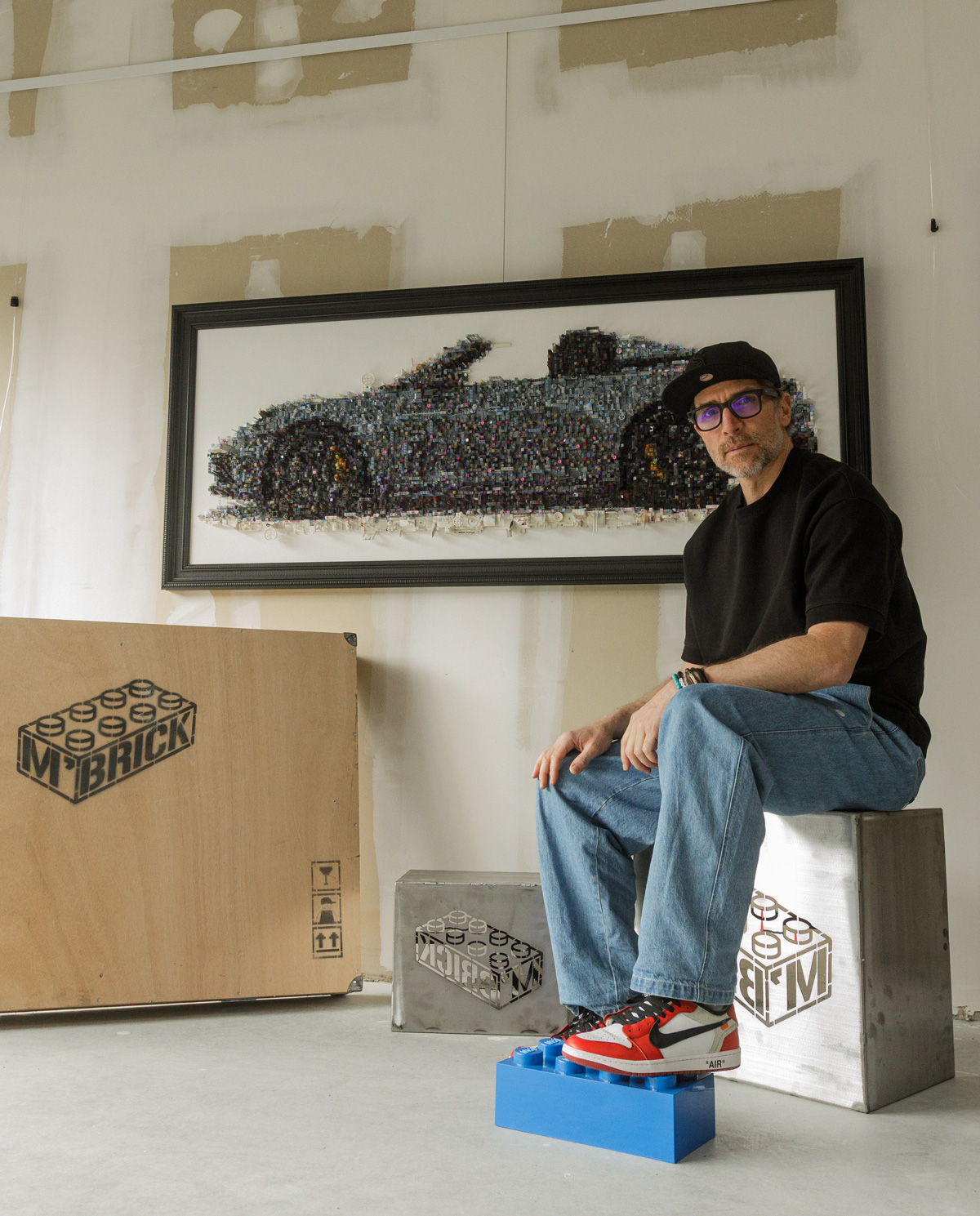
That’s part of the tension. Because what he’s making doesn’t behave the way those assumptions suggest it should. The system is still there — the geometry, the constraints, the repeatability — but the intent is different. The system isn’t treated as fixed. Pieces are altered, combined, and pushed beyond their intended use.
And as his work expands, so do the opportunities around it. Commissions now stretch out ahead of him. Brands have taken notice — IWC, Tudor — drawn to the same precision and surface complexity that define his pieces. The work travels, allowing M’BricK to travel too.
The Texture of a Thousand Choices
Our brains thrive on patterns. We’re constantly scanning, organizing, and trying to make sense of what we see. Part of what makes LEGO so appealing is the grid — repeatable, predictable, dependable. It’s a system built for clarity.
M’BricK works against that instinct just enough to make things really interesting.
Up close, the grid is still there, but it doesn’t behave the way you expect. Colors don’t align cleanly. Surfaces don’t smooth out. There’s depth off the wall and unpredictable color variation. The order starts to loosen. And your brain — searching for resolution — has to work a little harder.
You step back, and everything clicks — chaos resolves in real time into meaning.
When we see M’BricK’s work, we’re seeing a visual system that shifts with your perspective. Underneath the image — the one that holds together from across the room — are thousands of small, human decisions. Each piece placed with intent. Each one slightly off from what your brain expects, and yet somehow, all together, exactly right.