


Photography by Samuel Engelking
He was a king who chose discovery over power.
Mansa Abu Bakr II, ruler of the Mali Empire in the early 14th century, inherited unimaginable wealth. Gold flowed through his kingdom. Knowledge moved freely through his cities. Scholars gathered in Timbuktu, traders crossed deserts, artisans refined metal, wood, and stone into objects of enduring beauty. Abu Bakr ruled at the height of one of the most sophisticated civilizations the world has ever known.
His story was carried along the Niger River and preserved through scholars, griots, and travelers. Oral historians tell of a king who looked west, past the edge of the known world, and refused to accept that there was nothing there. So he left his throne.
Before relinquishing rule, Abu Bakr is said to have assembled a fleet. The first expedition — 200 ships sent westward across the Atlantic — never returned. Undeterred, he prepared a second fleet of 2,000 ships, provisioned with food, water, and gold — and led by the king himself. Only one vessel came back, its crew claiming the rest were swept up by a powerful current that pulled them westward, relentlessly, into the unknown. Some accounts suggest the king’s fleet made it as far as the Americas, perhaps beyond.
But history offers no definitive record of what happened. There are no paintings of triumphant discoveries, no wreckage recovered or artifacts on pedestals, no monuments in their honor. But West African memory holds the space open. A Black, Muslim king, leading a massive fleet, crossing an ocean 150 years before Columbus. The story survives in fragments, hovering at the edges of what we’re taught to remember — a story of curiosity, ambition, loss, and erasure.
When Ghanaian-Canadian LEGO-artist Ekow Nimako tells this story, he offers a powerful narrative that challenges who we allow to be remembered as explorers, visionaries, and builders of civilization. For Nimako, that story became the conceptual spine for his exhibition Building Black Civilizations: Journey of 2000 Ships, bridging the historical past to his creative present.
There's more! Continue reading this article by subscribing to BRICKA.
There's more! Continue reading this article by subscribing to BRICKA.

Encountering 2,000 Ships
The first thing that registers when you encounter the exhibition is scale — physical and emotional. It occupies space the way monuments do, with a gravity that quiets the space around it.
Building Black Civilizations: Journey of 2000 Ships began in 2019 through a collaboration between Nimako and the Aga Khan Museum, a Toronto museum rooted in preserving and celebrating Islamic art, fostering intercultural dialogue, and understanding. “They had a historical art show on view,” recalls Nimako. “With art that was centuries old from the kingdoms of Ghana and Mali in West Africa. And they wanted a local artist to respond to the work with their own.” Nimako was already considering a series of pieces focused on African kingdoms — the partnership gave him a framework to build on.
The show was Nimako’s first major exhibition, and he continues to make art and expand the series as the visual narratives crystallize in his mind. The work is composed entirely of black LEGO elements — thousands upon thousands of them — assembled into a fleet of fantastical sky-sailing vessels, detailed monochromatic landscapes, and elaborate metropolises. The forms rise and fold like carved shadows. The ships feel both ancient and futuristic, recalling West African sculpture, speculative architecture, and science fiction simultaneously — symbols of aspiration and wonder. The cities feel real enough to visit, yet abstract enough to set your mind daydreaming on how past, present, and future play out at this scale.

Light behaves differently here. It doesn’t bounce so much as it gets absorbed, tracing edges and contours before disappearing into the depths of the forms. From certain angles, the city buildings, towers, and bridges dissolve into one another, becoming a single mass, a migration frozen mid-journey. From other angles, each piece, each spire, asserts its own identity and place in the overarching narrative.
All of this meaning is rendered in LEGO. In Nimako’s hands, the plastic elements become what stone was to ancient builders — a modular unit capable of expressing culture and belief.
Within Building Black Civilizations: Journey of 2000 Ships, you are a witness — late, perhaps, but present. The work does not tell you whether Abu Bakr’s fleet survived. It does not offer resolution — it holds the journey open, suspended between departure from an ancient kingdom and arrival at somewhere new. The same system used to build castles, spaceships, and fantasy worlds is here enlisted to rebuild something far more fragile: memory.
Dimensions of Creativity
LEGO entered Nimako’s life as play — a means of building the things in his imagination. Born in Montreal to Ghanaian parents and raised primarily in London, Ontario, and Toronto, Nimako’s childhood was shaped by creativity, adaptation, and invention. His family didn’t have excess, but they did have LEGO.
“Growing up in the 80s was pretty cool. Transformers and Thundercats were on TV, and everything was just fueling my imagination,” he says. As a child, Nimako developed the compulsion to get the ideas out of his head and make them real: “You think of something, and then you have this amazing versatile tool to kind of get it out.”
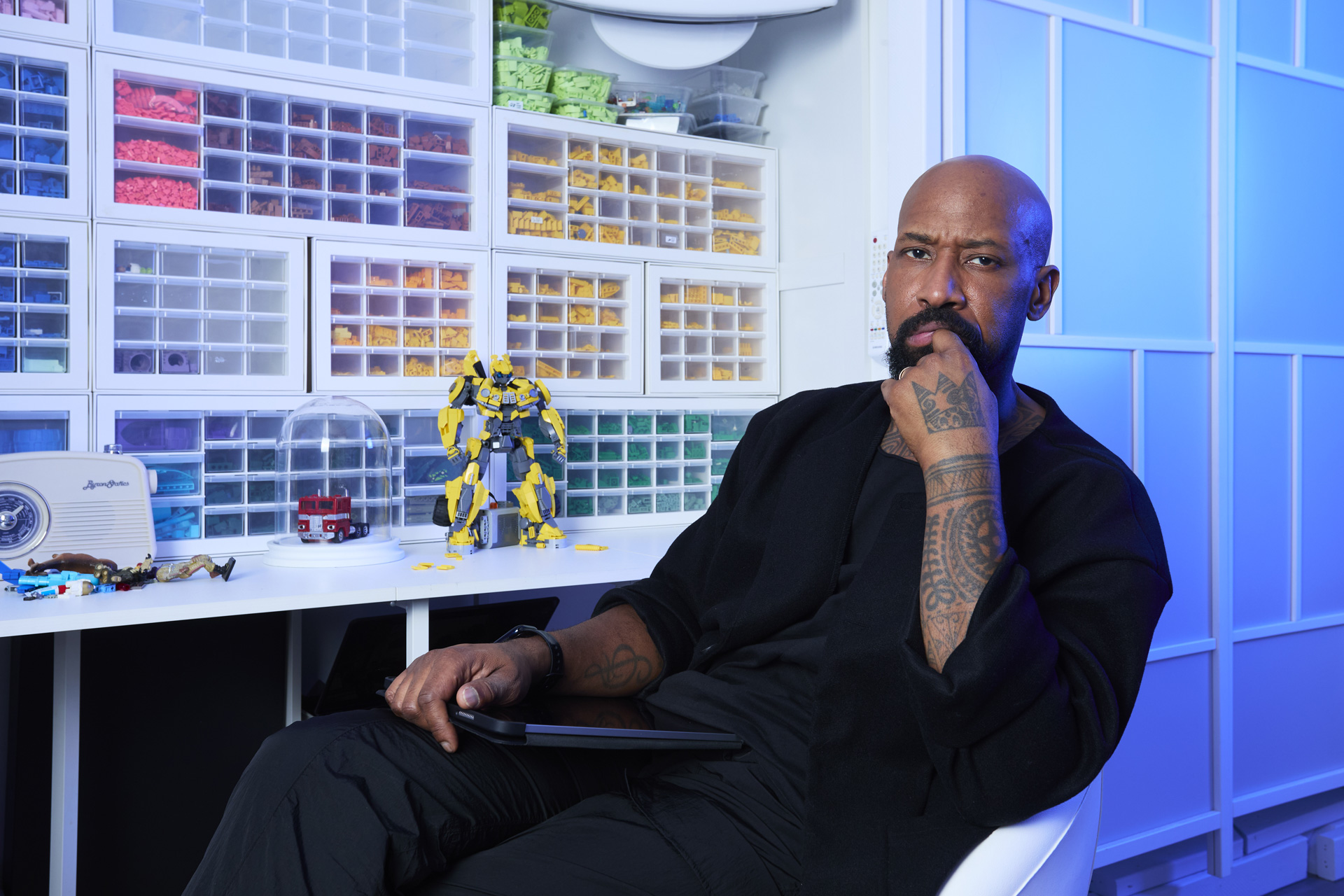
He built what he saw on TV — Transformers, vehicles, imagined machines — LEGO became the way he built his world. That instinct to create form never left him, but Nimako’s artistic path was not linear.
LEGO faded from view as adolescence arrived. Drawing took its place. “I grew up as an artist, always wanting to create, even though aside from a couple art books here and there, my parents didn’t really push me into the arts.” The child of immigrant parents, Nimako felt a slight push towards more traditional career paths. “For my parents, being an artist wasn’t a fully viable thing, it was just something I did.”
He drew his inspiration from books, movies, television, and comics. “I always drew. I started off drawing comics.” Nimako recognized through others that he could draw well around age nine and started drawing his own Garfield comics for fun and practice. But it was Calvin and Hobbes that pushed him to be better. “Bill Watterson, in my opinion, is a real artistic genius,” Nimako shares.
It was Calvin’s imagination — and the way Bill Watterson made it real — that stayed with him. When Calvin slipped into another persona, Watterson changed his world: alien planets for Spaceman Spiff, rain-soaked shadows and stark black-and-white contrast for Tracer Bullet — each imagined space rendered with total commitment.
Nimako moved fluidly across creative forms — in his early teens and into his twenties, he got into music. In high school, he met a group of friends who had a rap group, and they brought him in. For Ekow, it was constant artistic experimentation, yet still connected to the cinematic worlds he saw and imagined.
The Return to LEGO
Art school came later, and with it a return to LEGO. Nimako credits a layering of experiences that brought him back to the bricks. One was the live-action Transformers movie — the film rekindled the imaginative charge of his childhood. “I was back to being six years old, in grade school, everything was new, I was watching Transformer cartoons and building LEGO, and now I was having that same experience as an adult.”
At the same time, he started buying sets and playing with LEGO with his two young daughters. Pieces were around again. “I built all the Transformers from the first live-action movie,” Nimako recalls, “My friends didn’t know I was so into LEGO, because they had never seen it like that, they were like, ‘This is crazy.’”
The real spark came from his favorite art school professor and an assignment to create a working drawing machine. That was it, no constraints other than it must make marks on a surface. In Nimako’s words, “my mind just kind of immediately went to LEGO elements — I merged wood, metal, and LEGO, and the machine came to life kind of as a drawing vehicle. It was very Da Vincian.”
His relationship with the material was reconnecting, but his creative practice didn’t stop evolving. He left art school to work on a series of novels for young readers and even got a job as a writer. Eventually, he and others were laid off, which turned out to be a blessing in disguise for Nimako. “I had a lot of time on my hands that summer. A family was selling a bunch of LEGO on Craigslist, and I got it.” This was the most pieces he’d ever had in his life. “I was like, I could really do something — there was this abundance now.”
While Nimako currently works in monochrome black, he actually started that practice in red — simply because that first major LEGO haul happened to be dominated by red pieces. From the start, however, he wasn’t interested in using bricks as pixels; others were already building large-scale characters by stacking standard bricks into form. Ekow envisioned something different: to use the elements in all their varied shapes and sizes as true sculptural material, working at human scale to capture life.
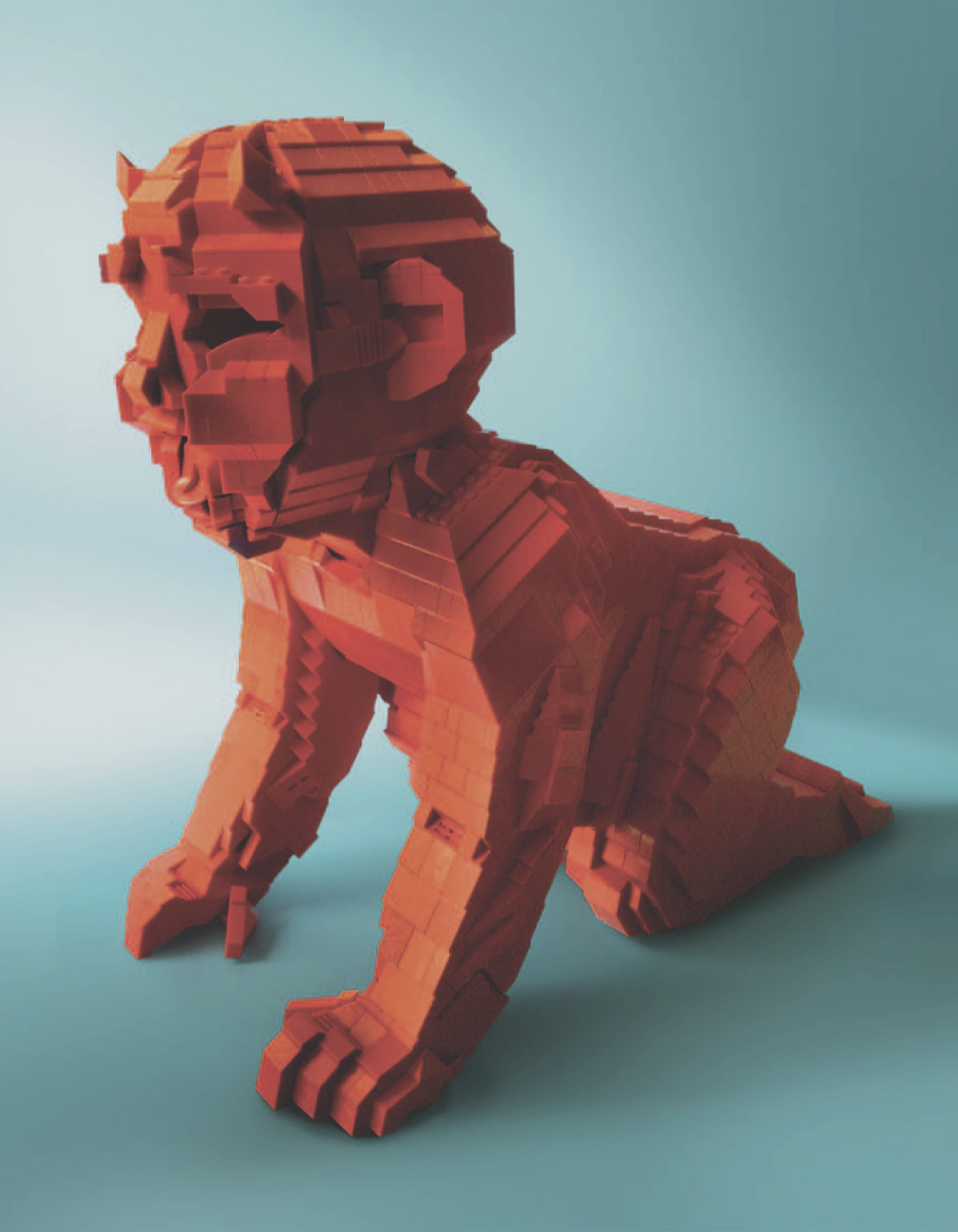
The abundance of red led to his first figure, which looked a little… infernal. Titled Junior, “the child was all red and about the size of a five- or six-month-old baby,” he recalls, “but with these horn-like forms — kind of like Hellboy as an infant.”
In 2014, his unique, sculptural style at life-size began to get noticed. A few of his early pieces, including the all-red Junior, were featured in Mike Doyle’s Beautiful LEGO 2: Dark, a showcase of brick-built masterpieces from around the world. Then the pivotal shift came when he received a grant to create and exhibit work celebrating Black culture, “That was the first time I’d received funding as an individual artist.”
Again, the layering of experiences brought Nimako an important revelation. He was already developing a penchant for monochromatic building, first with red, then with black. He wanted to build with the full range of available LEGO elements, and realized that structurally, black is the most diverse color in the system — the backbone of countless sets, present in obscure connector pieces, hinges, and structural elements unavailable in other colors. And as Nimako shared, “I kind of like black anyway, it speaks more directly to the tone and the subject matter of my work.” With that grant funding came the chance to buy more LEGO, a lot more LEGO — all in black.
Building Black: Masks & Figures
The color black is often coded as absence — void, negation, shadow. In Nimako’s hands, it becomes density, gravity, presence. Plus a chance to weave a sense of accessibility and wonder with the broader themes celebrating and speaking to Black culture, Black history and mythology, and Afrofuturism. Here, black stops being background and becomes subject. Without color to carry the eye, form has to do all the work. Every curve, plane, and negative space matters.
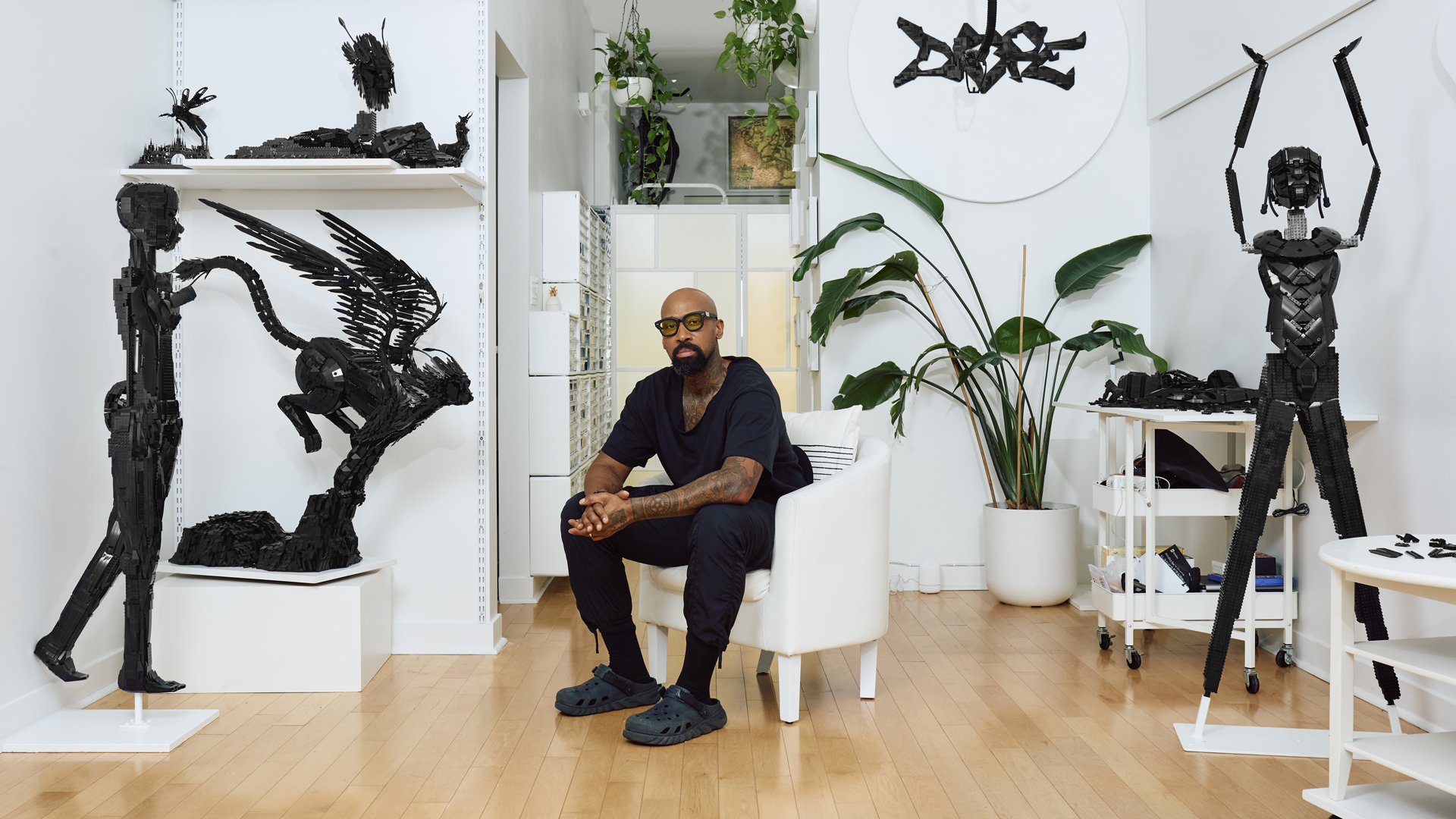
The first works where this philosophy fully crystallized were his masks. Nimako’s masks are not replicas of historical artifacts, nor are they meant to be read as literal ceremonial objects. Instead, they function as contemporary echoes — sculptural faces that sit somewhere between ancestry and futurity. They draw inspiration from West African mask traditions, but they are not bound to a single culture, tribe, or period. They feel invented, speculative, and alive.
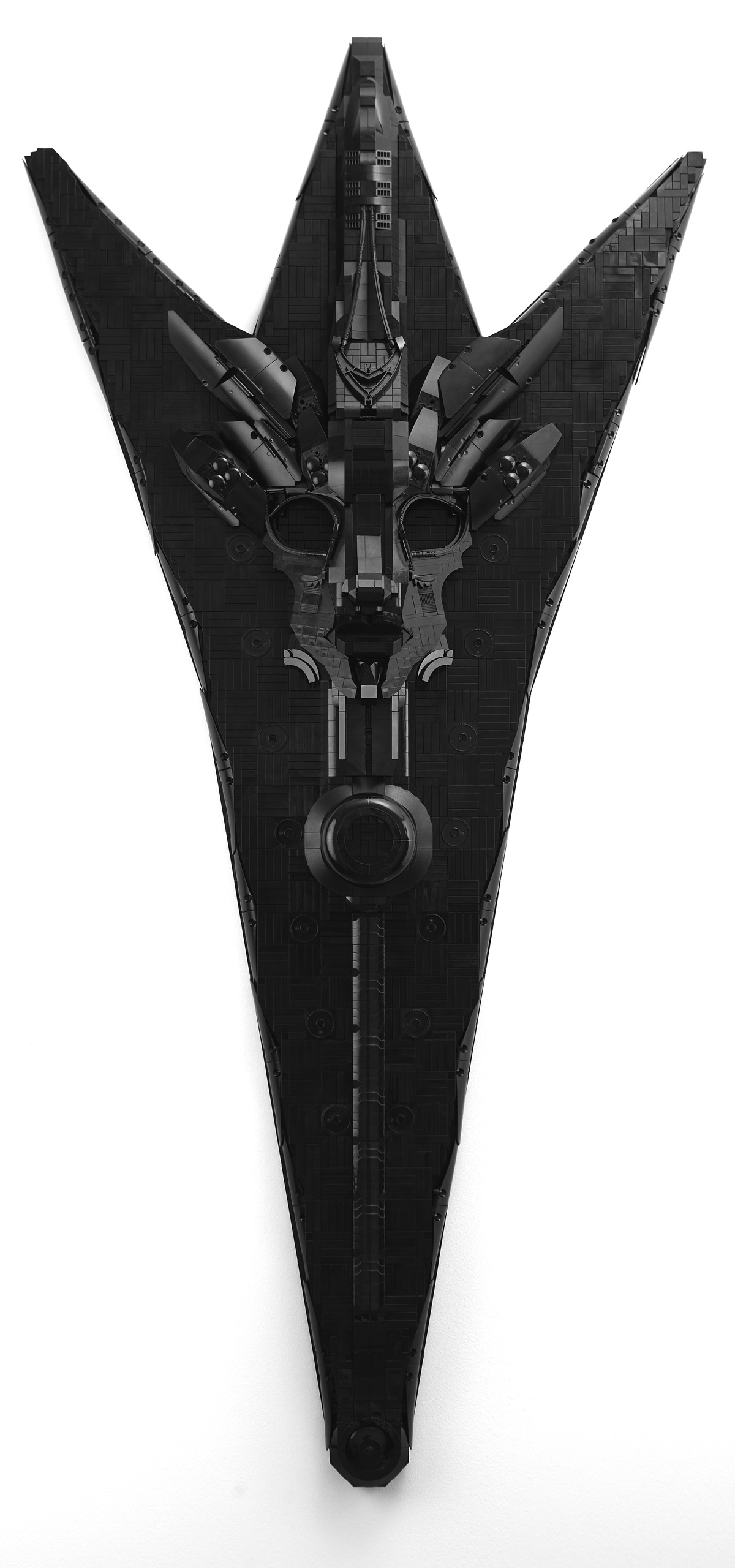
In the Building Black AMORPHIA series, the masks hover between human and mythic. Some stretch vertically, elongating the face into architectural proportions — even evoking interstellar spaceships. Others widen at the cheekbones or forehead, creating forms that feel simultaneously regal and alien. What’s striking up close is how they’re made — Nimako builds them from thousands of discrete LEGO pieces, hinges, clips, brackets, axles, and plates — assembled into flowing, organic surfaces. Studs appear and disappear depending on angle and light.
Working at this scale allowed Nimako to explore Black identity, power, and mythology without literal storytelling. Audience reaction reflected the intensity of the work. Viewers often describe the masks as haunting, reverent, or quietly confrontational. There’s a tension in seeing something so culturally significant, rendered in a material associated with childhood play.
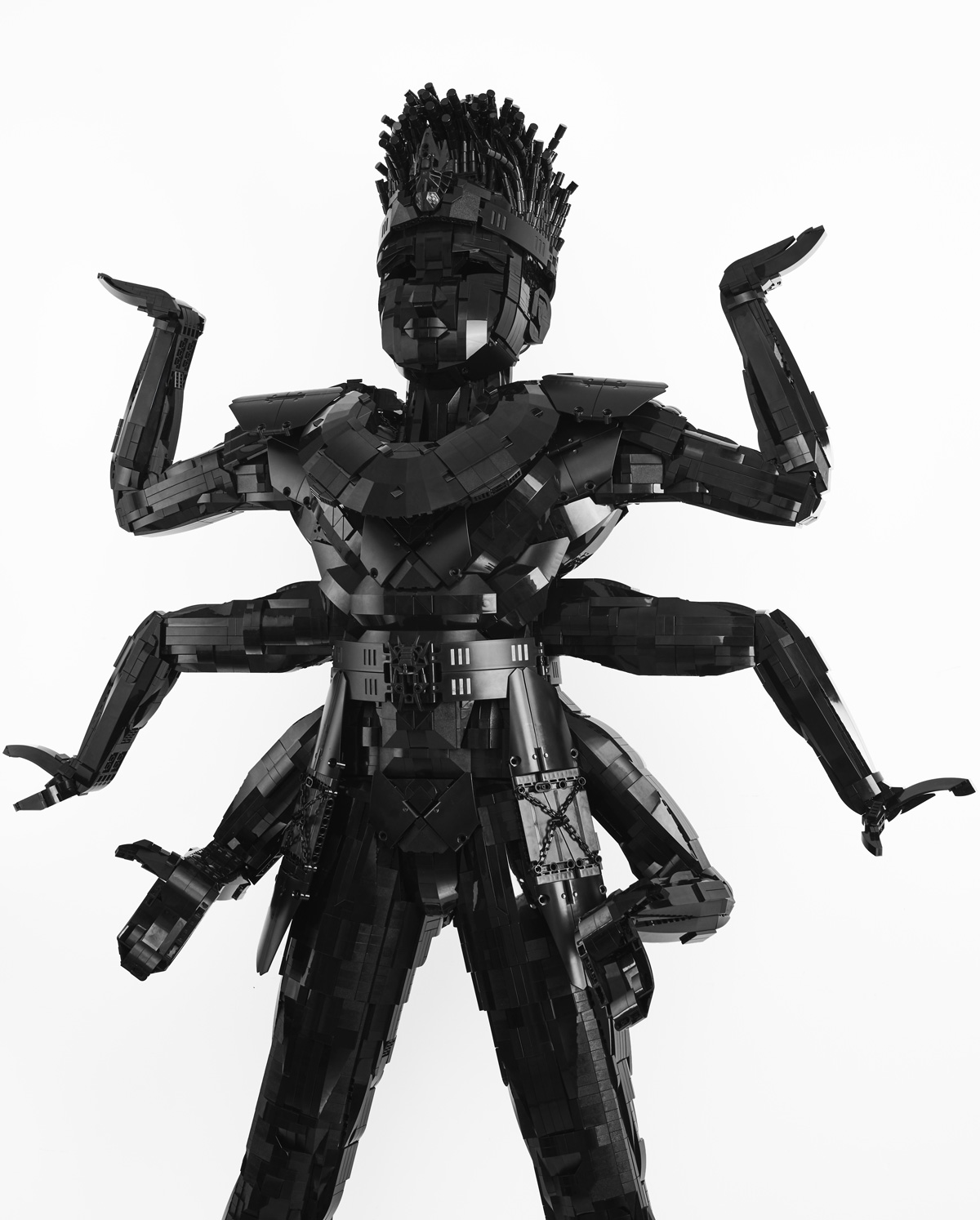
In the Building Black MYTHOS series, Nimako builds full-scale human and more-than-human forms — towering, poised, often mid-stride or mid-gesture. These figures feel like citizens of the worlds hinted at in Journey of 2000 Ships: explorers, sentinels, travelers, architects of unseen futures.
The figures carry themselves with quiet authority. Some stand upright and frontal, evoking a sense of guardianship or ceremony. Others lean forward — reaching, advancing, becoming. Their proportions stretch ever so slightly beyond realism — long limbs, widened shoulders, exaggerated headpieces — lending them a mythic scale without tipping into fantasy caricature.
Like the masks, the figures are built entirely from black elements, but they are anything but uniform. Nimako uses the full vocabulary of the building system: technic components for skeletal structure, curved slopes for musculature, clip-and-bar assemblies for texture, and layered plates to suggest fabric, armor, or skin.
You encounter them eye to eye or look up at them. The effect is deliberate. Nimako wants you to feel your own body scale in relation to the work — to stand beside a future ancestor and sense both difference and kinship.
Nimako’s figures are not fixed monuments; they evolve. One of the clearest examples is Flower Girl, a sculpture that has grown alongside the artist himself. The piece began in 2014 as the centerpiece of Nimako’s first Building Black exhibition — a life-sized figure of a young Black girl holding flowers. The inspiration was both historical and deeply personal. Nimako was thinking about young Black girls in American and Canadian history who, because of racist laws and social exclusion, were denied the simple visibility and joy of participation — unable even to take part in wedding processions as flower girls. “As a father of daughters, I wanted to create something that memorialized these young girls in history.”
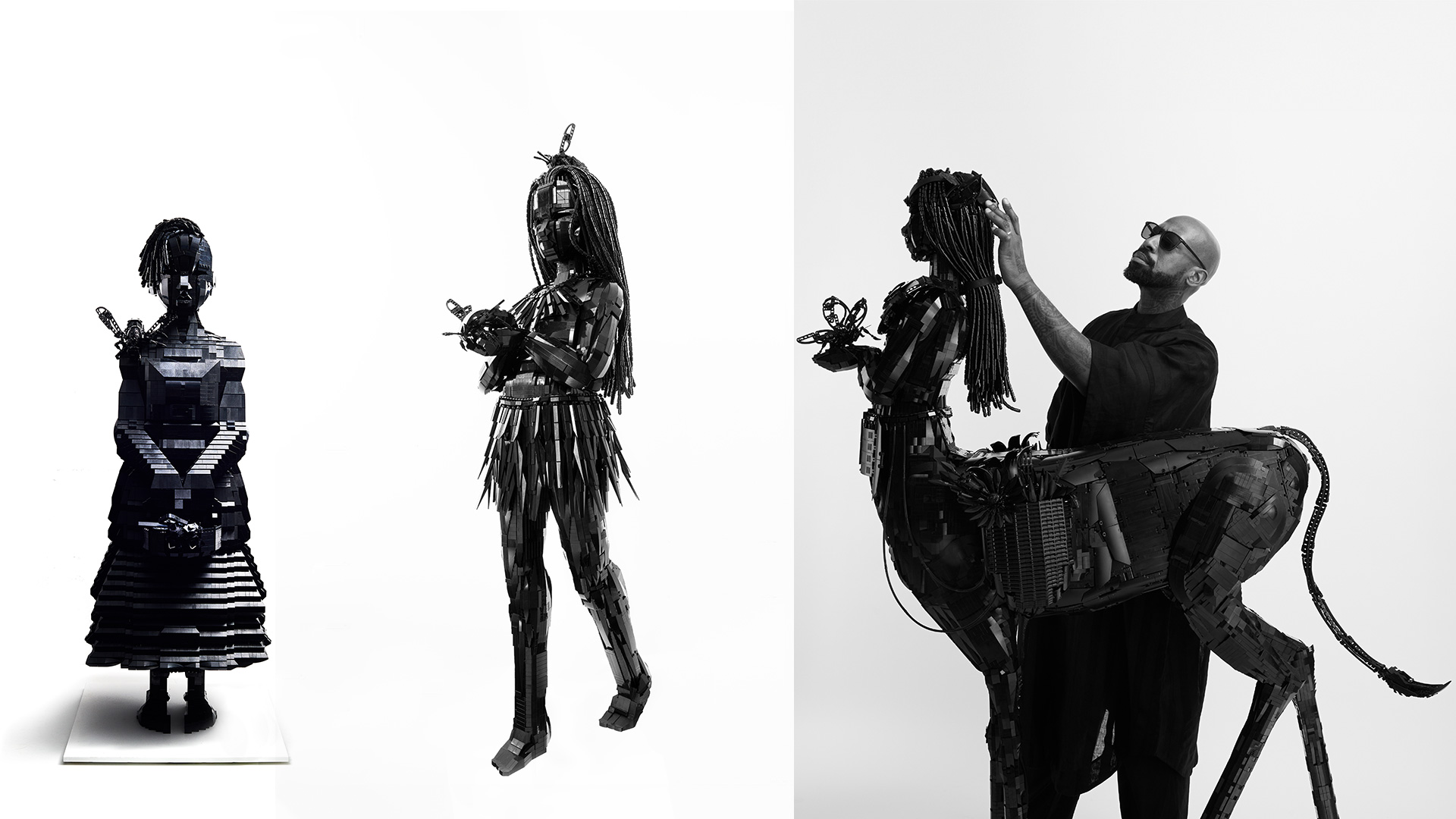
At the time, it was the largest sculpture Nimako had ever attempted, and it revealed the limits of his technique as much as his ambition. Built entirely from LEGO without internal armature, the figure was structurally fragile — sections shifted, the sculpture nearly toppled. Rather than abandon it, Nimako returned to it again and again. He rebuilt her taller. He changed her hair. She aged — from five to seven, then eight, then older still. Eventually, he introduced a custom metal frame, transferring the head and key elements from earlier versions into a more stable body. With each iteration, he learned, and Flower Girl matured.
Years later, after touring smaller communities in the UK and returning to Nimako’s studio during the pandemic, the work revealed itself again as unfinished. His skills had advanced. LEGO’s parts library had exploded. The lower and upper halves no longer spoke the same language. When an opportunity arose to work with the LEGO Group in Denmark and Paris, Flower Girl evolved one final time — merging with a centaur form to become Asaase Efua, a Ghanaian earth deity — like Mother Nature — in Akan spirituality, often depicted as both young woman and ancient presence, and symbolized by the antelope. The once-fragile child became a goddess.
Utopia After the Weight of History
Nimako knows the gravity of history. He felt it early in his practice, the instinct to reach first for the heaviest chapters of history: the transatlantic slave trade, Jim Crow, and the aftermaths that still press into daily life. “That past becomes the source material,” he says. “It’s so heavy. It’s just… heavy.”
Nimako continues, “And I think I wanted to, especially since my work is mainly in this very dark aesthetic, I wanted to kind of subvert the darkness of it with utopian places, themes, and ideas.”
The cities Nimako builds are not places of tyranny or despair. They are imagined civilizations where people live fully, creatively, joyfully, and freely. That belief crystallized in his vision of Kumbi Saleh, the historic capital of the medieval Ghana Empire and one of the most cosmopolitan cities of its time. In Nimako’s sculptural reimagining, Kumbi Saleh 3020 CE rises in concentric layers of architecture and carved terrain — solemn faces embedded into the surrounding rock formations like guardians. From the outside, the city can appear austere, even intimidating. But at its peak, on the tallest spire — called Gye Nyame — Nimako placed a single symbol: an Adinkra glyph. Drawn from the symbolic language of the Akan people, it crowns the city’s highest spire. It means jinnyami: to live life. To live well. To enjoy existence. To flourish.
Beneath the looming silhouettes and monumental scale, Nimako imagines, “The idea there is that people are living and enjoying their lives and living fruitful existences and happy and free of tyranny.” The work resists the expectation that Black history must always be narrated through suffering. Instead, it insists on joy, continuity, and future-making.
This shift in perspective carried directly into Journey of 2000 Ships, where Nimako expanded the idea of civilization beyond city walls into migration, exploration, and belief. From there, his imagination stretched even further — outward into landscape, ecology, and planetary scale with one of his recent pieces, The Nile (3025 CE).
At nearly seven meters long, The Nile is Nimako’s most ambitious work to date — not just in size, but in conceptual scope. The sculpture traces the Nile River from Lake Victoria northward through the African continent, flowing across borders and through time before emptying into the Mediterranean Sea. Kenya. Uganda. Tanzania. Ethiopia. South Sudan. Sudan. Egypt. The river becomes a spine of civilization, carrying memory and futurity together.
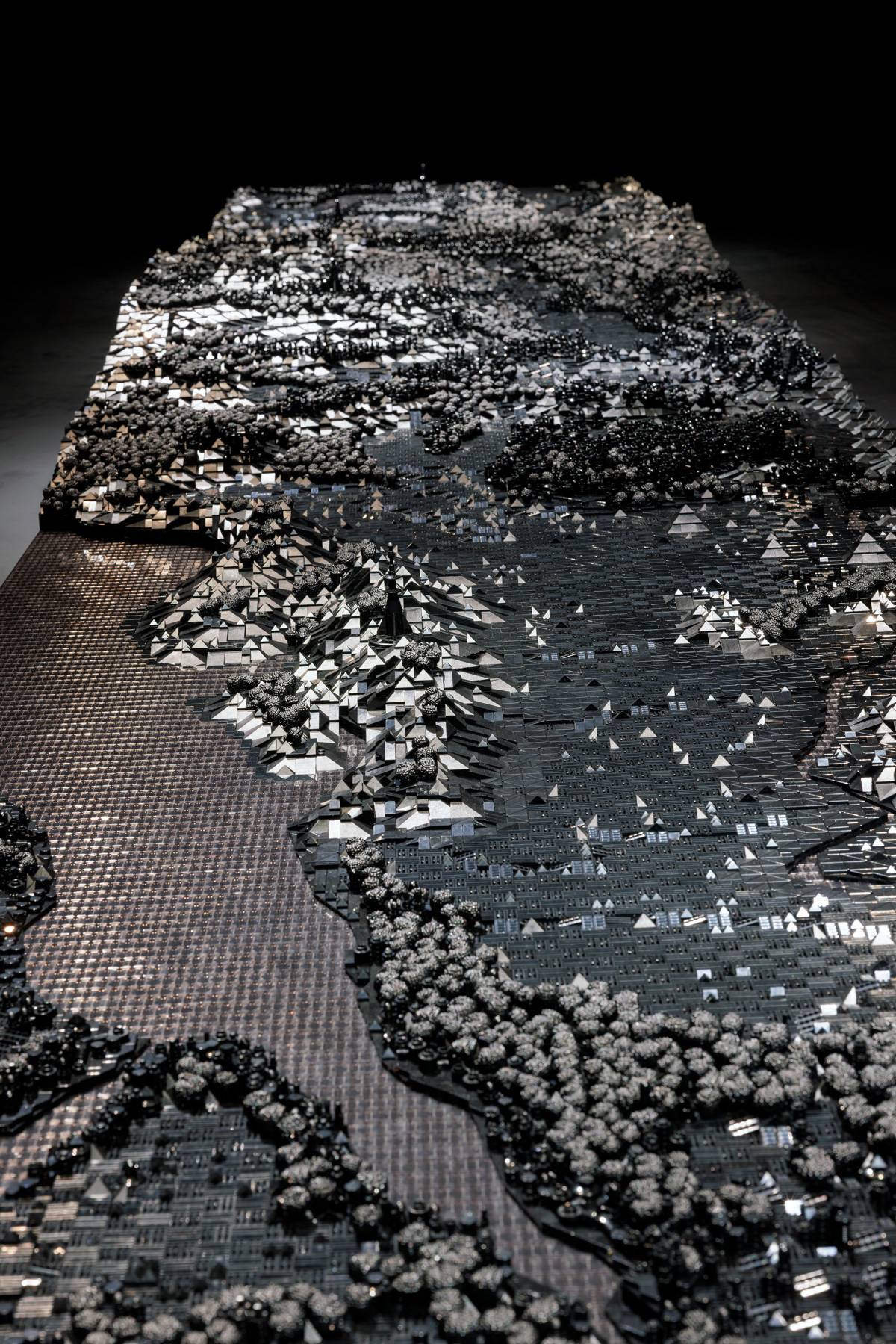
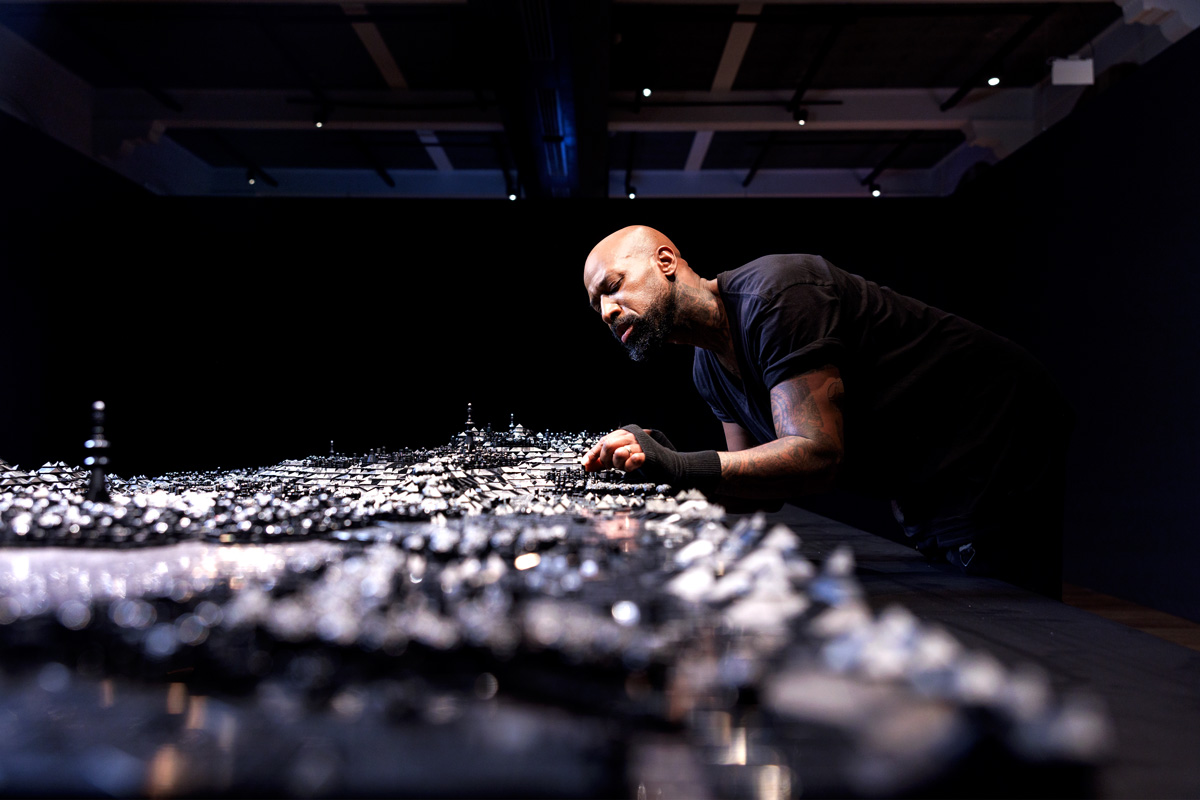
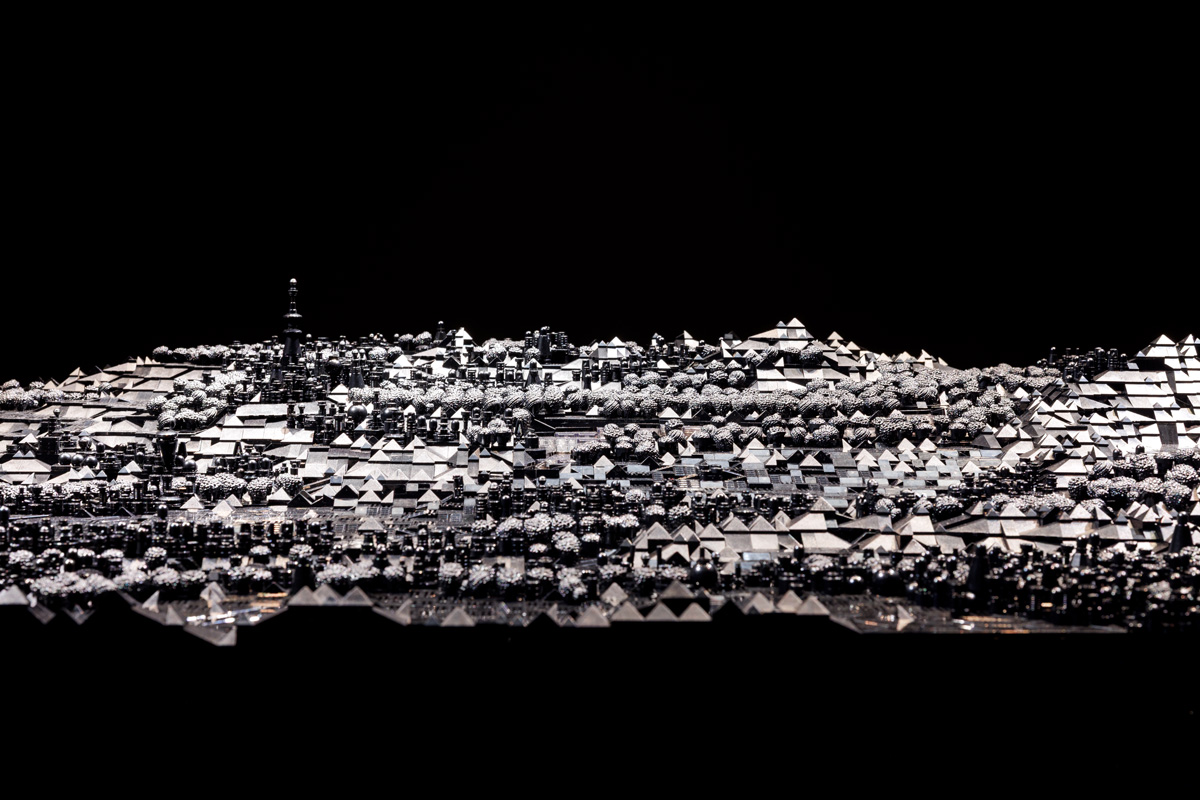
Unlike earlier works rooted tightly in architectural density, The Nile operates at multiple scales simultaneously. In some moments, you view it from a godlike distance — a bird’s-eye perspective where terrain flattens into pattern and rhythm. In others, the eye drops down into intimate detail: clusters of trees, dense foliage, small structures where people might live. Scale becomes fluid, almost illusory. You are constantly shifting between overview and immersion.
That challenge demanded innovation in materials. This was not a city you could abstract away from nature. The Nile required forests, grass, and terrain. And working entirely in black LEGO forced invention. Nimako found his solution for trees in an unexpected place: minifigure hair. Specifically, Black minifigure hair.
Using textured hairstyles originally designed for characters like Shuri and other figures from LEGO’s Wakanda sets, Nimako reimagined hair as forest canopy. From a distance, the forms read unmistakably as trees — organic forms and living density. Up close, they remain legible as hair, rooting the landscape unmistakably in African identity. “It was exciting,” Nimako says. “Building the longest river in the world — the most important river in Africa — and still finding ways to root it in African identity.”
Seen together, Nimako’s cities, journeys, and landscapes form a quiet rebuttal to dystopia. They do not deny history’s weight — but they refuse to let it be the final word.
Returning to the Horizon
Today, Nimako’s imagined civilizations are no longer confined to the studio. They are moving — across cities, across countries, across audiences. Building Black Civilizations: Journey of 2000 Ships is currently on view in Canada at the Robert McLaughlin Gallery in Oshawa, Ontario, running through February 16, 2026. The work then extends outward again. The Nile is on view for the first time at the Wereldmuseum in Amsterdam through March 16, 2026.
For Nimako, the real measure of success isn’t scale or prestige, but impact — especially on young viewers. He recalls watching a child move through his Paris installation, weaving through the sculptural terrain until they encountered Asase Yaa, the embodiment of Mother Nature rendered entirely in black plastic elements. The child stopped. Stared. Their mouth fell open. Nimako recalls the child looked up at him and whispered, “I think this is the best thing I’ve seen here.”
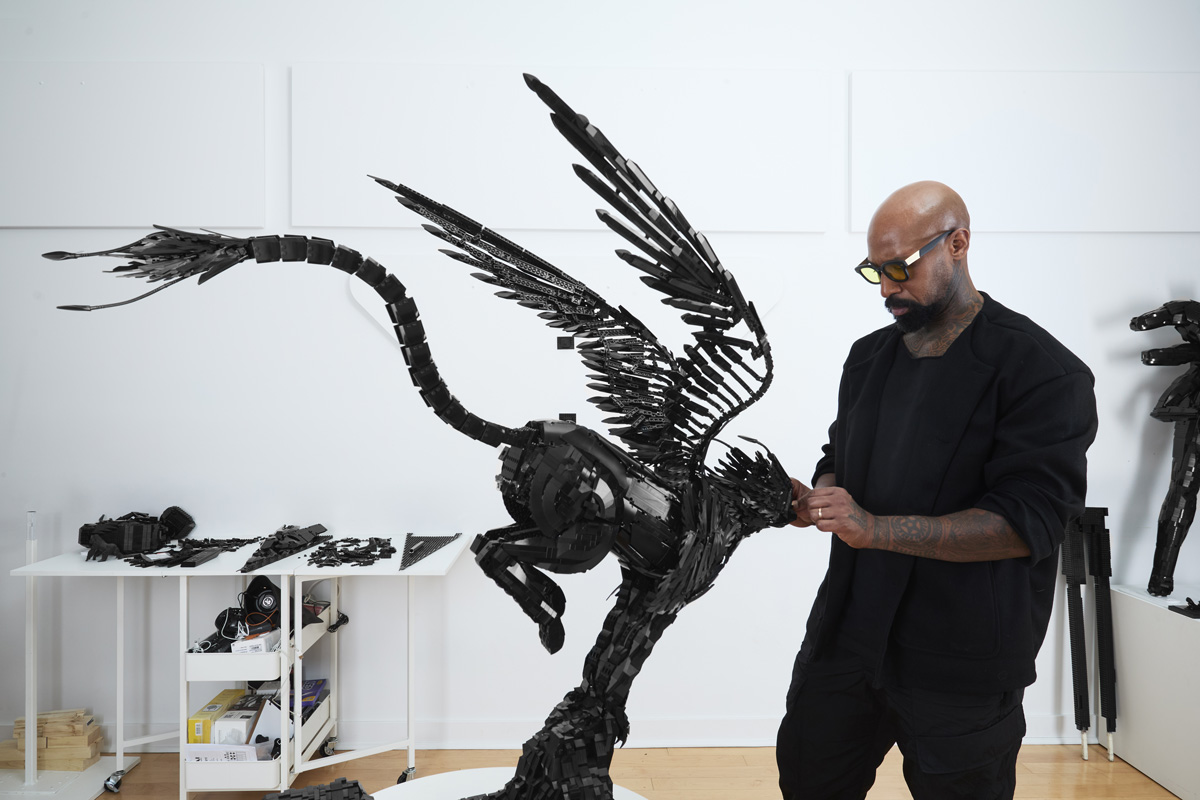
Nimako keeps a photograph of himself as a child — five years old, from an old passport — pinned in his studio. A quiet witness and a reminder. “A lot of what I do is to give the experience that I would have wanted as a young me.” If six-year-old Ekow had heard there was an artist making monumental worlds out of LEGO — and then walked into one of these exhibitions — he knows exactly what would have happened. “I would lose my mind,” he laughs.
In a way, the work becomes a message sent backward through time — a conversation across generations. To build forward while reaching back. As Nimako puts it, “When we see art that reflects us and grows from the Black imagination, and draws on the shared space shaped by our experiences of moving through the world, looking the way we do and being who we are, the impact becomes that much more profound.”
Nimako has chosen to use his talents not to document trauma, but to uplift — to build narratives where Black existence is expansive, generative, and oriented toward the future.