


Photography by Jeff Friesen
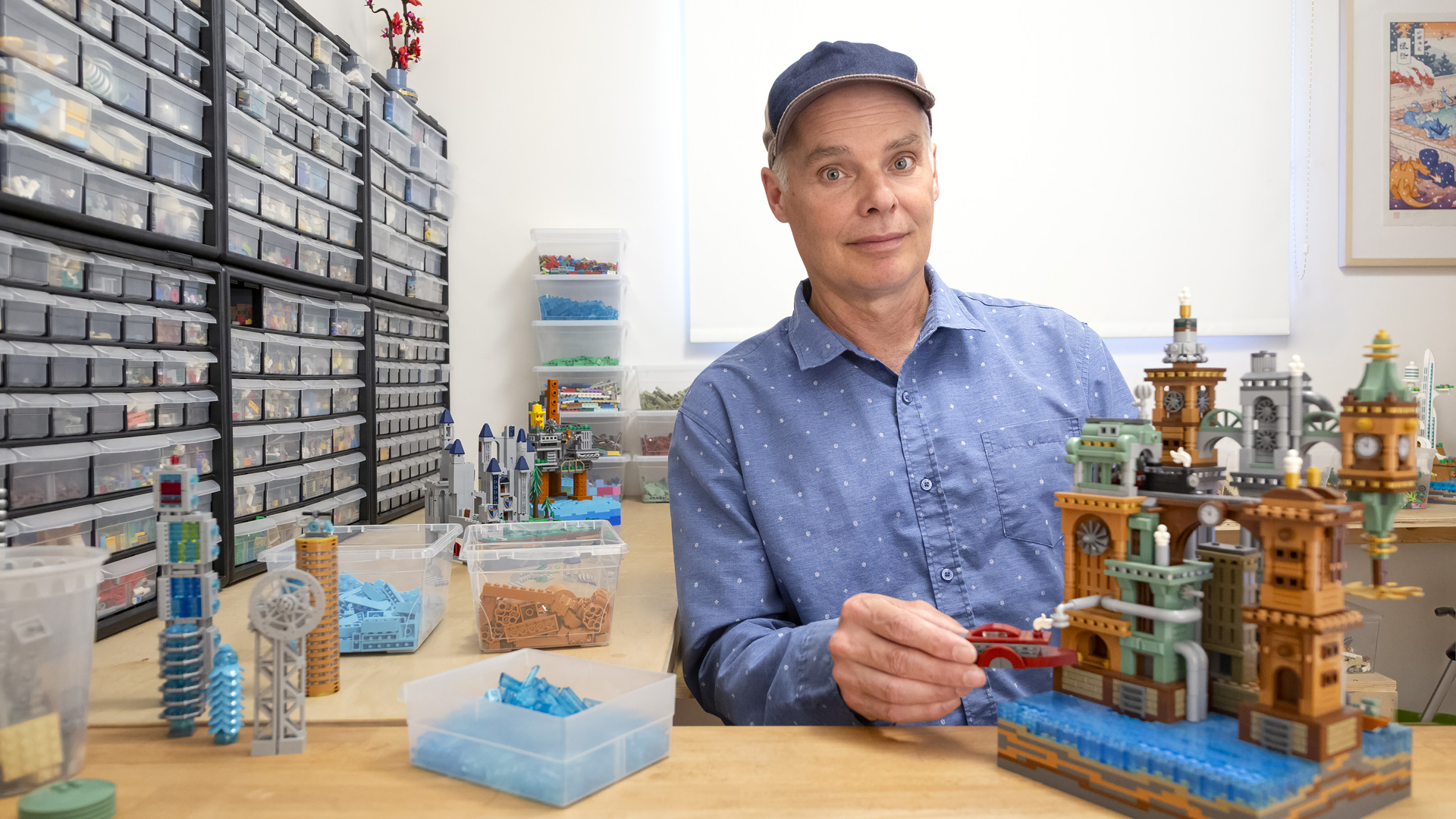
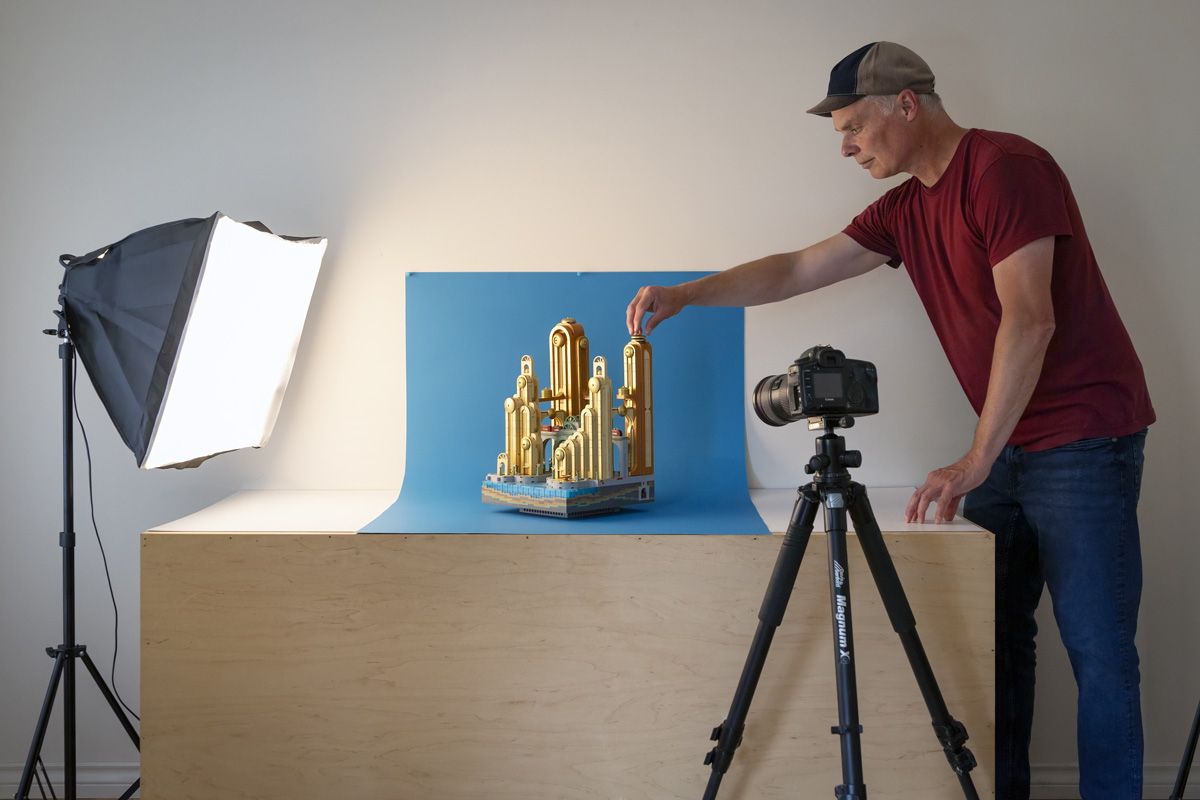
The buildings rise in golden tiers, a streamlined Art Deco tower flanked by its own modern reflection: radiator-cap ornaments catching the light, fluted columns running clean to the sky, a tram gliding across an arched viaduct above water the color of deep glass. It looks like a city that history either forgot to build or is about to. A metropolis from the 1930s or the 2130s.
Then you notice the studs — it’s a microscale assembly of LEGO bricks, small enough to hold in two hands, sitting on a table under carefully arranged light. The towers that read as skyscrapers are but a few inches tall. The deep-glass water is transparent blue tile.
There are two acts at the center of Jeff Friesen’s LEGO art: worldbuilding in brick, and worldmaking through the camera lens.
He is two artists at once: an award-winning LEGO builder whose microscale cities have earned top honors and a devoted following in the LEGO community, and an accomplished professional photographer whose work is recognized in the broader commercial and fine-art world.
You can see this merging in his work. The composition is planned before the last brick is placed. The lighting is imagined while the towers are still going up. He moves between building and shooting so fluidly that, in any given hour, it can be hard to say which one he’s focused on.
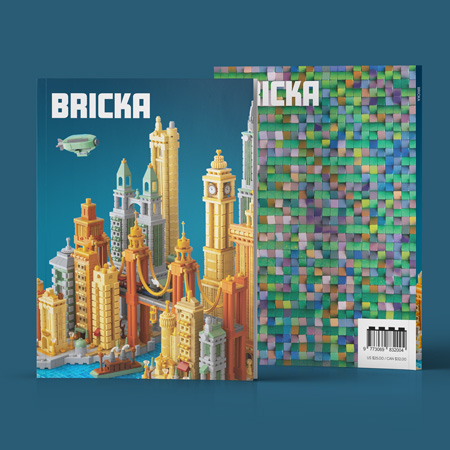
There's more! Continue reading this article by subscribing to BRICKA.
There's more! Continue reading this article by subscribing to BRICKA.
A future that feels remembered.
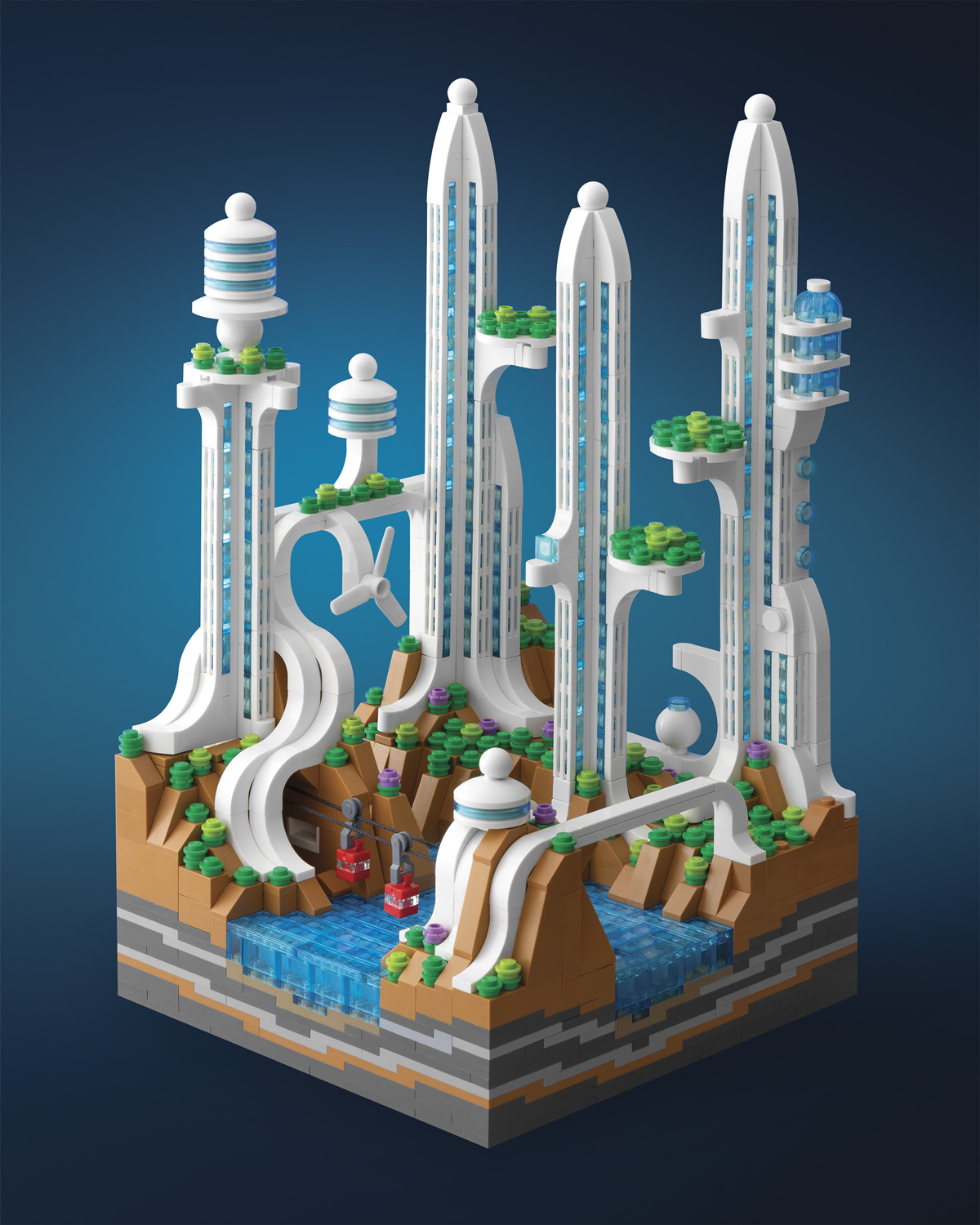
One of his cities rises in slender white spires, their cores glowing with blue glass, green terraces spilling off the sides at improbable heights. Red cable cars cross a canyon of transparent water; a wind turbine turns; vegetation colonizes every ledge. It’s a solarpunk vision — a hopeful future where the towers and the gardens have made peace. Like the Deco waterfront, it refuses to sit in any fixed decade — the viewer imagines and decides.
A Creative Career
Jeff’s city and landscape-building began in a childhood bin of bricks. For him it was the blocky, basic elements of an earlier era — the humble 2×4 — and building abstractly pushed his imagination. There were no instructions to follow and few specialized pieces to follow them with, so a brick had to become things rather than depict them — a habit of invention that would outlast his childhood. “Whenever I hold a two-by-four brick,” he says, “it’s a foundational memory. Just holding it is the best feeling. This is the DNA of my memories.”
Like many of us, he eventually stopped building as a child — and didn’t pick up bricks again for decades. But it wasn’t a period empty of artistic pursuits; it was a whole creative life. He became a working photographer and writer, built a real career, earned accolades, traveled, shot, and published. By any outside measure, he was a successful photographer, and yet he’ll tell you there was always a missing piece.
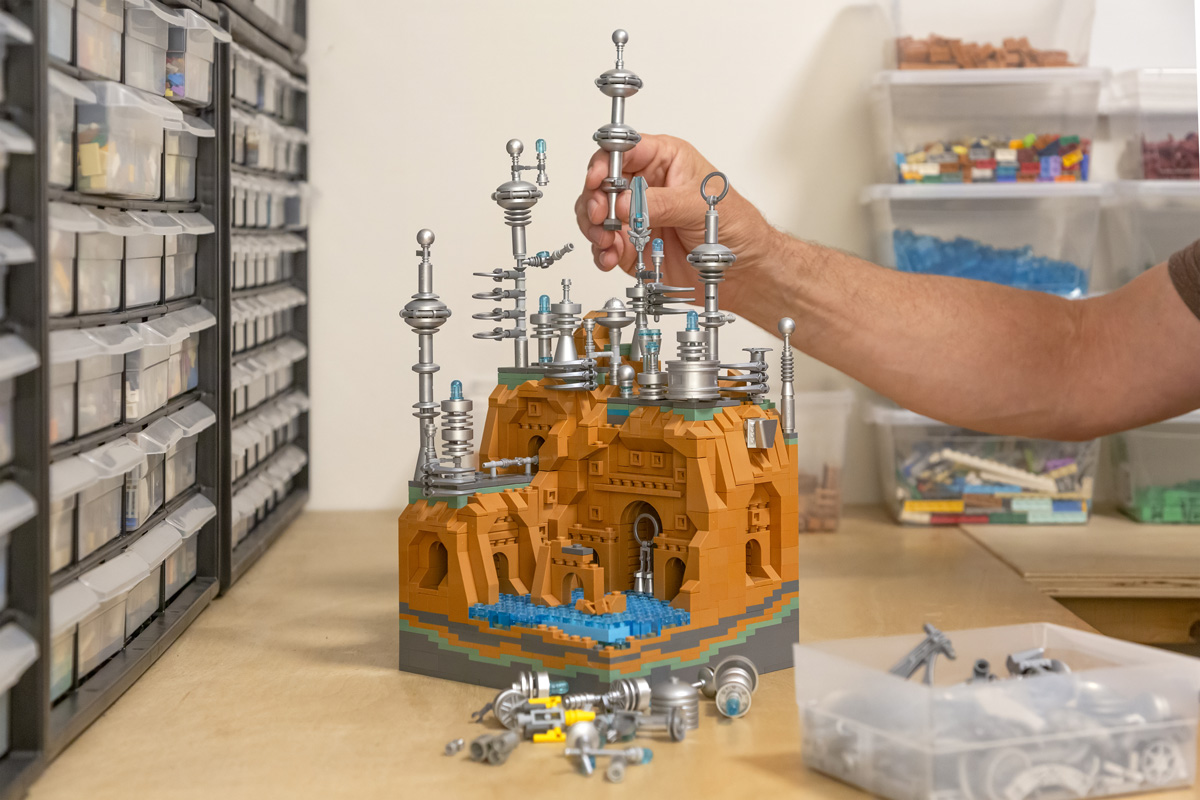
His daughter found it for him. Before long, the two of them were building LEGO side by side — Jeff making castles, his daughter building microscale on her own, using little one-by-one round plates as people. And because he already kept a tabletop photography studio at home, he let her photograph her own small builds. “I was having fun with my daughter, letting her take pictures of her own little scenes,” he says. “And I thought, should I take pictures of my own scenes? I was kind of resisting it.” But he did it. He built, he captured, and he posted the results, uncertain whether anyone would care about a professional photographer aiming his craft at little plastic bricks.
People noticed. The images boomed out across the early blogosphere, and the missing piece was found. The two halves of his life — the bricks he’d loved as a boy and the camera he’d mastered as an adult — turned out to belong together in the same frame.
Banksy on the Line
The work that first made him go viral was equal parts interpretation and imagination.
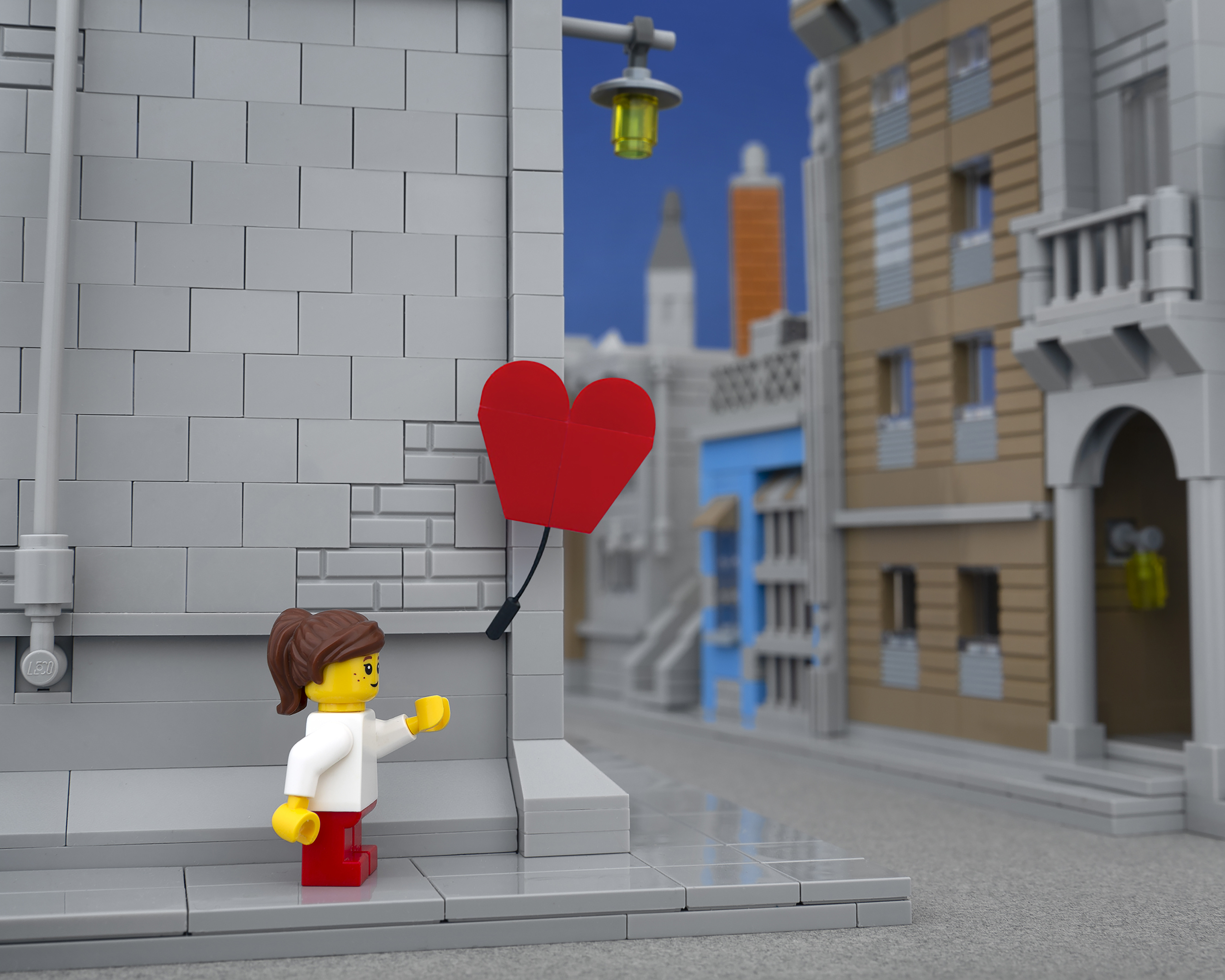
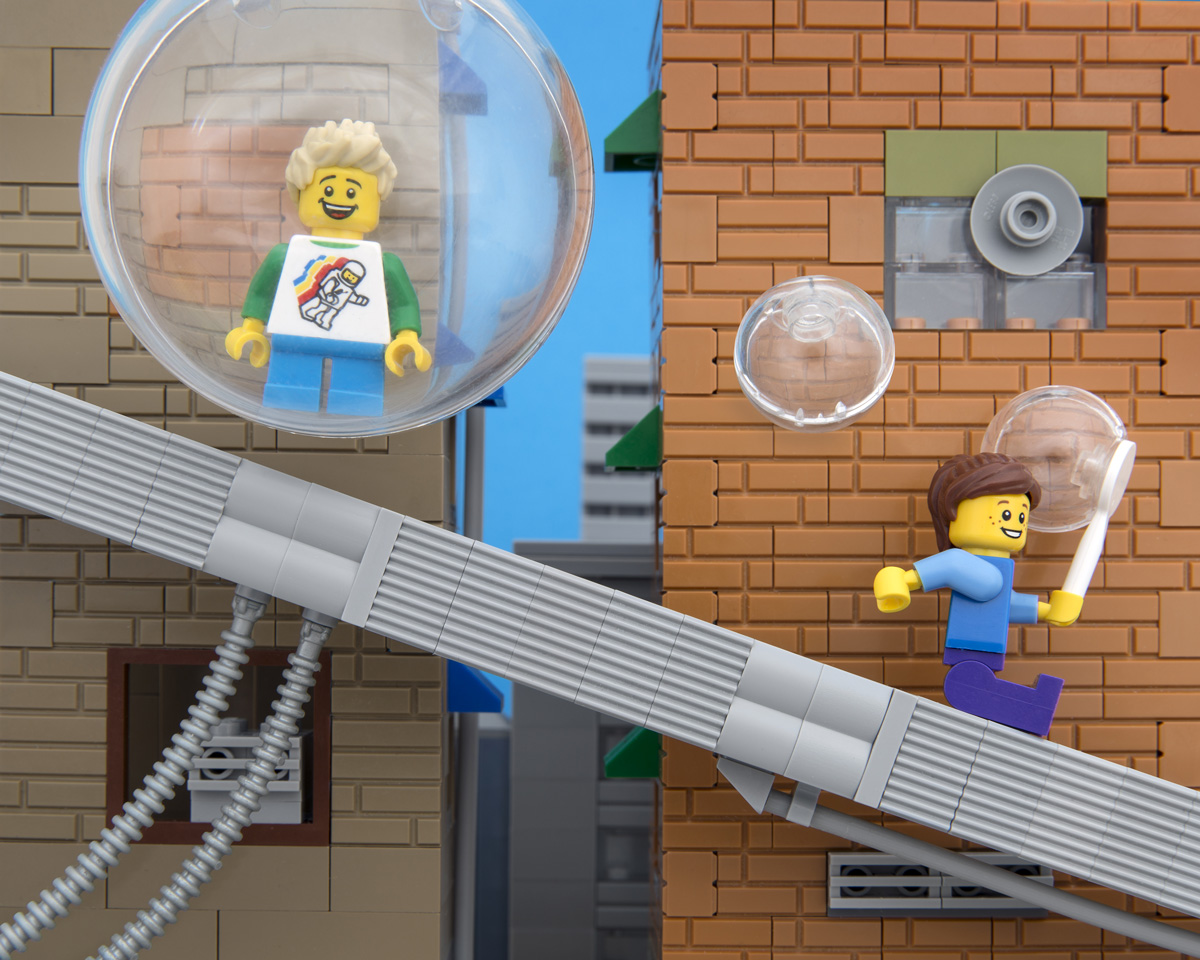
Jeff began recreating famous images in LEGO — among them the street art of Banksy, whose stenciled figures and sly visual jokes made for interesting visual subject matter. “There’s nothing more incongruous than LEGO and Banksy,” he says. “If creativity’s defined as joining two unexpected things, you can’t do better than this — clean modernist kids’ toy Lego and rough street art.” The balloon girl, the other familiar provocations, rendered in studs and photographed with a professional’s eye. He spent the next month, in his words, “cloistered like a monk,” making Banksy scene after Banksy scene, amazed no one had done it before.
They were good enough to travel across the internet. They even reached Banksy himself, whose account took notice and shared the work. Then came the press, interviews, even friends turning up at dinner going LEGO Banksy, that was you? It’s a feeling he’s chased ever since: the certainty of having an idea people will love. But the viral rush taught him something too — he didn’t just want to reproduce other people’s images in LEGO; he wanted to build his own. The recognition gave him the confidence — and the audience — to stop translating and start inventing.
The Storybook City
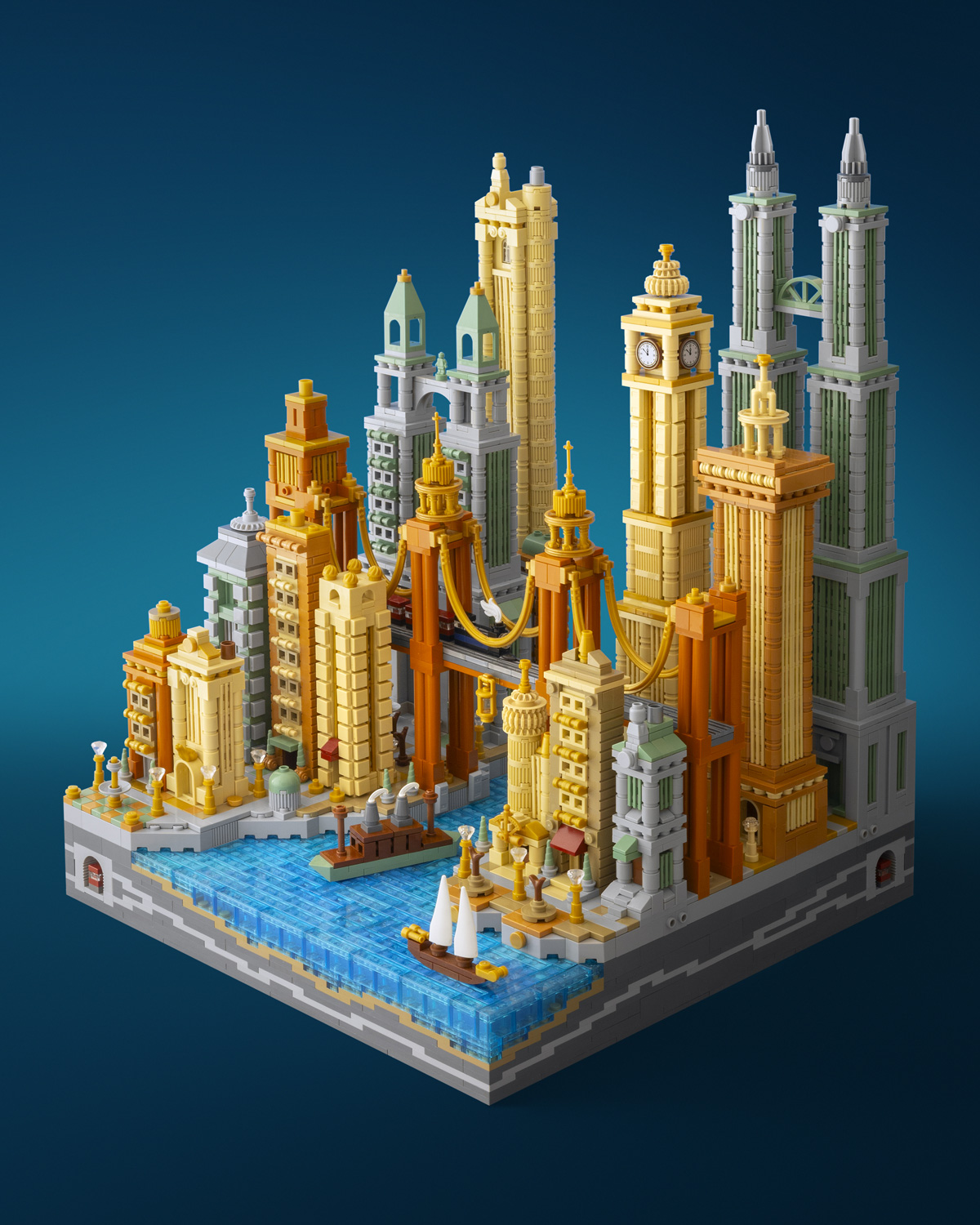
His cities carry the constraints and the detail of LEGO to new levels, even at microscale. One reads as New York or London, or both, with a great clock tower keeping watch, a suspension bridge slung on golden cables, white sailboats tacking across transparent water — and, drifting over the skyline, a mint-green zeppelin. Another world from the mind of Jeff Friesen, equally fantastical and bustling with real life.
Three Pillars
To understand why a Jeff Friesen city looks the way it does, you have to understand the influences that shape it.
The first is SimCity 2000, the city-building game of his youth, seen from that particular elevated, isometric, god’s-eye view — a whole metropolis laid out below you on a grid, knowable and buildable. He played it obsessively, terraforming impossible rivers and cliffs until he thought of infrastructure itself as an art form. But what stuck was something the 8-bit era taught him: the blocky, simplified image that hands the rest to you. “You have to fill in the rest,” he says. “You get this blocky thing, which is very abstract and simplified, but it gives you the essence of what it is — and then your imagination is still doing a lot of the work.”
Then there’s Monument Valley, the game of gorgeous impossible — yet atmospherically real — architecture, where geometry alone conjures the sense of a whole civilization that built it. “It feels like there’s stuff off the screen,” he says — which is exactly how he wants his cities to feel. “This is a slice of the world, and you can imagine the rest.”
The oldest and probably the most important influence: Japanese ukiyo-e woodblock prints, especially the landscapes of Hiroshige. What Jeff took from them is a specific and unusual way of organizing space called parallel perspective. In Western art since the Renaissance, images obey a vanishing point — lines converge as the scene funnels toward a single fixed viewpoint. It gives the art a sense of realism, but you, the viewer, are pinned to one spot. Ukiyo-e doesn’t do this. The parallel lines never converge. There’s no single vanishing point, no one place you’re meant to stand. Your eye is free to roam across the entire scene, discovering it piece by piece, as though you were wandering the landscape yourself. A tower in the foreground and a bridge in the far distance are rendered with the same clarity and geometric precision; neither shrinks to prove it’s farther away. The effect is more like a place to explore than a static image.
Likewise, Jeff’s cities are shot to let you explore — corner to corner, tower to alley to waterline, every part of the frame equally in focus and equally inviting. It’s the quality he admires most in the wood block prints: “There’s just everything everywhere all at once, and everything is balanced.” He builds toward that balance obsessively, watching how his own eye travels and correcting when any one spot pulls too hard. He’ll even pull out a single red brick if it’s hijacking attention — “you can make the eye dart around with red quite easily.” The result is an image with no single primary subject and therefore a hundred of them.
He compares the exploration he’s seeking to another video game, The Legend of Zelda: Breath of the Wild. “You have this total feeling of exploration,” he says, “which I want when people are looking at my cities.” That’s the pull he’s after: not the awe of a monument at a fixed distance, but the freedom to roam. He wants you to look at his cities the way a kid looks at a hillside — as somewhere to go.
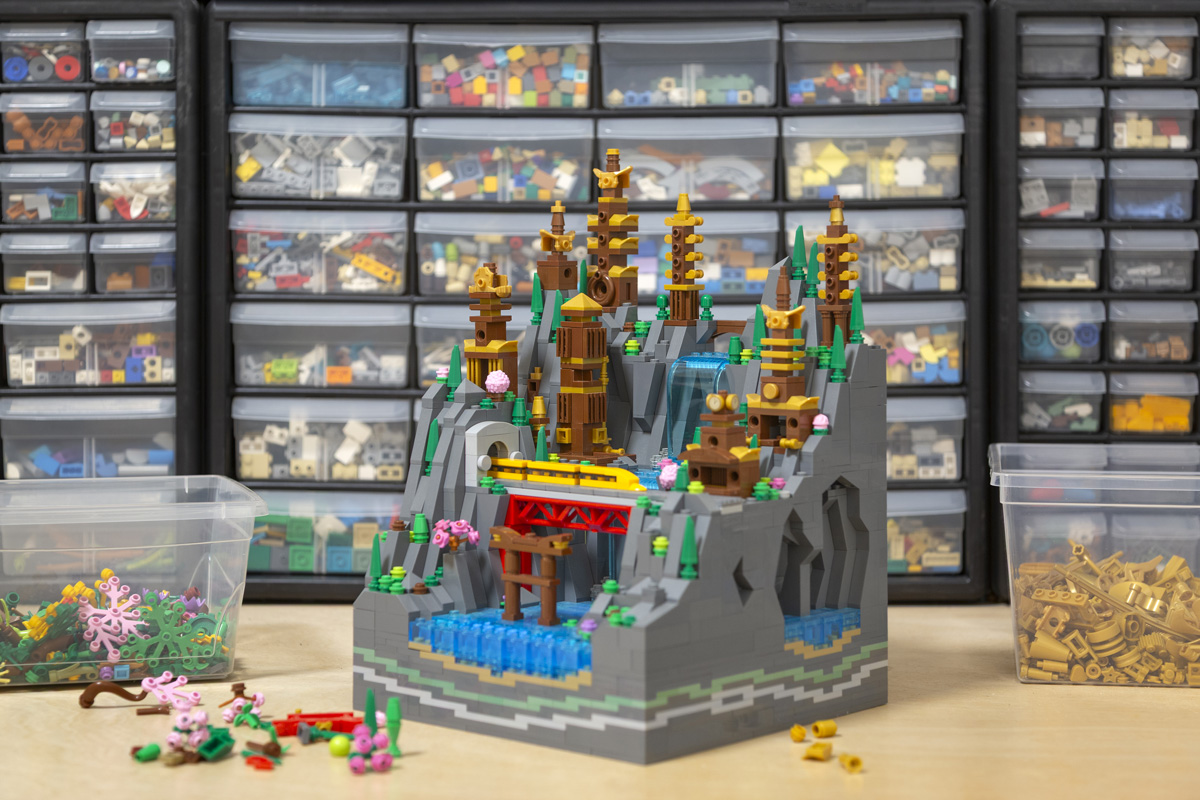
Exploring Dense Landscapes
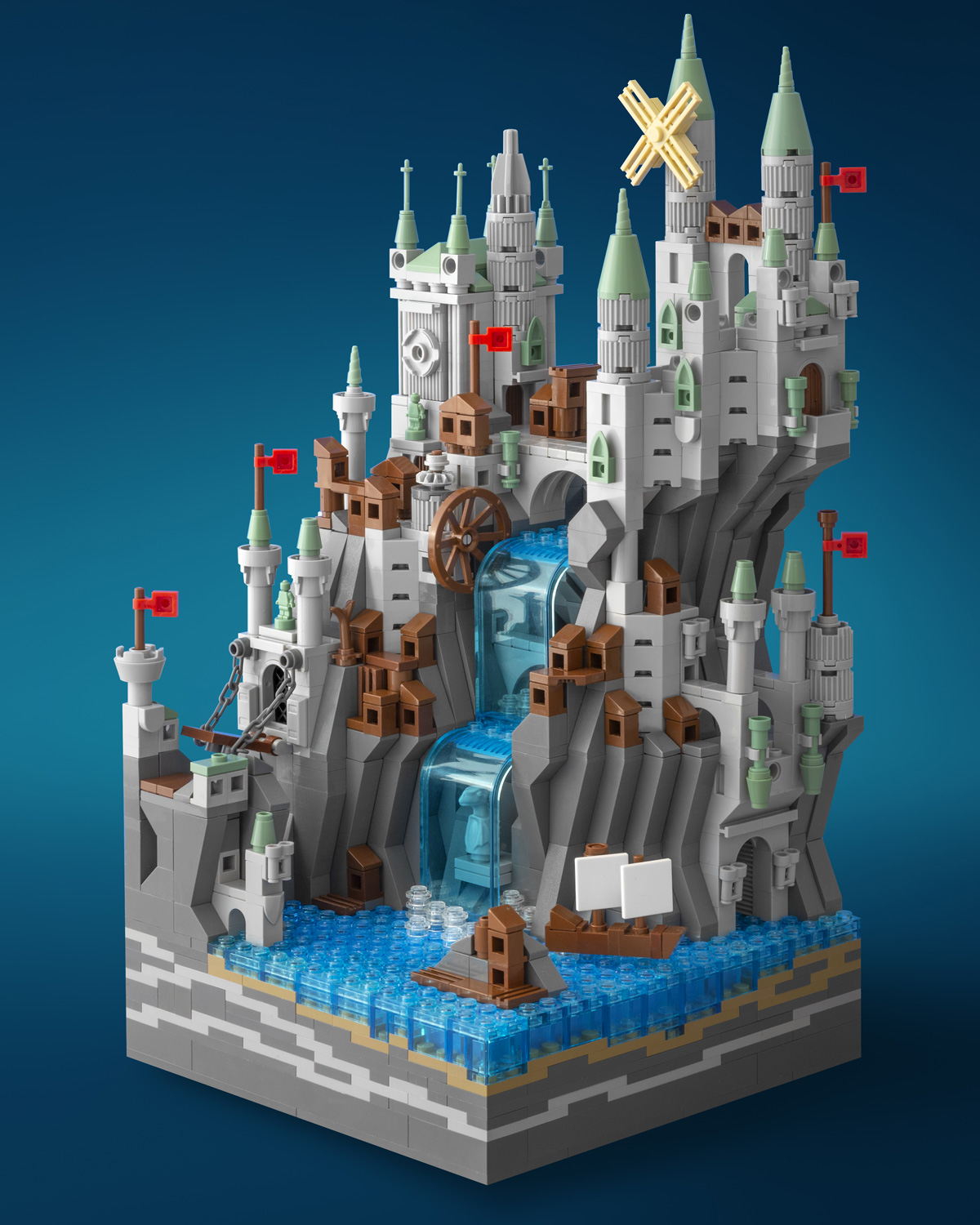
A microscale castle shows the magical exploration Jeff can wring from an unforgiving system. The structure is a gray crag bristling with spired towers, a windmill at its peak, a tiny sailboat at its base — but the star is the water. Two waterfalls pour down the rock face in smooth, curved sheets of transparent blue, and the achievement is that they read as liquid — as motion, falling — despite being made from a medium of hard edges and fixed studs. The rock does the opposite job: jagged, faceted, irregular, coaxed from the same grid that produces the glassy water beside it. One system, but two states of matter. The system insists on right angles. Jeff answers with a river.
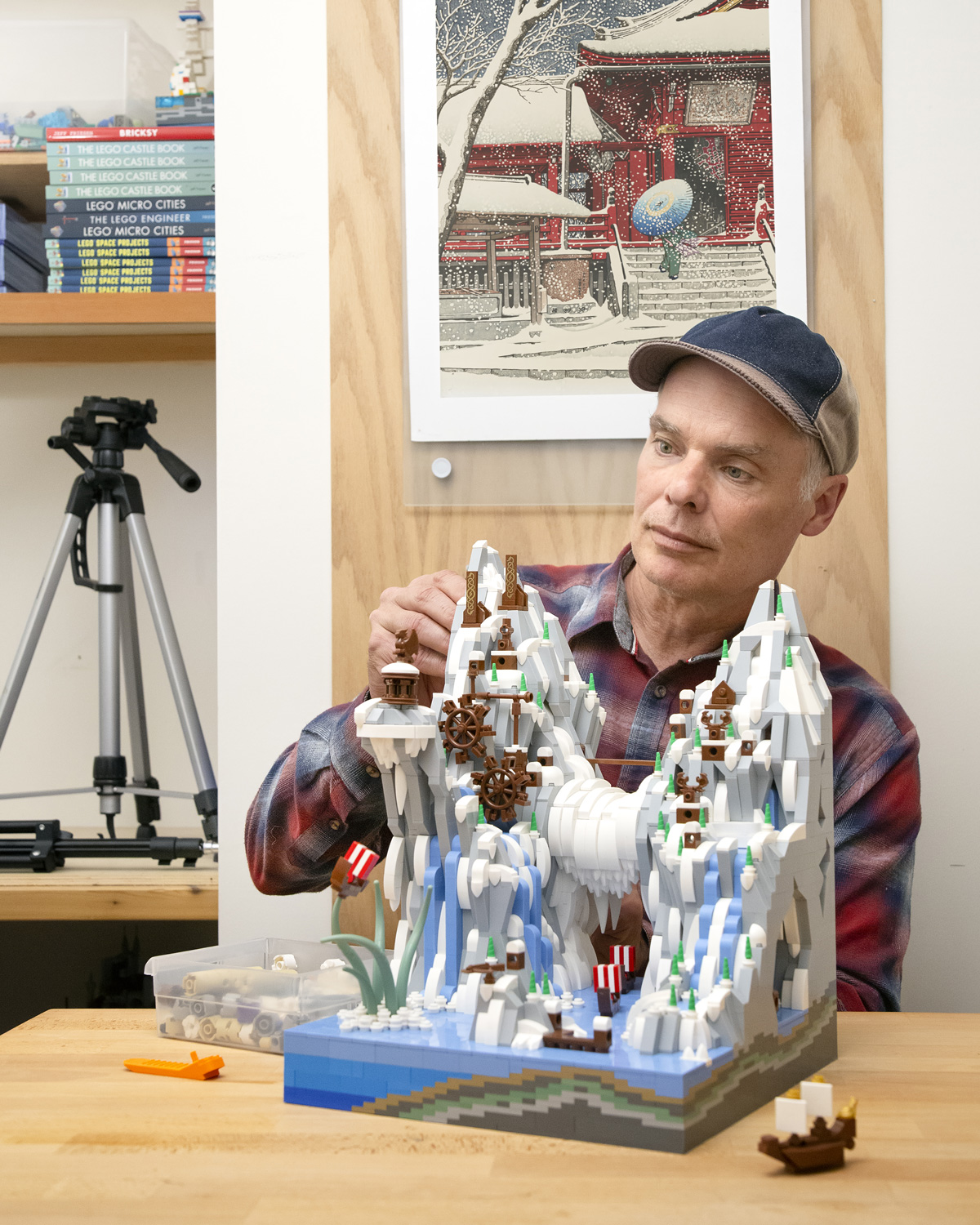
His Viking village marks a turn toward larger scale. Snow-capped peaks rise over a fjord, striped red sails cluster at the waterline, waterwheels churn against the icy rock, a dragon perched atop a domed rotunda watching over it all. Where most of his microscale scenes are built to be perfect on a screen, the landscape and village have real presence — bigger and denser, rewarding proximity over the scroll. It feels like an actual world that wants you to visit. It’s a scale Jeff is building toward deliberately — with an eye on future in-person exhibitions of his work.
Building Worlds
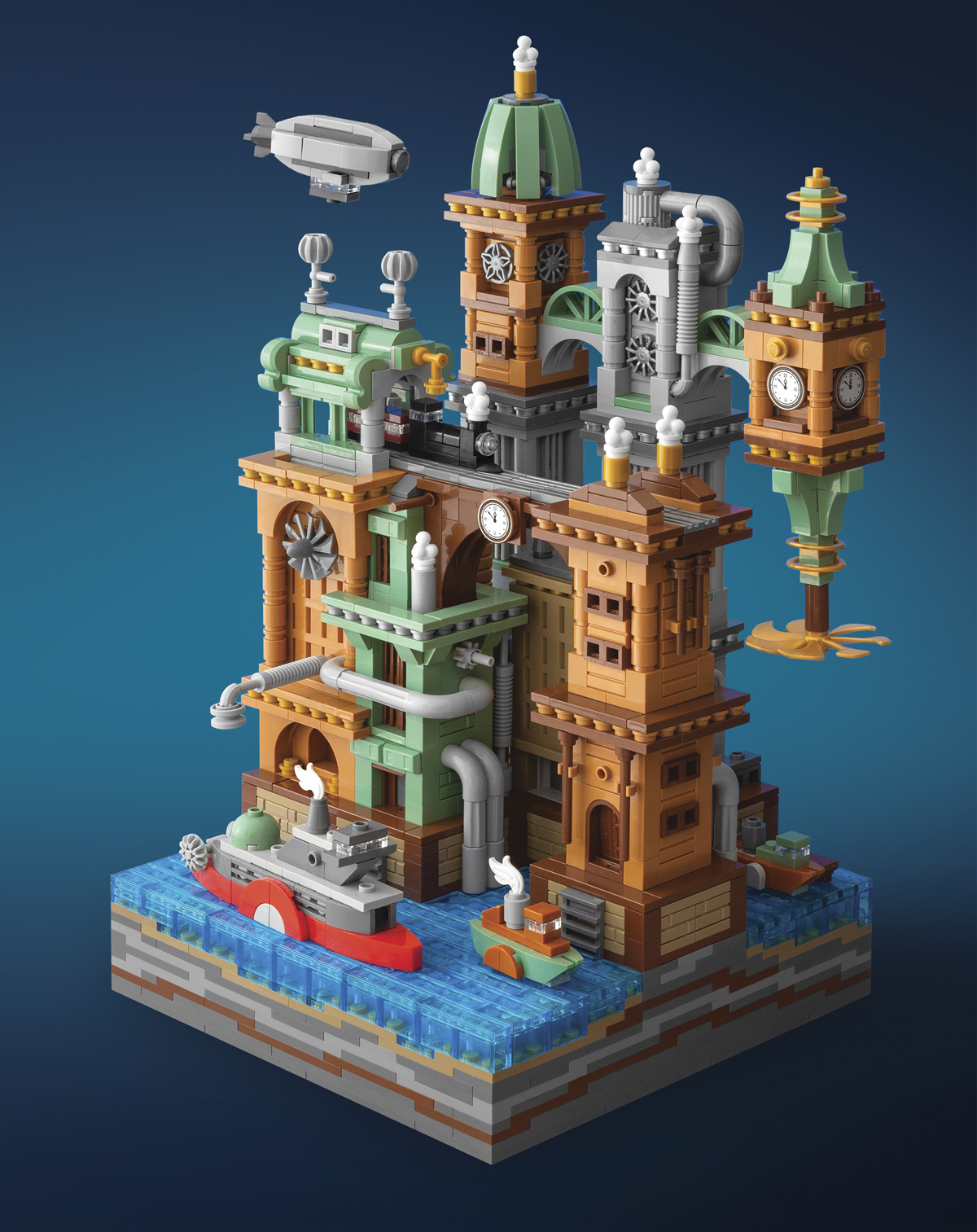
Jeff begins his work on a new world by looking at individual LEGO elements. “My way of building is to look at parts,” he says. “On BrickLink, looking at parts — and imagining how they could be used. Sometimes there’ll be one seed part, and I’ll think, I can build this cool clock, and then it leads to a steampunk city.”
It means his rough drafts require ordering elements from the far corners of the globe and waiting for them to arrive, so he always keeps at least two builds going at once — while one waits on a shipment, the other is in his hands. He’s convinced the inefficiency is part of the method: the time spent sifting through bricks is when the problems solve themselves. “Often when you’re concentrating on something besides your main creative problem,” he says, “that problem can resolve itself.” He thinks by building, the same way he did as a kid, letting the bricks push the idea somewhere he couldn’t have planned in advance.
Constraint, for Jeff, is the spark rather than the enemy of imagination. “Constraints encourage creativity,” he says. “LEGO the ultimate example of that.” He imposes more than the system requires — whole cities in just a handful of colors, a Viking great hall rendered by a single one-by-two Technic brick with a hole in the front. “It’s distilling everything to its essence,” he says. “Almost as simple as you can make it.”
You Can Make Worlds, Too
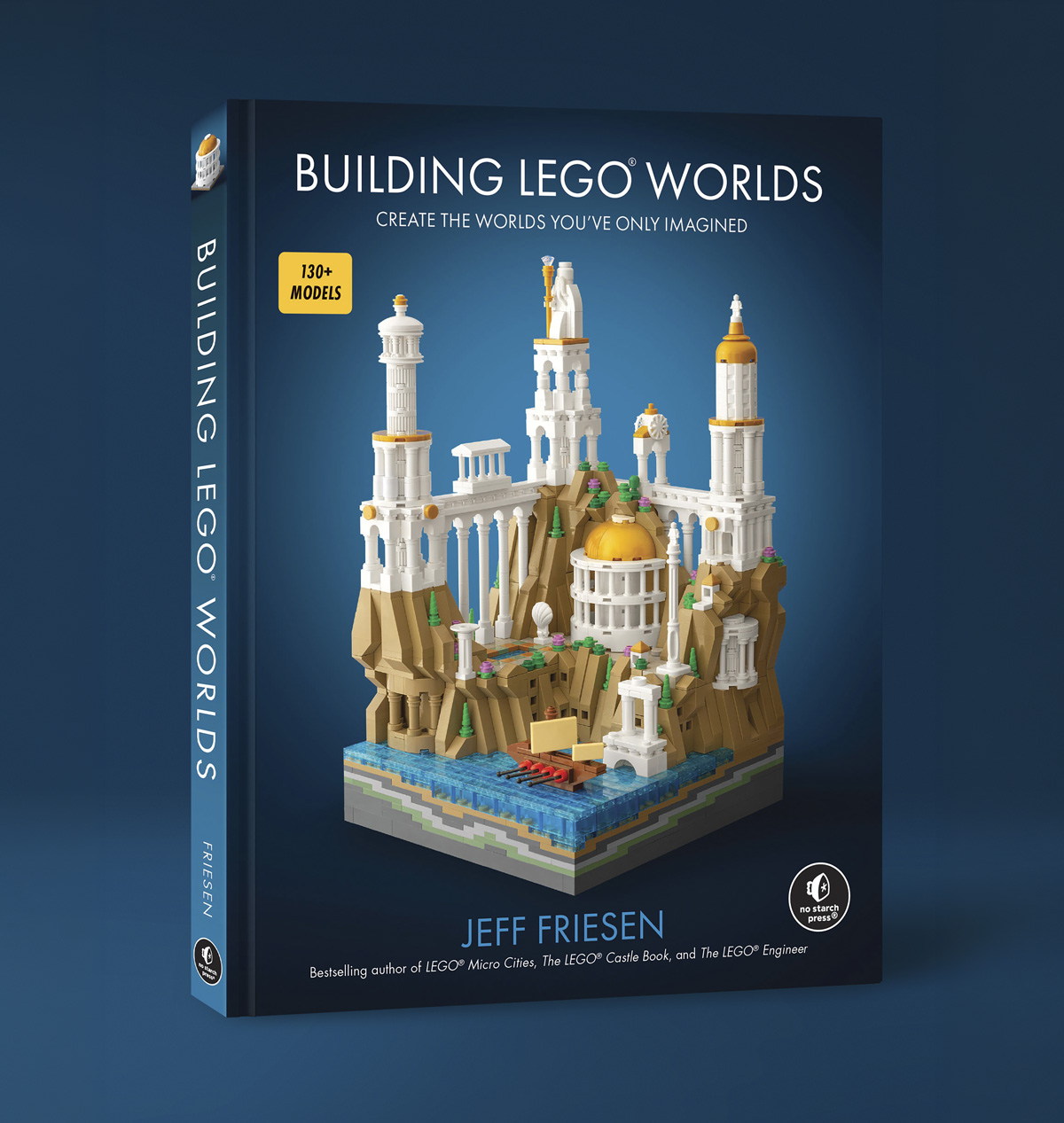
For all the craft he pours into his own creations and images, Jeff is unusually generous with the how. He’s the author of a shelf’s worth of LEGO-focused books, and he’s clear about why the format matters more to him than gallery walls. “For a photographer, books are the ultimate goal,” he says. “Exhibitions come and go, but books, collected in libraries, give an impression of permanence.” He calls his latest book — his seventh — his magnum opus: Building LEGO Worlds, a complete course in microscale worldmaking with some 130 models that plug and play like the system itself. “If I didn’t make any other books,” he says, “this is the book that I want to be out there.”
The books exist to hand people the tools and then get out of the way. He wants readers building their own cities, their own castles, their own impossible hopeful futures, and feeling while they do it the thing he’s really after: that sense of childlike exploration, a world opening up with room to wander. It’s the same permission he gave himself as a boy clicking two-by-fours into ferries and fleets of planes: no matter the scale, build something vast, and see where it takes you.