


Photography by Fletcher Wold
The bar was dark — the kind of darkness built for sound rather than sight. Music pushed through the room in waves, bodies packed close, conversations stitched together between songs. JacQueline Sanchez stood at the bar wearing a ring she had made for herself — a LEGO brick set with a diamond.
Someone leaned in closer. Another person squinted, then smiled. In the low light, strangers began asking the same question: Is that a LEGO? Is that… a diamond?
Discovering the Craft
Sanchez grew up on Long Island with parents who supported whatever creative interest appeared — buying a camera, paying for classes, making space for exploration. “We didn’t really have much money, but somehow I was spoiled in all the right ways,” she remembers fondly.
Her high school allowed students to pursue a major and a minor, and she chose art as her secondary track. Photography. Ceramics. Painting. Each was engaging, each enjoyable, but none settled into place. Making was present, but the medium hadn’t arrived yet.
That changed in her final year, almost accidentally. She needed one more art class to graduate. Jewelry was the only option left. She wasn’t interested, but she signed up anyway.
The shift was immediate. The class was more about learning how metal behaves rather than learning decoration. Wood, brass, form, pressure. Sometimes the projects weren’t even wearable — objects built to understand movement, tension, and control. She fell hard for the process. “I instantly fell in love,” Sanchez recalls.
There's more! Continue reading this article by subscribing to BRICKA.
There's more! Continue reading this article by subscribing to BRICKA.
Around the same time, a school trip brought her into a New York City studio to meet a glass artist. What stayed with her was the atmosphere. The artist was fully immersed, generous with time, animated by the chance to share his work with a group of students who had interrupted his day. “That was the moment when I said to myself, ‘this is what I want to do.’”
Formal Training
When Sanchez began looking for formal training, she tested the expected path first. A summer program at the Fashion Institute of Technology in New York confirmed what she already suspected: the work there leaned conceptual, expressive, and broad. She wanted something narrower, sharper, and more technical.
That search took her to Paris — Paris, Texas that is — to the Texas Institute of Jewelry Technology; far from Long Island, far from the art-school mythology she’d imagined. The town was small and dry. MTV was banned. And the program was relentless. Every semester focused on a different core skill: sawing, casting, stone setting, gold, and platinum. “It was really intense — nine to three every day at the bench.” Lines had to be straight. Surfaces clean. Tolerances exact. Everything was examined, and everything mattered.
Sanchez gained proficiency and confidence, expressed in deep knowledge of the materials and muscle memory. After school, she entered the professional jewelry world the way many bench jewelers do: one shop at a time. She worked alongside older craftsmen, absorbing techniques, habits, and expectations. The environment was demanding — Sanchez describes it as, “so stressful and horrible.” It was often hierarchical and not especially welcoming to women. Still, she learned.
Her last major role was managing a corporate shop for Jared Jewelers. The position offered stability and resources, but the stress was constant. The pressure to perform, to manage personalities, to assert authority in rooms where she was routinely dismissed, took its toll.
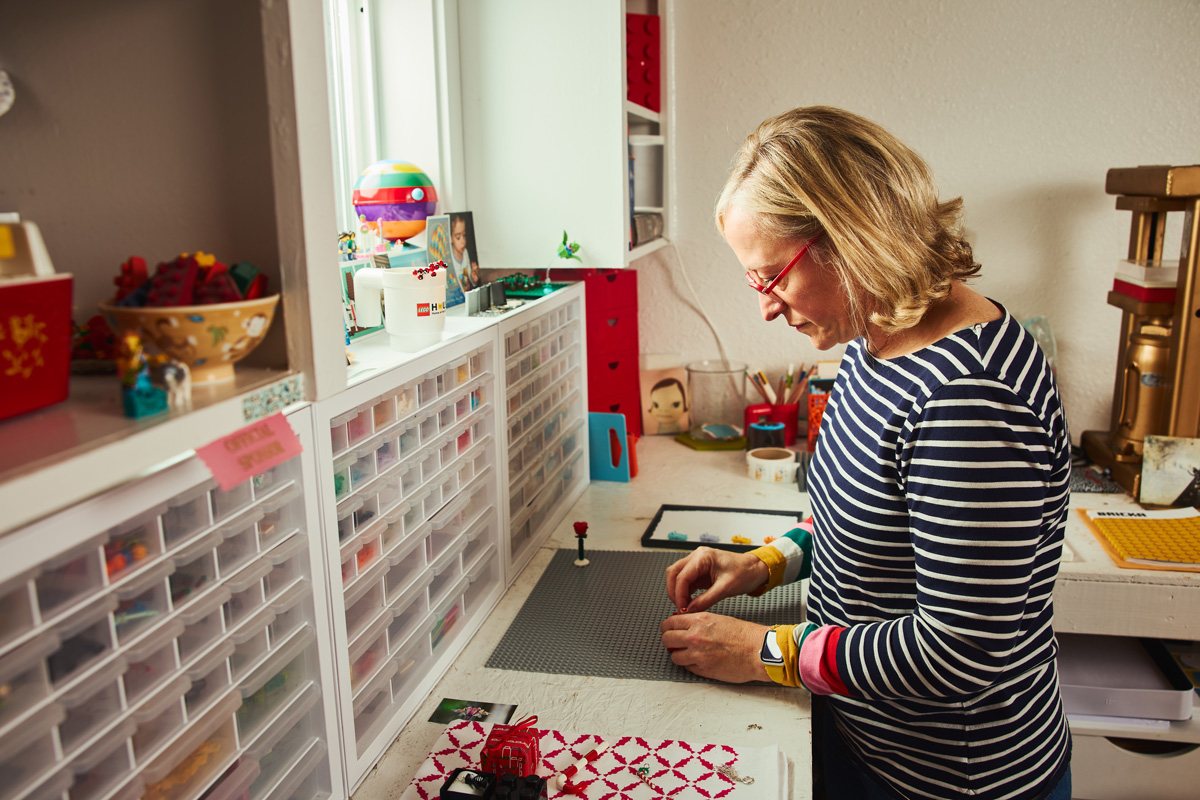
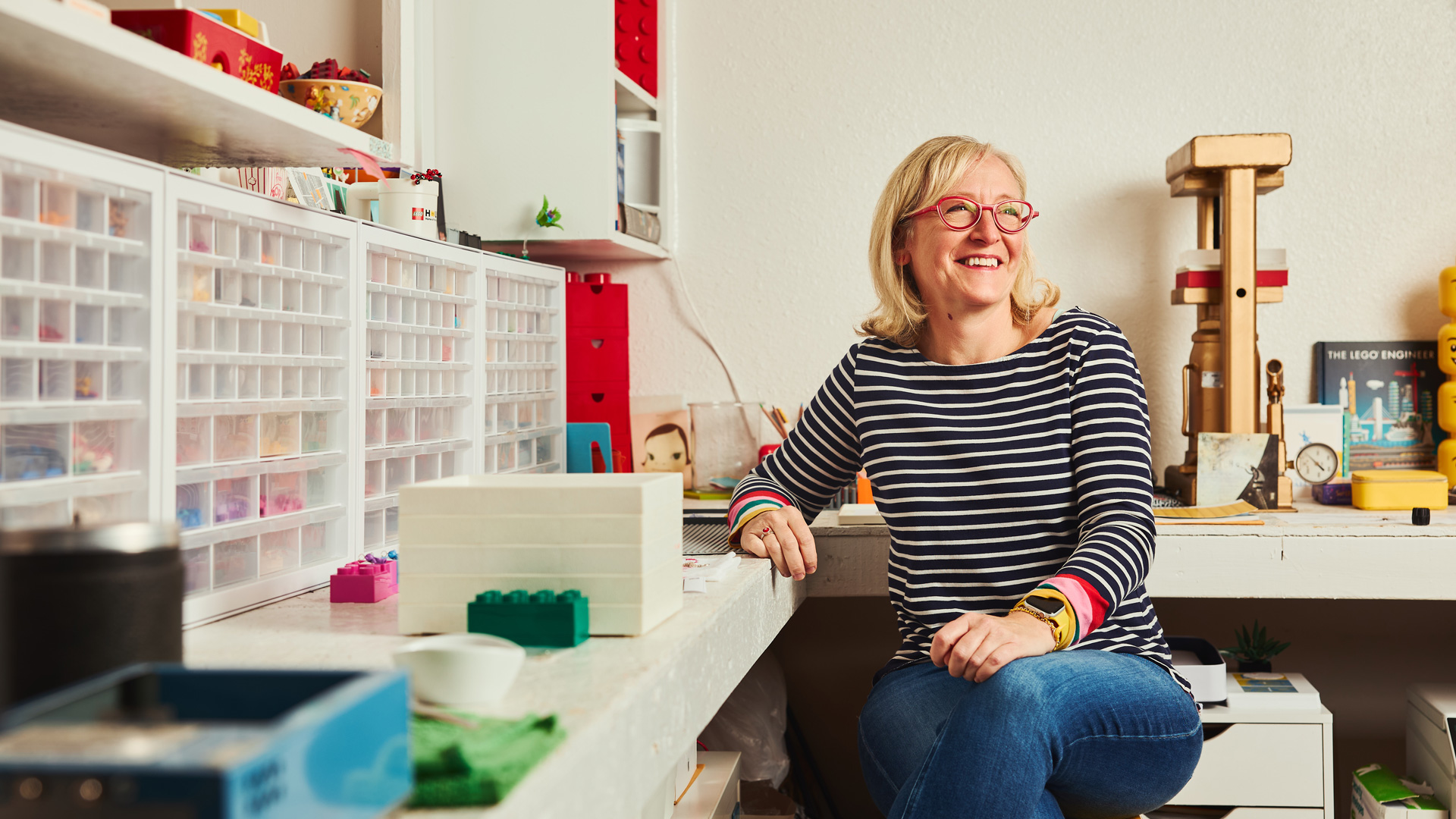
Over time, she saved enough to begin building her own studio — she accumulated tools piece by piece. On the side, she took custom commissions: engagement rings, wedding bands — work that required both technical fluency and emotional sensitivity.
A fellow jeweler studied Sanchez’s work and offered a critique. She told Sanchez at the time, “I love your skills, you have the craftsmanship, but look at it this way: you may have been the valedictorian before, but now you’re a valedictorian amongst valedictorians. You have to push the envelope.” The critique clarified for Sanchez something she hadn’t yet articulated. At the time, she was experimenting with different techniques but realized, “I wasn’t even wearing my own work. I loved it, and it came alive on people, but I wasn’t having fun.”
The Toys “R” Us Material
What Sanchez took away from that advice disguised as critique was that craft alone wouldn’t be the differentiator she was looking for — direction was. She left the corporate world and explored her own unique voice. She wanted to work with color but wasn’t fond of precious stones; she laughs and tells me, “I only like diamonds.” Sanchez began looking for a material that could carry color without the baggage of gemstones and had always wanted to work with plastic — but back then, there was no easy, non-toxic way to process it in a small studio.
She needed a plastic material that already existed in abundance, that didn’t require an elaborate setup or an industrial-scale studio. Something precise, stable, and ready to work.
She hadn’t been in Toys “R” Us in years. Walking through the store triggered a physical response: “Walking in there brought back all these memories.” Memories surfaced without invitation: her father surprising her with a bike. Her mother picking up extra shifts at the toy store during the holidays just to get a discount. And the colors — color was everywhere.
The big yellow LEGO brick packaging stopped her. This could be it. She brought it home and treated the plastic brick the way she would any unfamiliar material. She tested it. Cut it. Sanded it. Drilled into it. The plastic behaved with a consistency she recognized immediately. Edges stayed clean. Surfaces finished evenly.

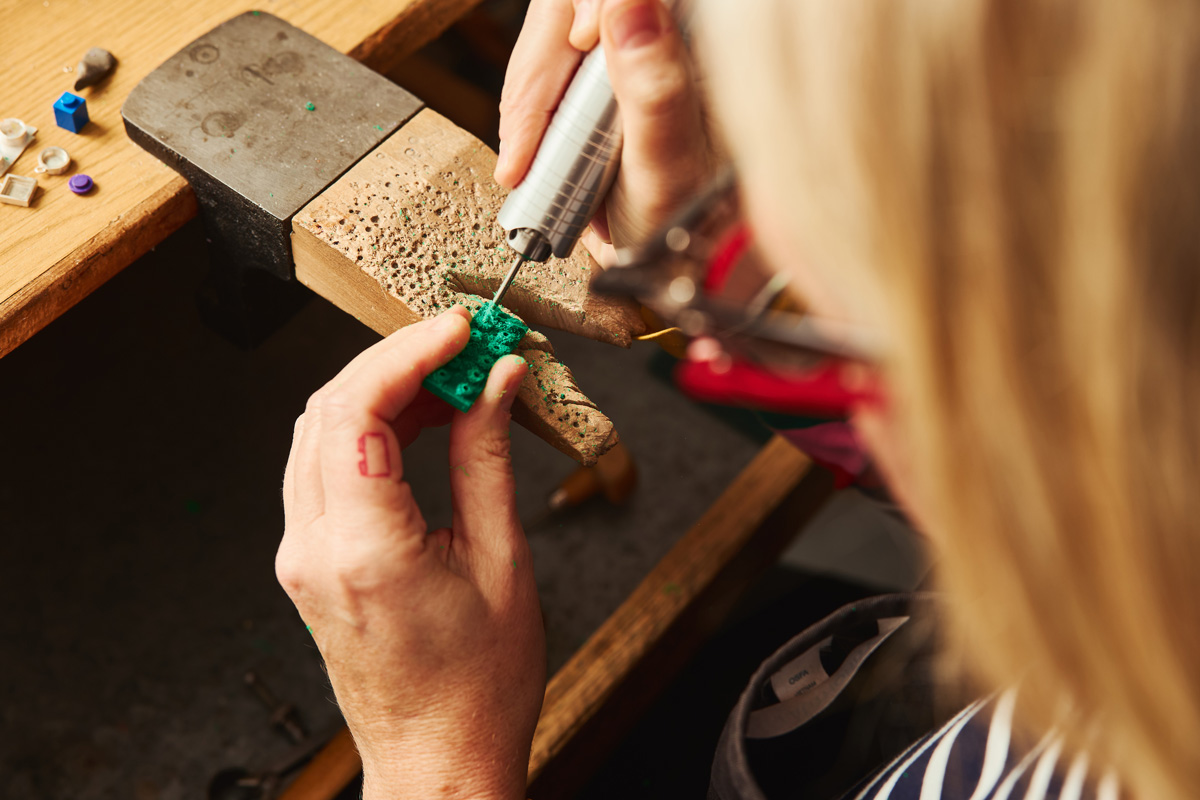
“So I made one ring,” she recalls. “And, of course, I had to put a diamond in it.” The choice felt obvious, almost inevitable. Years later, she would recognize how much was happening in that moment — how nostalgia, material logic, and craft instinct converged. At the time, she was simply following momentum.
The brick had passed the master jewelers’ test. And she was hooked. She began to move beyond testing and experimentation and started to intervene deliberately. She sanded away the LEGO logo. Not because she needed to, but because it disrupted the visual conversation between materials. Gold and silver speak quietly. The stamped mark spoke too loudly.
She sandblasted the surface to remove the toy-like gloss. The matte finish softened the brick, shifting it from object to surface, from plaything to form. What remained was color, geometry, and proportion. And the diamond stayed.
To Sanchez, the stone didn’t elevate the brick. It met it. “Putting a diamond in LEGO actually made sense to me.” LEGO’s precision, consistency, and design discipline earned the pairing.
Over time, she came to think of LEGO the way other jewelers think of precious materials. Not rare, but rigorous. Not delicate, but exact. A material defined by tolerance, repeatability, and intent. Industrial-scale exactness masquerading as a child’s toy.
Meaning in Pieces
Sanchez’s ideas live in her hands first. When she sits down to create a new piece, she doesn’t start with sketches, not as drawings anyway. “I start by moving the metal, I shape it,” she says, “To me, that’s drawing. I make it as I go and alter it.”
Silver becomes a kind of sketch material — forgiving enough to explore without fear, responsive enough to keep pace with intuition. But LEGO introduces a different challenge. The brick offers no forgiveness. “No wiggle room,” as she describes it. Its geometry is exact. Squares are… square. Circles are perfect. There is no visual tolerance for error, no space for approximation. Sanchez learned quickly where hand fabrication made sense and where precision demanded casting. Though she often surprises herself with how she has memorized the dimensions of LEGO at this point in her journey with the material, “I don’t even measure anymore, I can eyeball it,” she shares with some confidence.
If a new line or individual piece feels uncertain, she wears it. Weight, thickness, and proportion must be correct, but what really matters is how it makes her feel. Each piece holds that trace of her decision-making, and each surface remembers the hand that shaped it.
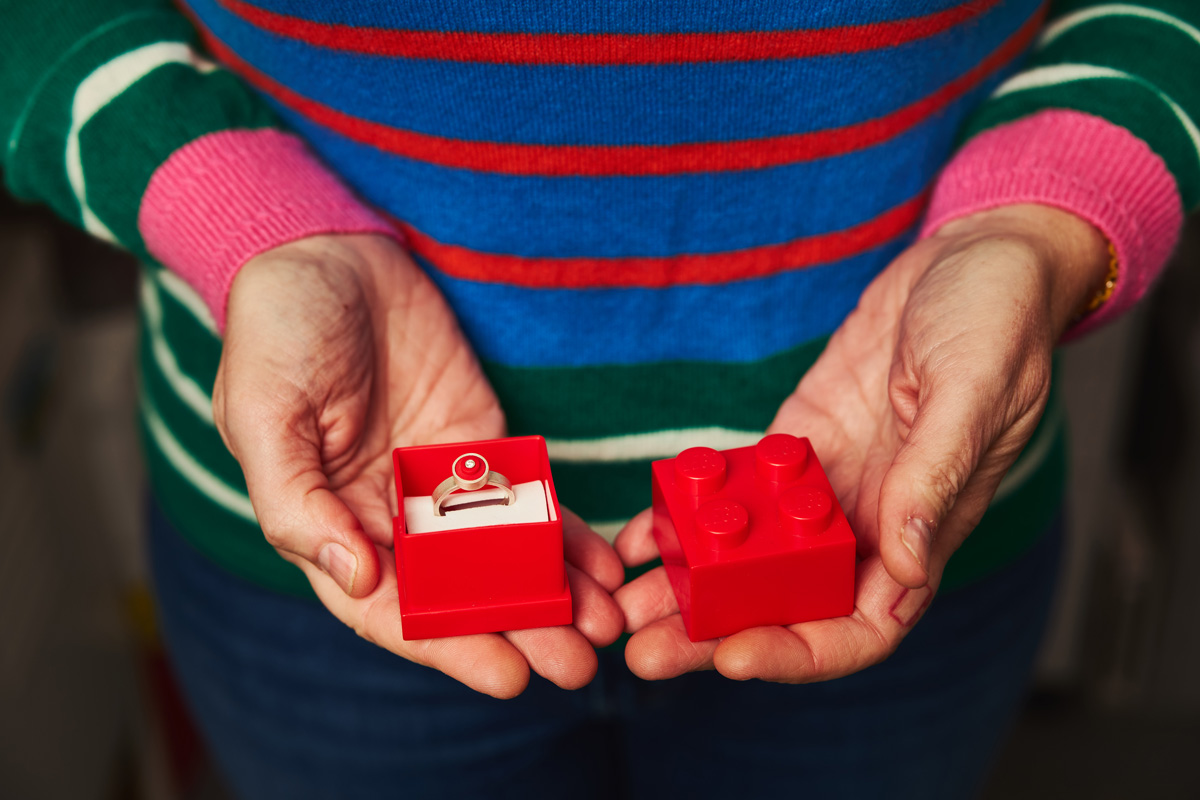
JacQueline’s work also helps those who wear it reminisce. Stories usually follow. Conversations begin. The piece does its quiet work long before anyone asks where it came from.
Take the Dot & Diamond Ring. A single LEGO stud, softened to a matte finish, nested into sterling silver, the stud holding a diamond in its center. It’s compact, deliberate, and immediately legible. The color reads first — bold, graphic, unmistakable. Then the eye catches the stone. Not oversized. Not showy. Just enough light to change the meaning of the brick beneath it. The ring invites recognition — the moment someone notices it, they already know something about the person wearing it, not unlike that first ring she wore to the concert.
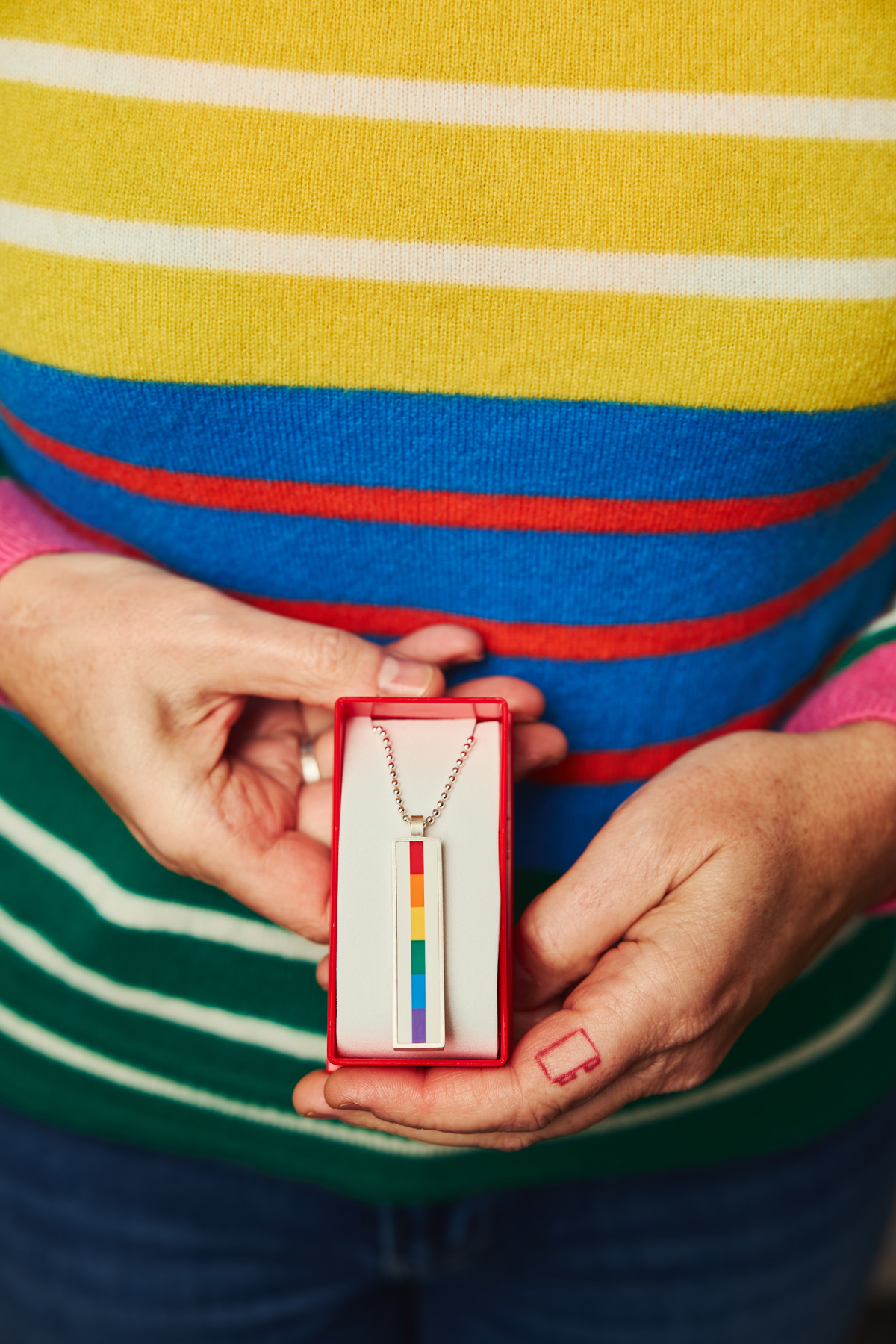
The Linear Rainbow Pendant stretches that recognition into a vertical rhythm. A 1×5 column of the color spectrum — red through violet — set cleanly into silver, hanging with the weight and restraint of a modernist pendant. From a distance, it reads as pure color and proportion. Up close, the 1x1 LEGO plates reveal themselves.
Some of the most emotionally charged pieces emerge from collaboration. One rainbow pendant began as a commission from a client who wanted to mark a hard-won marriage — years of struggle, laws changing, love finally recognized. Later, after the client passed away, the piece took on another role. “That piece means even more now… every time I make one, it’s really in memory of him.”
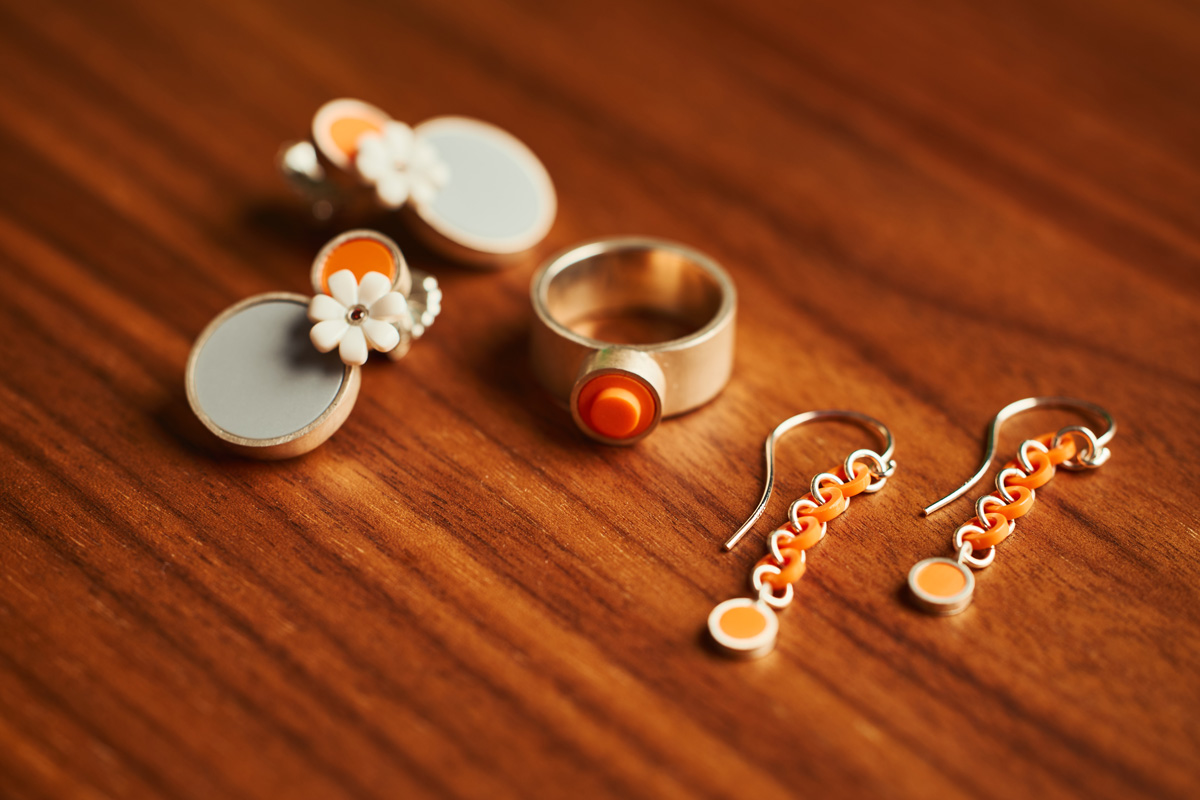

Other pieces carry joy more lightly, without losing intention. The colorful Cascade Link Earrings feel kinetic even at rest — small circular elements linked in sequence, each one a stud, precisely cut and drilled to form a ring, and finished by hand. The stud rings and silver links alternate to connect and sway when worn, catching light along their edges, the color doing what plastic does best: staying vivid. They’re playful without being precious, balanced without feeling restrained. When JacQueline talks about wanting her work to “bring some spark” to an everyday outfit and to “cheer people up”, these are the kind of pieces she means.
“LEGO has completely taught me to play and have fun,” and it’s true; her jewelry is just as fun as it is beautiful. Her Modular Rings are built from multiple studs — greens, blues, soft neutrals — arranged like punctuation marks across silver bands. Each stud is familiar. Together, they feel newly composed. These rings tend to stop LEGO fans in their tracks. That’s the feeling she’s chasing: resonance. She wants the jewelry to live with people — to move through their days, to be noticed and then re-noticed, to spark stories they didn’t expect to tell. As JacQueline puts it, “I really feel like I am transforming memories into wearable art.”
Recognition: LEGO & AFOLs
By the mid-2000s, JacQueline’s work had begun to circulate beyond craft fairs and local shows, where many independent jewelers quietly build careers. She was accepted into prominent art shows, often singled out for her work with a material not meant for jewelry. Reviewers and curators used words such as ‘innovative’ and ‘unexpected’. Audiences leaned in closer.
At the same time, a quiet anxiety followed her. She assumed LEGO would eventually find the work and shut it down. The pieces were clearly made from real bricks. The material was unmistakable, and her reach was growing.
Then, in 2007, an email arrived. “I get this email from LEGO, and I’m like, oh no…” The subject line alone was enough to spike her pulse. LEGO wanted to talk.
What followed wasn’t a legal warning or a request to stop. It was an invitation. She smiles as she shares, “They totally embraced my idea.” LEGO asked Sanchez to participate in what was then called Creation Nation — a campaign designed to show how far the brick could travel beyond the instruction manual. Her jewelry appeared alongside institutions such as NASA and was featured on LEGO’s platforms.
The timing mattered. Blogs were just beginning to function as cultural accelerants. Word traveled fast. Orders began arriving from places she’d never shipped to before. Luxembourg. Across Europe. Across continents.
The arc, as she describes it now, came in waves. A sharp rise. A leveling out. A long stretch of steady making. Another swell building underneath. She was finding her market.
When she relocated to Portland, Oregon, one day she heard an announcement on the radio: a LEGO show was coming to town. “That changed my world,” she recalls.
She tracked down the organizer — Bricks Cascade — and asked about having a booth. The response was a bit skeptical at first, but she got a booth and showed her work at the show. What she found there reframed everything. The AFOL community wasn’t niche in the way she’d imagined. It was dense with engineers, architects, scientists, designers — people who understood tolerances, precision, systems. People who noticed the finish. People who cared how something was made.

Any lingering worry about “cutting LEGO” dissolved almost immediately. The brick wasn’t sacred because it was untouched. It was respected because it was well used. She recognized herself in them. The joy. The obsession. The fluency. “These are my people,” she remembers thinking.
In 2019, JacQueline traveled to Skærbæk Fan Weekend in Denmark, a pilgrimage site for adult LEGO fans. She was invited to have a booth — already a milestone for her — and arrived expecting a good weekend.
As attendees filtered through, people began approaching her table wearing her jewelry. Quietly. Casually. Some had owned the pieces for nearly a decade. Some were LEGO employees, executives, and designers. They hadn’t announced themselves when they purchased the work years earlier. They hadn’t framed it as a corporate gesture. They had simply worn it into meetings, into daily life, and into the culture of the company itself. “That was really empowering.”
Seeing her pieces there, in LEGO’s home country, worn by the people shaping the future of the brick, landed differently than any press or partnership ever could — the most meaningful, genuine support she could ever hope for.
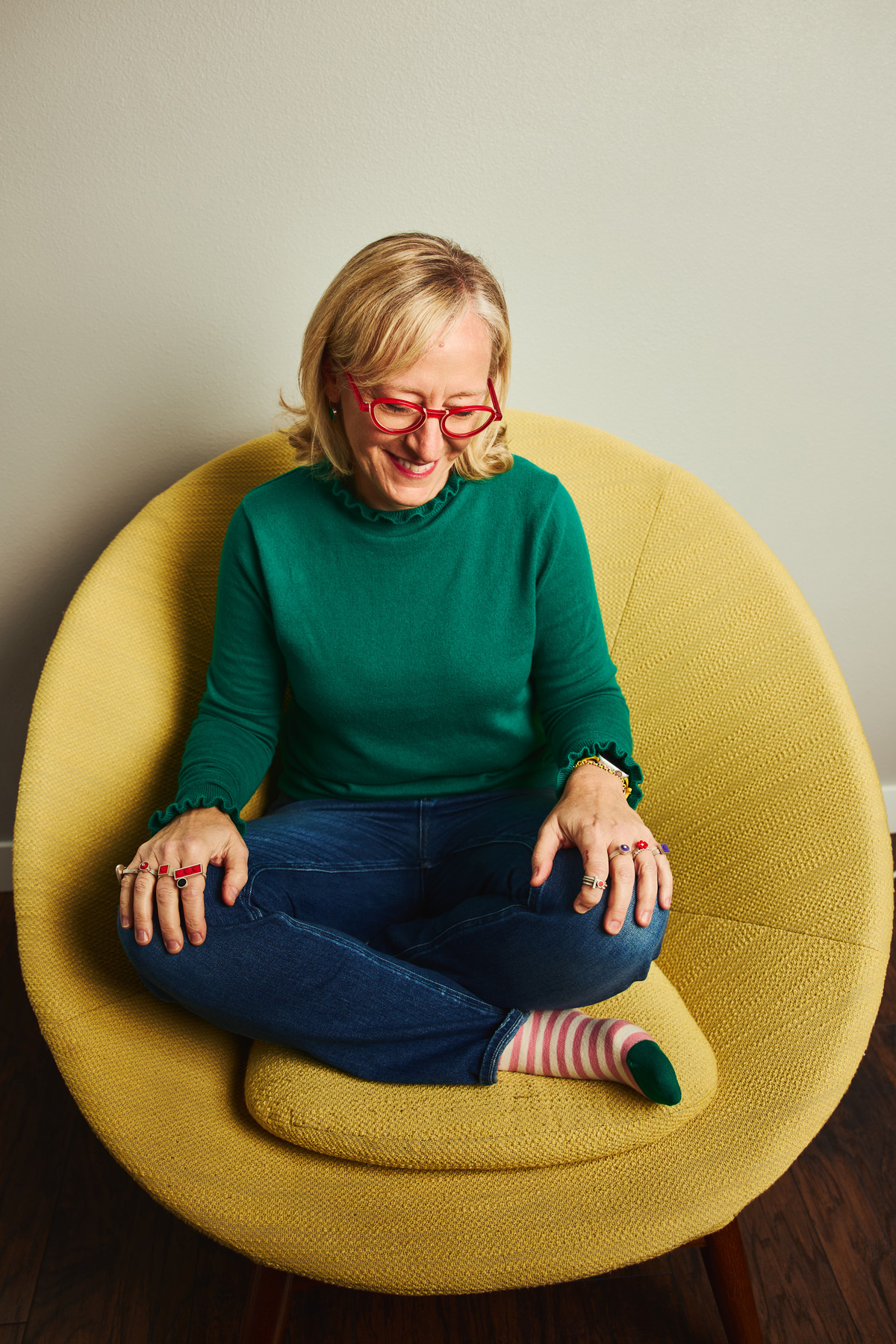
Making Space for Joy
For years, JacQueline’s work in traditional jewelry came with an audience. Customers would watch through the glass as she set diamonds — sometimes out of fascination, sometimes out of concern for their investment. Every movement carried pressure. Every decision had to be perfect. LEGO changed the emotional temperature of her practice.
“I never realized that I could have fun doing what I was doing. So it’s just such a gift.” She’s grateful to the brick for bringing play back into the studio. It softened the stakes without lowering the standards. Precision remained essential, but joy returned to the process. The work became something she could enter without bracing herself — she could actually… be herself.
That doesn’t mean ambition disappeared. She still dreams in diamonds. She still sees techniques she wants to master and continues to grow as a small business owner.
LEGO bricks and diamonds come from opposite worlds, but in JacQueline’s work, they meet with surprising ease — precision answering play, permanence answering joy. When asked what advice she’d give to artists working in unconventional ways, her answer is immediate. “Don’t give up. And don’t let anybody tell you you’re crazy.”