


Photography by Adam Ragan
The first time I saw Luke Doell’s castles, I thought of the creek in the woods behind my childhood home. The forest seemed to go on forever. Down Walnut Creek to Buttermilk Falls. We’d spend whole afternoons hauling sticks, stacking rocks, and digging channels in the mud that we called moats. We built forts and castles out of sticks — those woods were our kingdom.
We couldn’t be outside all the time, of course. And on those days — the rainy ones, the sick days, the deep winter afternoons — I’d bring it inside. LEGO castle sets on the floor of my basement, building the same world in miniature. The drawbridge, the tower, the knights arranged in permanent standoff. I’d narrate the story in my head as I built, but the bricks were always a half-step behind the imagination.
Luke’s castles contain exactly what I couldn’t build as a kid. The vines are there. The waterfall is there. The moss and the age and the feeling that something important happened here, and might again. Looking at his builds, I felt something I can only describe as recognition of my childhood wonder.
The Ravine Kid
Luke grew up in British Columbia, in the kind of landscape that allows a child’s imagination to thrive — lush, coastal, forested, with mountains visible in every direction and a ravine behind the house that functioned as an entire other world. He and his brother built Ewok villages in the trees, rope bridges between them, and trails through the undergrowth. They had tools borrowed from their father with one condition: bring them back.
“It was the absolute best,” he says of those years. “The ravine was our world. We would disappear for hours and play and build every free chance we had.”
There's more! Continue reading this article by subscribing to BRICKA.
There's more! Continue reading this article by subscribing to BRICKA.
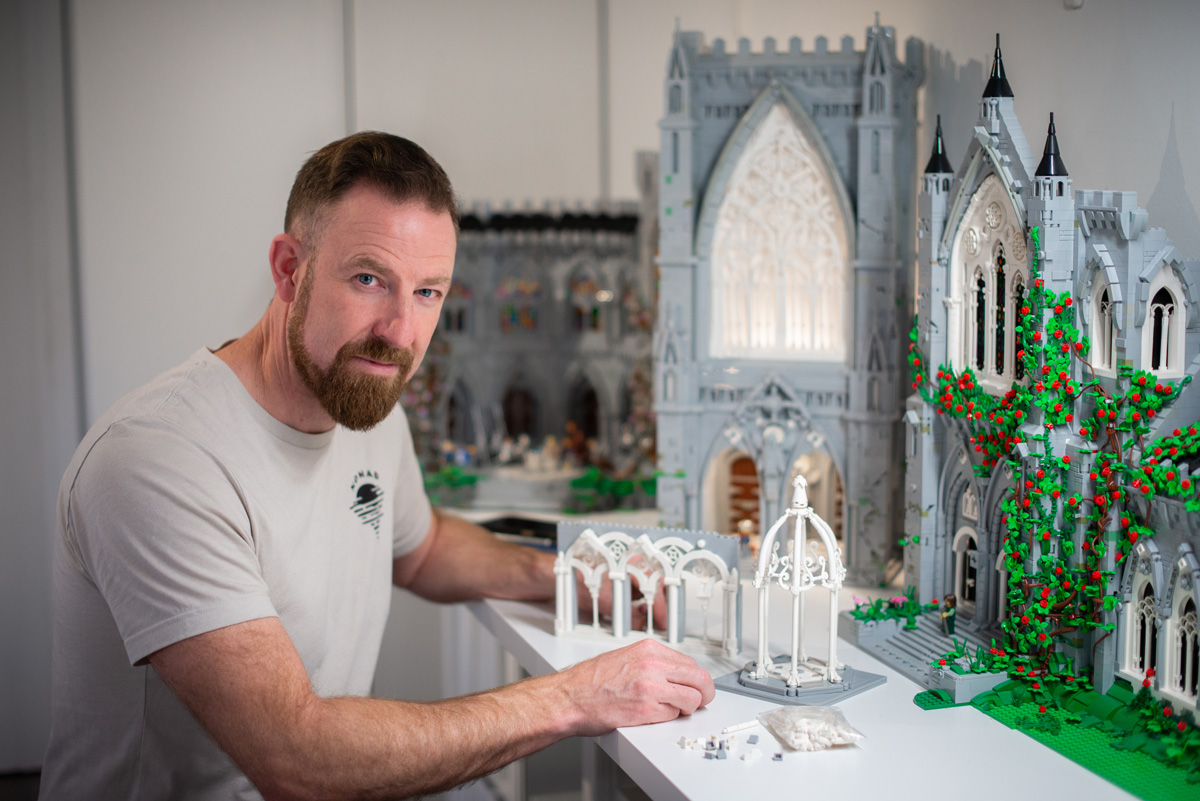
His mother was an artist, and eventually his art teacher in high school, which meant the creative impulse was both inherited and cultivated. By third grade he was known as the kid in class who could draw, and was often asked to draw pictures for his classmates. But it wasn’t formal art that captured him — it was illustrated storybooks, fantasy films, the specific pleasure of seeing a world rendered with full commitment. He grew up checking illustrated books about castles and cathedrals out of the library. Not to study architecture — he never wanted to be an architect — but because he loved the look of them. The verticality. The detail. The sense that someone had cared enormously about a single stone arch.
Robin Hood: Prince of Thieves gave him the rope bridges. Lord of the Rings gave him everything else. “A lot of what we created was me trying to create a fantastical experience,” he says. “Not just being in my own time, but imagining being elsewhere.”
He chose Playmobil over LEGO as a kid — not because he didn’t love bricks, but because money was limited and he had to choose. He’d go well beyond playing with the figures themselves, constructing dioramas with found materials, sourcing things from outside to make the scenes feel real.
A Long Way Back to the Table
After high school came university in North Vancouver — a degree in graphic design and illustration that taught him how to make things and how to work with clients, write briefs, and run a business. He came out of school ready to be self-employed, and largely has been ever since. A career built from creative positions that often didn’t exist until he made them. Eventually, Wild Outdoors Club, his own apparel brand rooted in skateboarding culture and the outdoor life he’s always lived.
Then came COVID, the couch, the endless scrolling. “I was getting really over it,” he remembers. “I’m like, this can’t be how I’m spending my time. Just not being creative, scrolling through a feed that’s not producing anything.” He discovered LEGO Masters — expecting that it would be about children — and realized it wasn’t. He drove to his parents’ house, went through their storage, found a bin of old bricks, and brought them home.
Within minutes of opening the bin, he could already see what it could become. It wasn’t enough. He went on Facebook Marketplace, started buying other people’s collections, accumulating raw material for visions that had already formed. He bought no sets. “Everything I have is my own work,” he says. “My interest isn’t to have the sets. I want to create stuff.”
He built for three years before showing anyone. Entirely self-taught, in the evenings, for no audience, for the love of it. Then, in March 2025, the first Instagram post from Doell as Cathedral of Bricks. The caption says it all, “It’s never too late to enter the world of Lego. Let’s create!”
The Isle of Solace
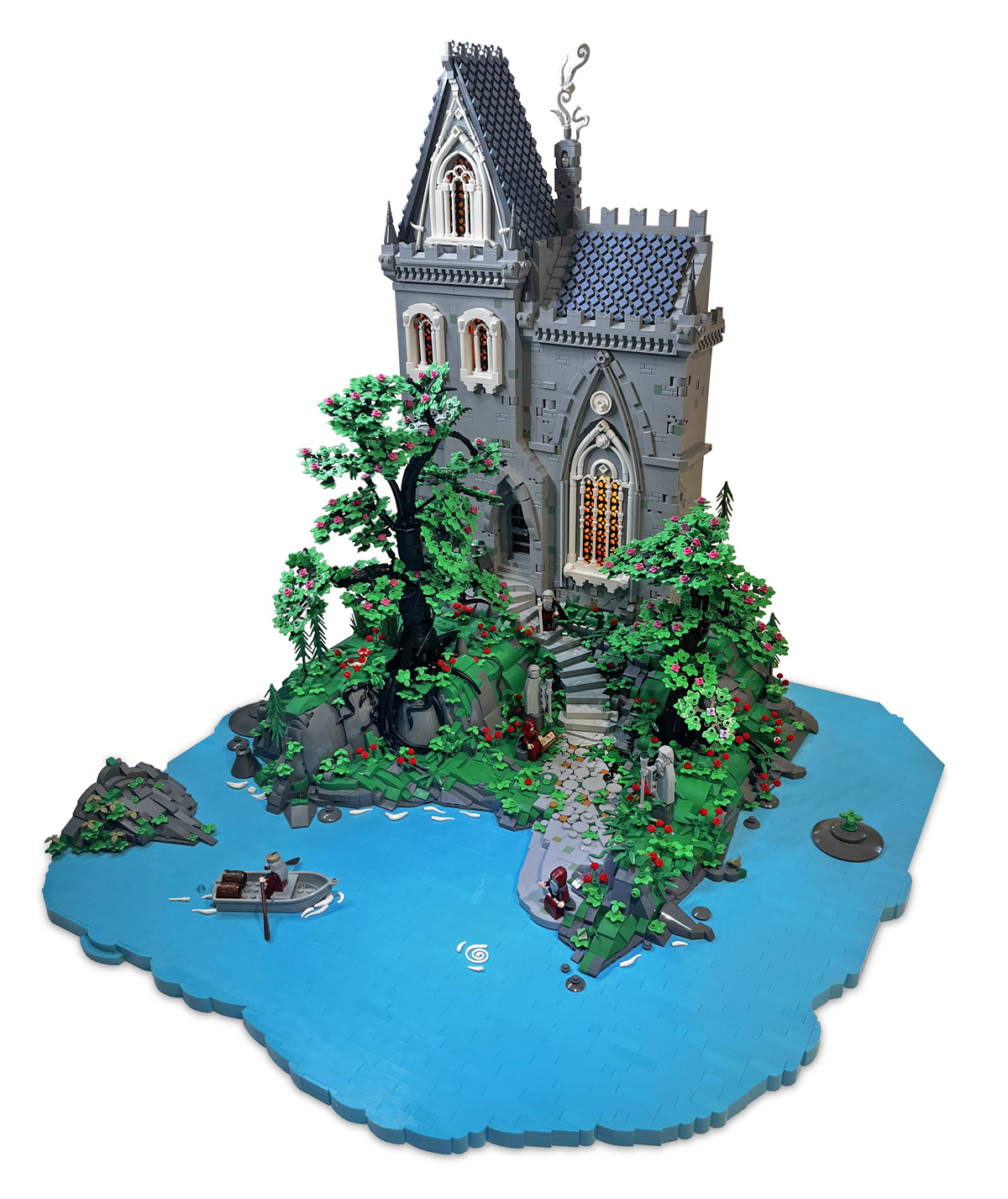
Doell’s Isle of Solace embodies his approach to structures and foliage that feel cinematic: the gothic chapel rises from a small island, surrounded entirely by water, approached by a single rowboat.
The chapel itself is all grey stone and pointed spires, with stained glass windows that glow a rich amber within the arched frames. But what makes the piece is what surrounds the architecture: dense, almost overwhelming foliage, layered tree canopies with leaves and flowers in red and pink climbing the walls and the trees, black-barked twisted trunks reaching up alongside the stonework like they’re competing with it.
The trees in this piece use an unexpected technique — LEGO rubber tires repurposed as organic texture, stacked and arranged to simulate bark, branches, and volume. He had accumulated bins of wheels and tires from Marketplace hauls with no obvious application. Castle builders don’t need wheels. “What am I gonna do with all these?” he thought. Then: a tree. The tires give the trunks a dimensionality — a roughness and density — that standard LEGO tree elements rarely achieve. He built the tree, and once he had a convincing tree, the island needed to exist beneath it. And once there was an island, a castle naturally followed.
The Arch Holds Everything
“If you put a kid with paper and crayons and say, ‘Draw me a house,’ you know exactly what they’ll draw,” he says. “Straight walls, angled roof. Rigid shapes.”
In Luke’s hands, train track rail sections are repurposed as gradual curves. Rubber tubing is bent to create internal tension. Foliage is layered to soften every hard edge the system wants to force.
He doesn’t call any of this illegal building. He finds the term counterproductive. “I think you should be creative, and rules kind of stifle that,” he says, though he’s equally clear that breaking bricks is not the goal — he wants the system to bend, not break. A tire is a tire until it’s bark. A rail curve is a track until it’s an arch.
He draws a connection to the builders of actual Gothic cathedrals — craftsmen who created structures we still don’t fully understand, whose techniques died with them. “People couldn’t duplicate them now,” he says. “I saw a documentary about Notre Dame, about trying to repair the ceiling after it collapsed. They couldn’t understand how it was built.” He wants to hold onto the kind of making that requires patience and care, and the willingness to work on something longer than anyone expects you to.
The Fellowship
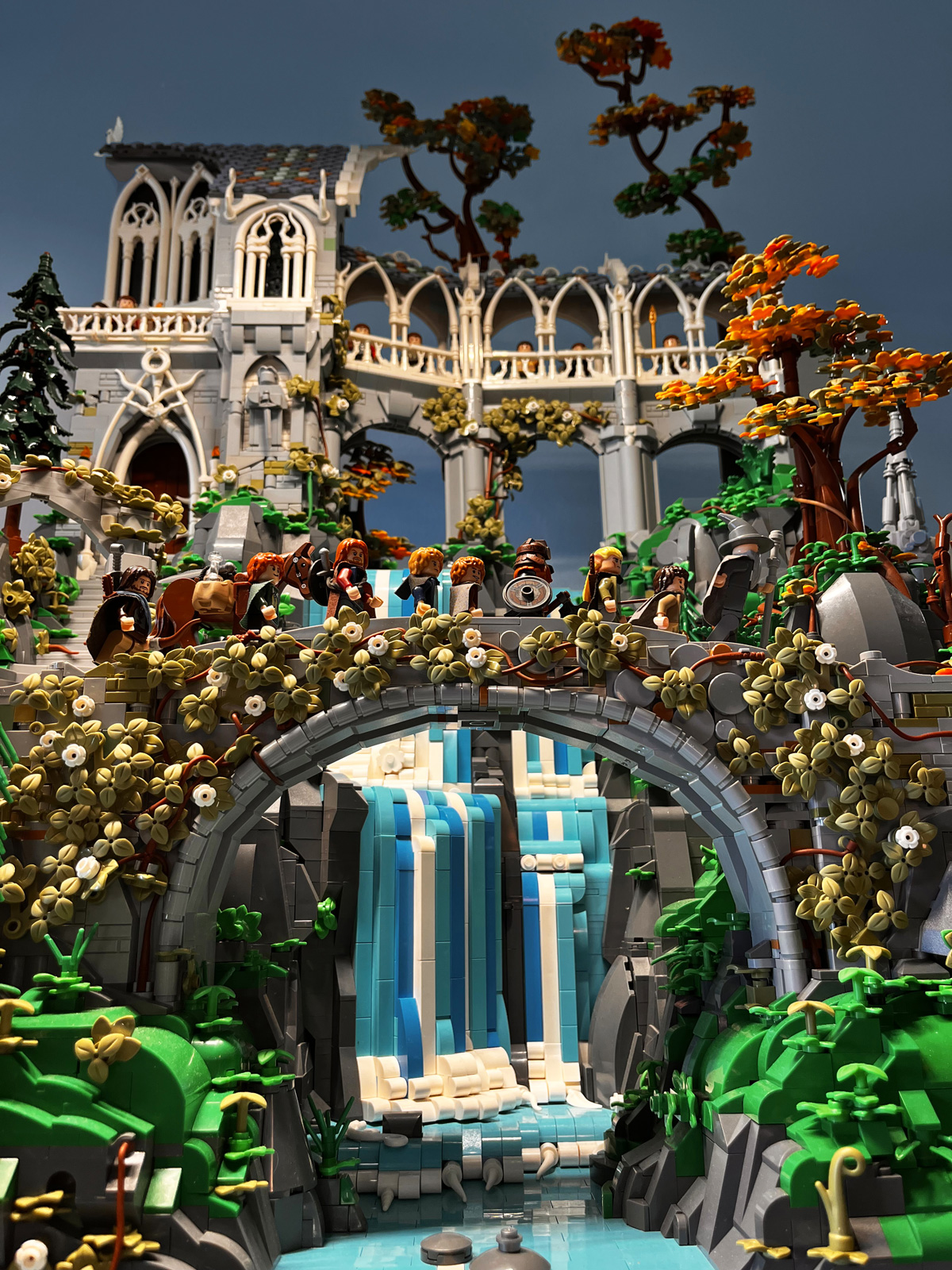
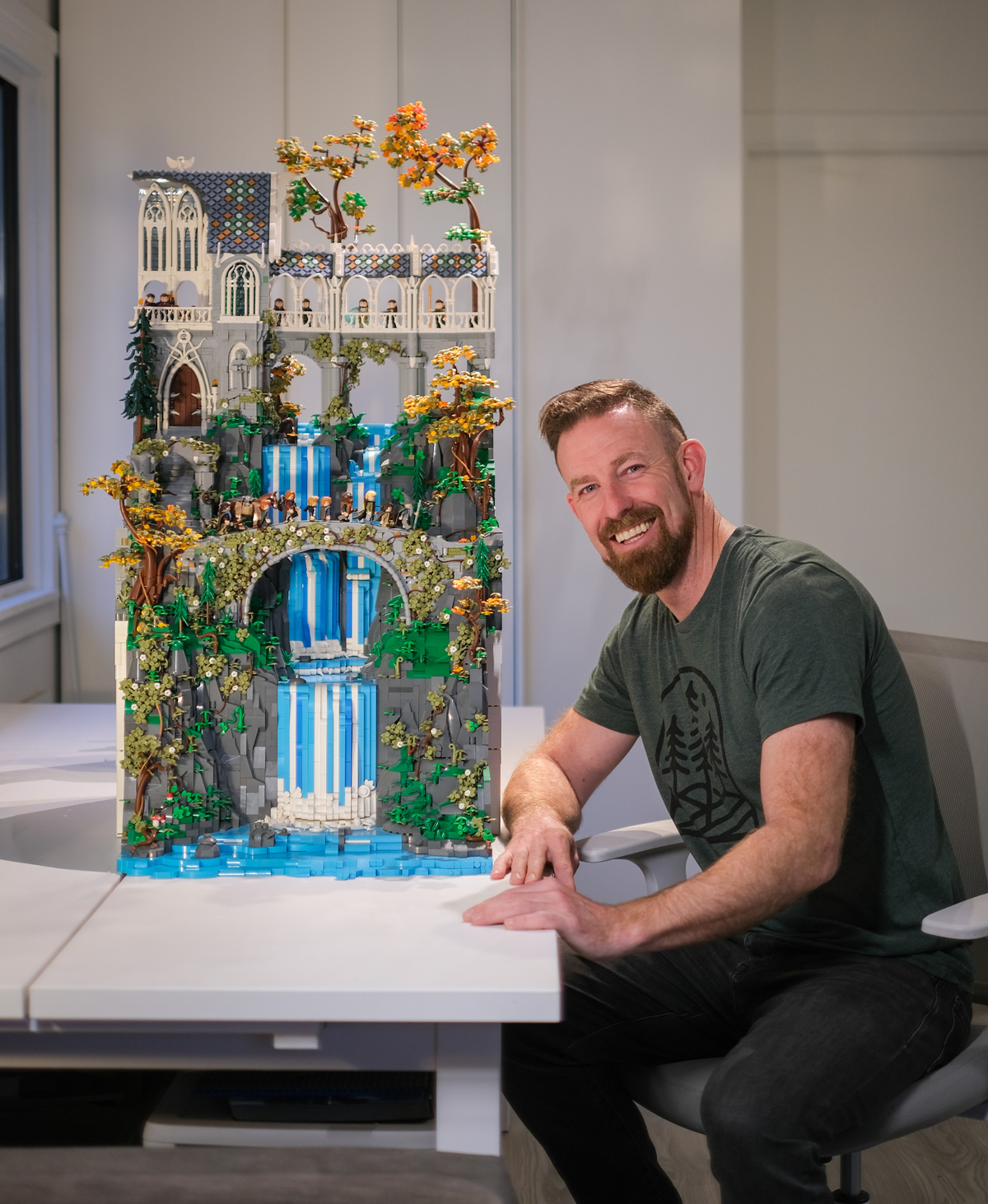
The build that changed everything for Luke started as water. He wasn’t making a Lord of the Rings tribute. He wasn’t even trying to build a castle. He was making a waterfall — just trying to solve the problem of how to render falling water in brick without defaulting to the standard clear-translucent-blue approach everyone uses. He wanted contrast. He wanted the crash and foam of real water, the darkness at depth, and the white at the surface. He layered opaque blues with white bricks, building a kind of visual rhythm that reads as movement.
Once he had the waterfall, it needed a bridge. Once there was a bridge, someone had to be crossing it. He thought of the Fellowship leaving Rivendell, and suddenly the whole thing developed into something enormous. The elven architecture climbed above the falls: white columns, Gothic arches with pointed peaks, balustrades fine enough to make you question whether they can possibly be LEGO, autumn trees in gold and orange leaning over the terraces like something from a Tolkien illustration. The falls cascade in three distinct drops, each framed by overhanging rock and layered vegetation, finally pooling at the base in still blue water reflecting the sky.
The community’s response to The Fellowship caught Luke completely off guard. For the first time, he saw his work differently — as art. It spurred him to push his builds further. His skills had caught up with his imagination.
Castle Craftsmanship
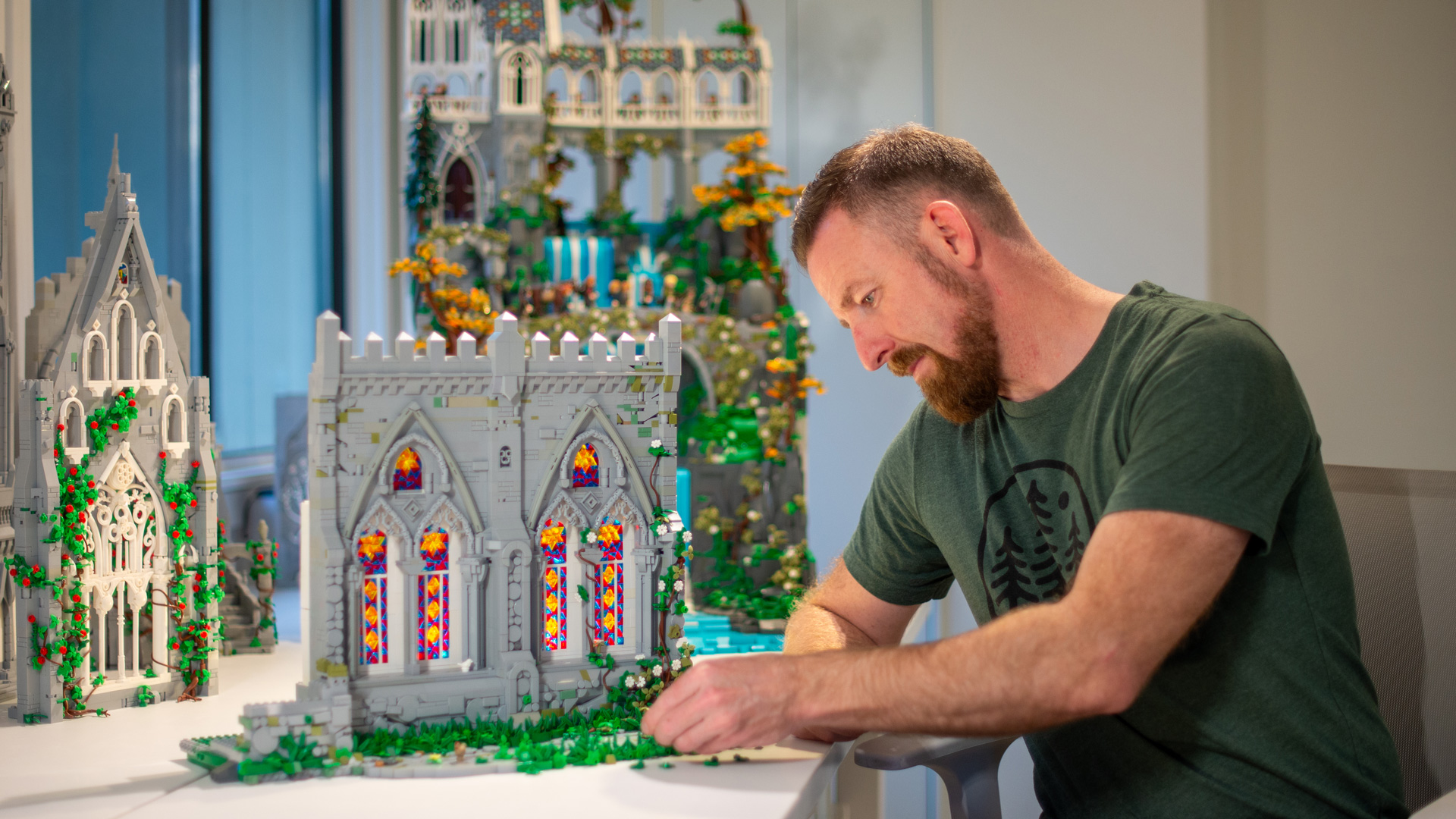
His pieces can take months to build. He’s in no rush. He wants to get them right — at times spending weeks to get a stained glass window perfect, before duplicating it across the span of a stone wall.
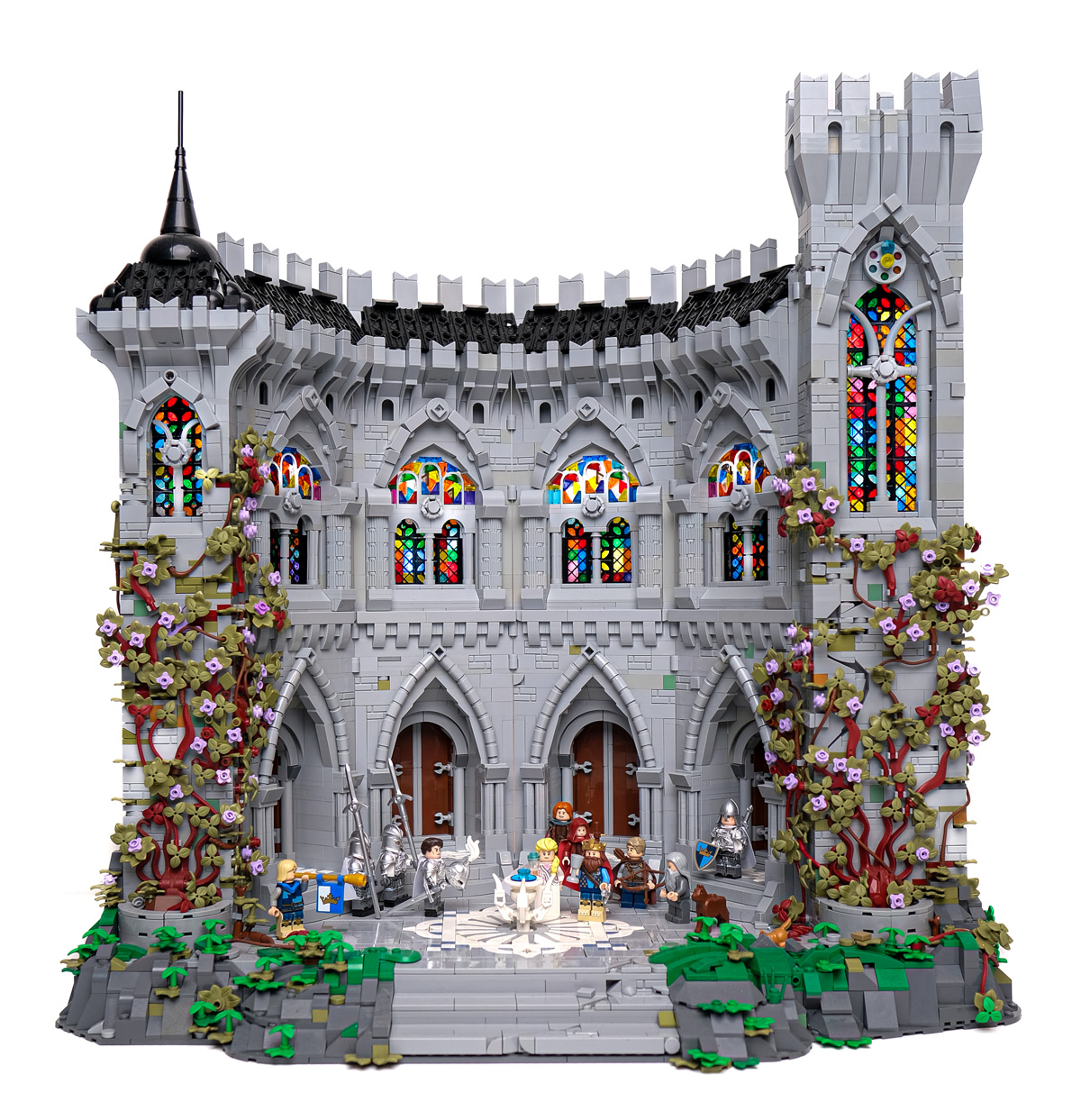
In The Fountain of the King, Doell renders a royal scene set in a grand Gothic courtyard, open to the sky, populated with figures gathered around a central fountain — the “eternal spring” commissioned by a newly crowned king.
The architecture here is stone-grey and intricately articulated. Three enormous pointed arches frame the facade, each subdivided into smaller arched windows that glow with stained glass in every color — built from individual 1x1 transparent round plates and slopes arranged into patterns. Backlit, these windows shine like the real thing. The arches themselves use multiple techniques layered together: curved slope bricks for the outer profile, detailed white molding elements framing the openings, and subtle SNOT (studs not on top) work where the stone courses shift direction to suggest the structural logic of real masonry.
Below the great arches, the courtyard floor is a full mosaic — tiles arranged in a geometric pattern that radiates from the central fountain. The fountain itself is small and white and precise, a focal point for the figures arranged around it.
Flowering vines climb the left and right flanks of the facade. There are cracks in the stone steps. The building is grand, but it shows its age — Luke built imperfection into it deliberately, because a castle without weather is just a model.
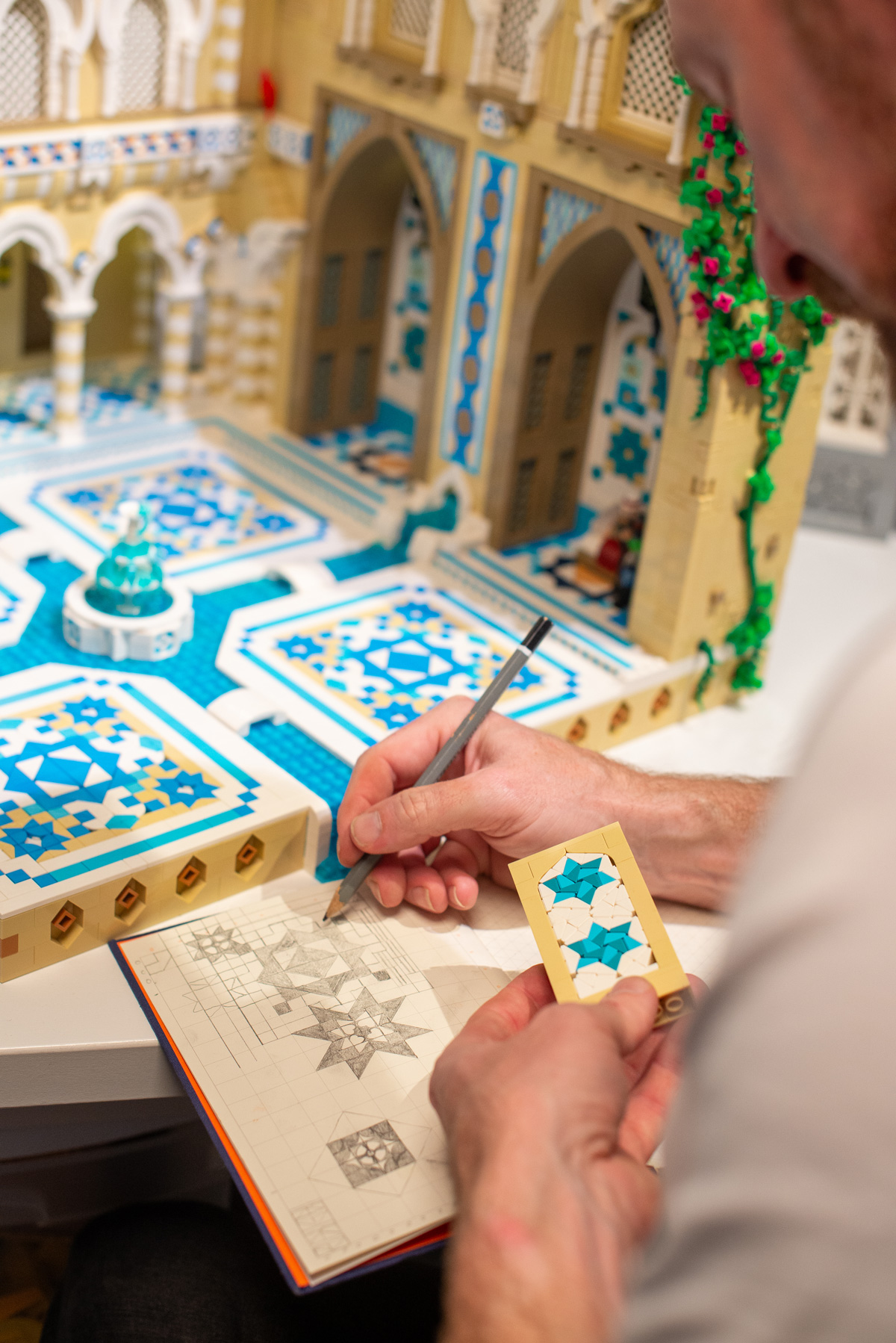
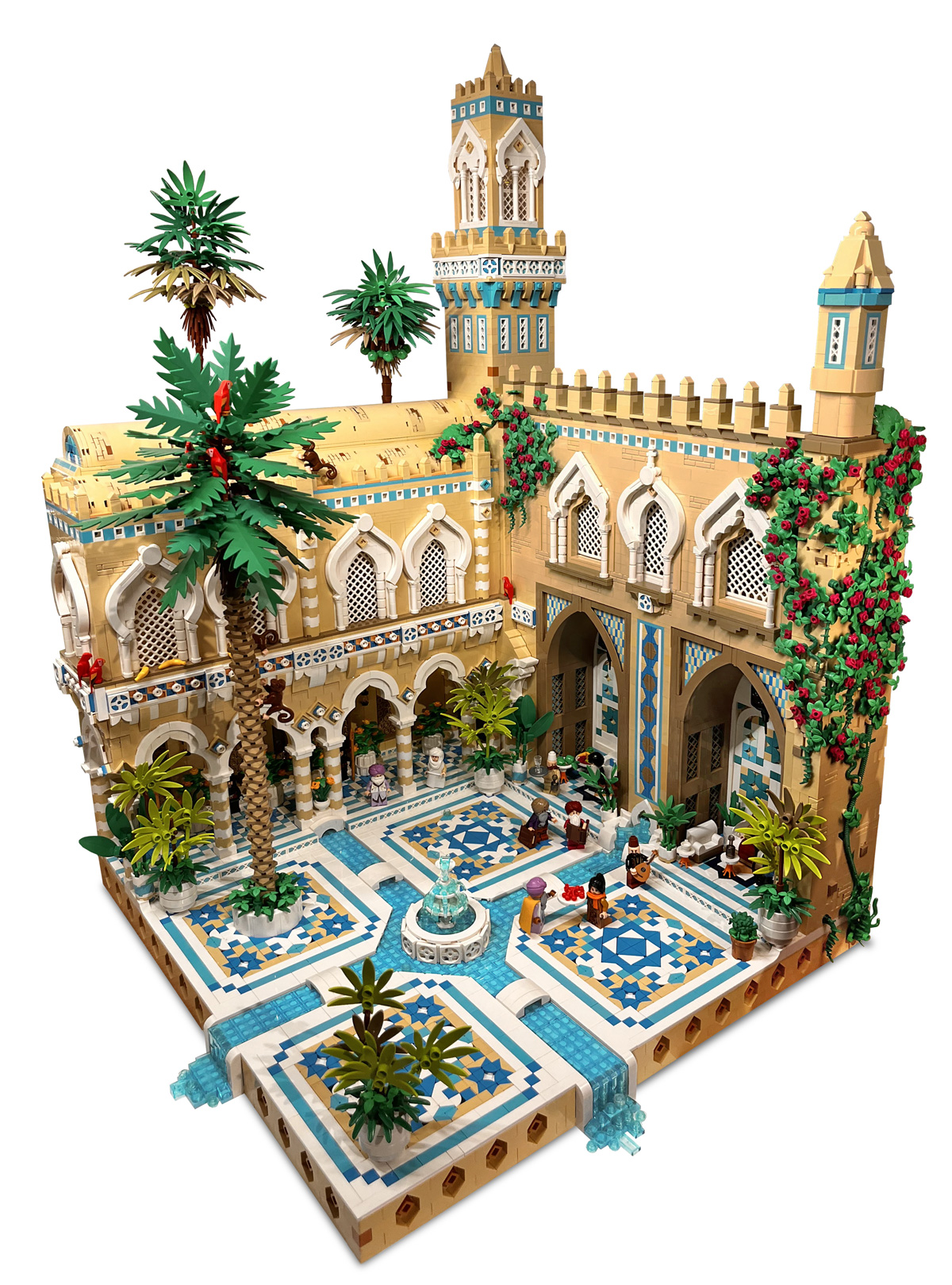
The Delights of Marrakech takes all of that ambition somewhere entirely new — and adds light. “From the beginning, I thought, ’This is going to have lights in it,’” he shares.
The obsession with arches, the layered foliage, the intricate courtyard floor, the sense of a world fully inhabited — they’re all here — but Delights transports them entirely into Moorish and Islamic architectural tradition. The palette shifts from Gothic grey to warm sand and ivory, with turquoise tile-work running throughout in geometric patterns. Horseshoe arches replace the Gothic lancets. Latticed screens sit above the archways where the stained glass would have been in an earlier build. Cascading pink and magenta flowers spill from the upper battlements, and small lanterns hang between the columns.
Luke is as deliberate about how his work is documented as he is about how it’s built. He thinks about the photograph from the beginning — where the camera will sit, what angle will show the depth of the arches, how light needs to fall across the courtyard floor to make the tile-work legible. For the Marrakech piece, his custom LED lighting transforms the build entirely after dark: the lanterns glow warm amber, the windows cast color, the fountain at the courtyard’s center catches the light in a way that makes it look like flowing, bubbling water.
Still Building Forts
Near Luke’s house, there’s a river. Every summer, he goes down with his chainsaw and his tools and does what he’s been doing his whole life: builds things. Communal seating. Structures from driftwood. Spaces for people to gather. The boy who built Ewok villages in the ravine is now the man who builds riverside beach cabanas.
“Staying young at heart is a life giving practice for me,” he says. “And it’s not accidental. It’s very deliberate.” He chose self-employment so he could protect it. He builds LEGO in the evenings, without deadlines or commissions or an audience in mind, just for the joy of creating from imagination and building with bricks.
Somewhere between the ravine behind his childhood home in British Columbia and the table where he now builds, the castles that were always in his head are finally getting built.