



Photography by Ben Gebo
They had a mission. They needed a ship. Not a good ship — a forgettable one. They walked the salvage line for the better part of an hour before the taller one admitted it was hopeless. They needed something that could sit in an Outer Rim docking bay and draw no second glances — a ship that looked pulled from a scrap heap and lashed back together by someone who didn’t know any better. But it had to be fast, and it had to hold together when everything else was inevitably coming apart.
“There’s a ship builder,” the shorter one said. “Out past the last of the desert waste settlements. Works a huge scrap yard. They say he can make anything out of anything.”
The scrap yard was more like a ship graveyard masquerading as a functioning workshop — the hollowed-out husks of TIE fighters stacked three high, freighter hulls split open like fruit, bins of parts towering into the dusty sky. The builder listened to the pair’s needs without saying much, then walked the rows, running a hand along a dented cockpit here, a bank of engines there.
“This cockpit,” he said finally. “Those engines off the wrecked gunship. And the wings — swept back, not forward, so it reads wrong to anyone who knows ships.” He was already crouched in the dust, sketching on a data pad.
“You can actually build something like that?” the taller one asked.
The builder didn’t even look up. “It’s all in the design, my friend.”
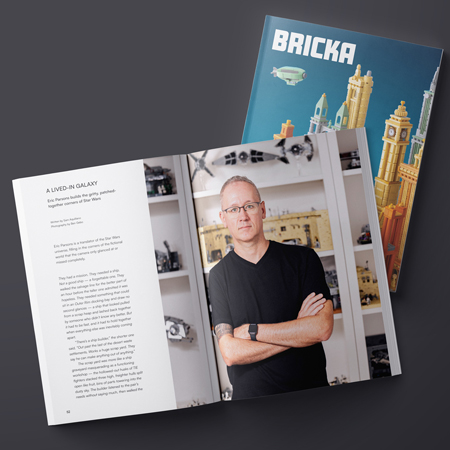
That ship builder has a name in our galaxy. His scrap yard looks an awful lot like a home office in a town outside Boston.
There's more! Continue reading this article by subscribing to BRICKA.
There's more! Continue reading this article by subscribing to BRICKA.

The Uglies
In the Star Wars universe, there’s a whole class of ships born from wreckage. They’re called Uglies, and the lore is simple and perfect: out on the margins of the galaxy, scrappers and pirates and desperate pilots take the remains of destroyed starfighters and weld them into something — anything — that flies. A TIE cockpit bolted to a Y-wing’s engines. A stolen wing grafted onto a salvaged hull. They’re ugly because they were never meant to exist. But they exist because someone needed them to.
Eric Parsons has built fifty-six Uglies out of LEGO, every one of them unique. He builds the way the scrappers would: grabbing what’s on hand, welding it into place, seeing what holds.
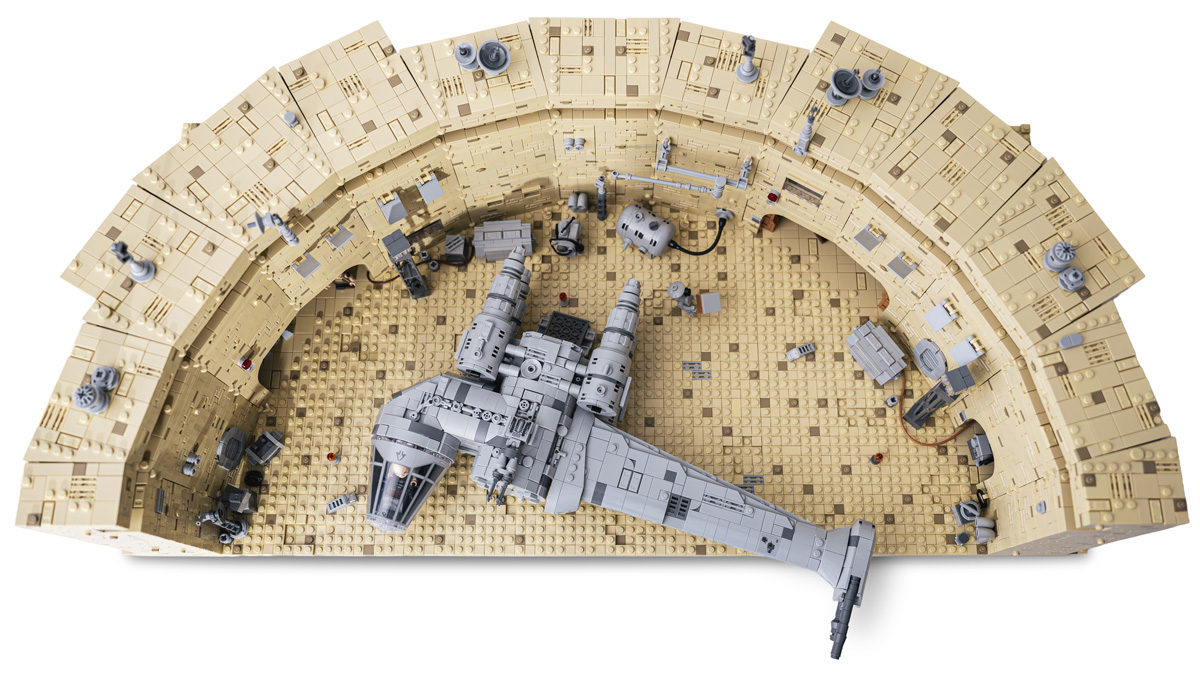
At one end are the Uglies that feel completely real. His favorite, the BUT-YT, is asymmetrical — a B-wing fused to U-wing engines, a TIE bomber’s body, the cockpit pod off a YT-1300 freighter. “The coolest ships are asymmetrical,” he says. It’s gritty, weathered, with an interior hold you can imagine a smuggler actually using. Another you can practically hear: built around the engines of the Razor Crest, it reads as a slow-moving gunship with real heft.
At the other end are the ones built purely to make people lose their minds — a Naboo Starfighter brutally mashed into a TIE fighter, an aesthetic crime Eric commits for the comments. What did you just build, and why?
Running alongside the Uglies is a separate project with a stricter rule set: his modular TIE fighter series. Seven variants, each rebuilt from the ground up so their components share connection points. “There are so many TIE bomber MOCs out there,” he says, “but no one had done anything like this.” Wings pop off one and onto another; whole bomber sections detach and reattach elsewhere. The series is engineered to be mixed and matched, and it culminates in TIE It Up — “when an engineer has no constraints” — a two-foot-wide monstrosity combining parts from all seven, which he’ll happily tell you could never actually be built.
What ties it all together — the sublime and the ridiculous alike — is Eric’s habit of building backstories as he goes. The little snub fighters especially: he’ll customize a minifigure pilot and invent a history for the person who needed it. The starships transform from interesting MOCs into settings for Eric’s imagined stories.
Pajamas at the Drive-In
Eric Parsons grew up in Bismarck, North Dakota, an only child raised by his mom. Born in 1974, he was a kid of the 1980s — GI Joe and Transformers fed a steady diet of the era’s imagination. His grandmother would take him to the mall and spoil him, and he’d leave with a small LEGO set, mostly Classic Space themed. He never had a huge collection, but enough to build spaceships, and he drew constantly — a lot of house floor plans, just for fun. By grade school, he’d narrowed his ambitions to two: astronaut or architect.
Then, one night, he witnessed The Empire Strikes Back.
He was very young, in his pajamas in the back seat at a drive-in, and remembers only fragments — but something took hold. Boba Fett made a lasting impact before Eric even owned the toys; he had a Boba Fett birthday cake in third grade. When Return of the Jedi came out, he saw it a dozen times in the theater that summer.
What really drew him in was the grit — Star Wars wasn’t an unrealistically shiny space drama. “The bad guys kind of won” in Empire, he says, and that was unique — a little dark, a little unresolved. He was fascinated by the Empire, the Stormtroopers, the nameless people inside the machine. Even Han Solo wasn’t exactly a good person. These characters had shadows, smuggled cargo, and broke the rules. “It felt more real than something like Star Trek,” he says, “where they’re all clean, wearing tight outfits.” Everything in Star Wars felt used, patched, weathered. Lived-in. That grit is the key to everything Eric would go on to build.

Two Dark Ages and the Return
Like most kids of his era, Eric hit an age when toys stopped being cool. But his first return came early, when his son hit the perfect age just as LEGO launched its Star Wars line. Eric bought almost everything for two or three years. He and his son built the sets, then began building beyond them — Eric’s first true MOCs were inspired by the blueprints in the old Star Wars cross-section books. He placed his first parts order back when BrickLink was still called BrickBay and made his son a custom Mara Jade minifigure from the expanded universe.
Then his son grew up, and Eric — in a move any AFOL will recognize — claimed all the LEGO for himself. The bins followed him everywhere: through a move from North Dakota to Massachusetts. Plenty of other things got left behind, but the LEGO made the cut.
The second return was COVID. Working from home, Eric reached for a hobby. He broke out the old bins and started sorting. And the creative doors popped open again.
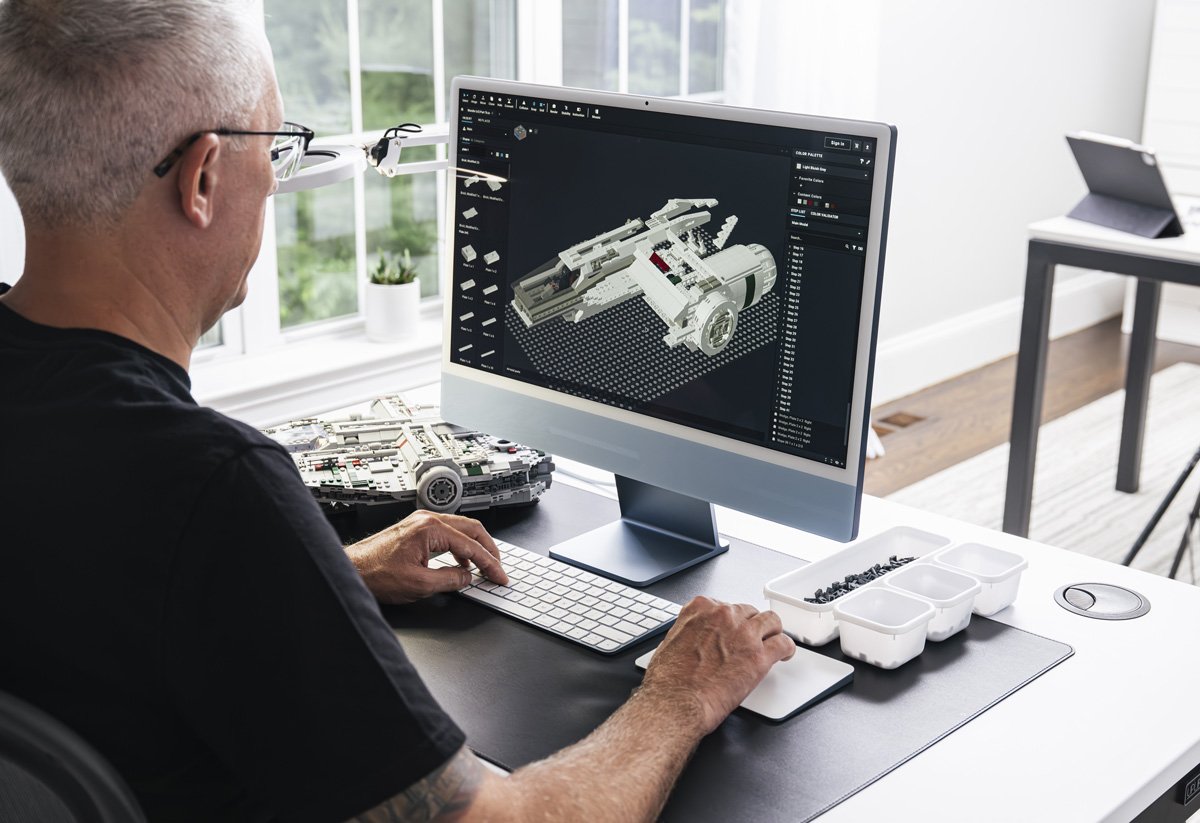
It was the Razor Crest that really did it. He started modifying the set’s cockpit to make it more screen-accurate, posted the changes on a new Instagram account, and people wanted instructions. His first attempts involved taking photos in a light box and hand-annotating images in Photoshop — painful enough to prompt the inevitable there must be a better way moment. That’s when he found BrickLink Studio, the digital design software that would change everything. He learned to model his modifications, build entire sets digitally, and then render and publish instructions. His Star Wars-focused design practice was born.
What Makes Star Wars Star Wars
Ask Eric what makes something feel like it belongs in the Star Wars universe, and you’ve asked the question he thinks about most. He’s got hundreds of screenshots of movies, episodes, books, and more captured for close study.
The answer comes back to that lived-in detail. The industrial crates. The panels patched where something broke. The cabling and hoses and cords — all the layer-on-layer of stuff that accumulates anywhere people actually live and work. A random weird droid in the corner. “If you remove those things,” he says, “it can kind of be anything. But once you start layering in those things, now it starts to feel Star Wars.” Color matters too — mostly its absence. Too much saturation and a build stops reading right — a Venator-class ship being the brightest color, in a red so muted it’s barely red at all.
It shows up even in the ships almost nobody remembers seeing — the vessels that flash across the screen for five seconds, that a concept designer poured hours into before they got buried in the background of a single shot. “I feel this drive, or this need to recreate it,” he says, about the background ships.
The clearest example is a ship from Andor — a vessel in the junkyard where Cassian borrows a shuttle, on screen for seconds, only ever shown from the front. For a long time, it didn’t seem to have a name, so Eric called it the Mandor. He’s since learned it might have an official canon name: the Hyrotii D-85 Freighter. To build it, he became a visual detective. He pulled every screenshot he could find, brought them into Figma, and outlined the shapes and surfaces. He found an important frame with Diego Luna standing beside the ship, looked up the actor’s height, and used it to establish scale — he reverse-engineered a ship that was never fully shown and built it in wonderful LEGO detail.
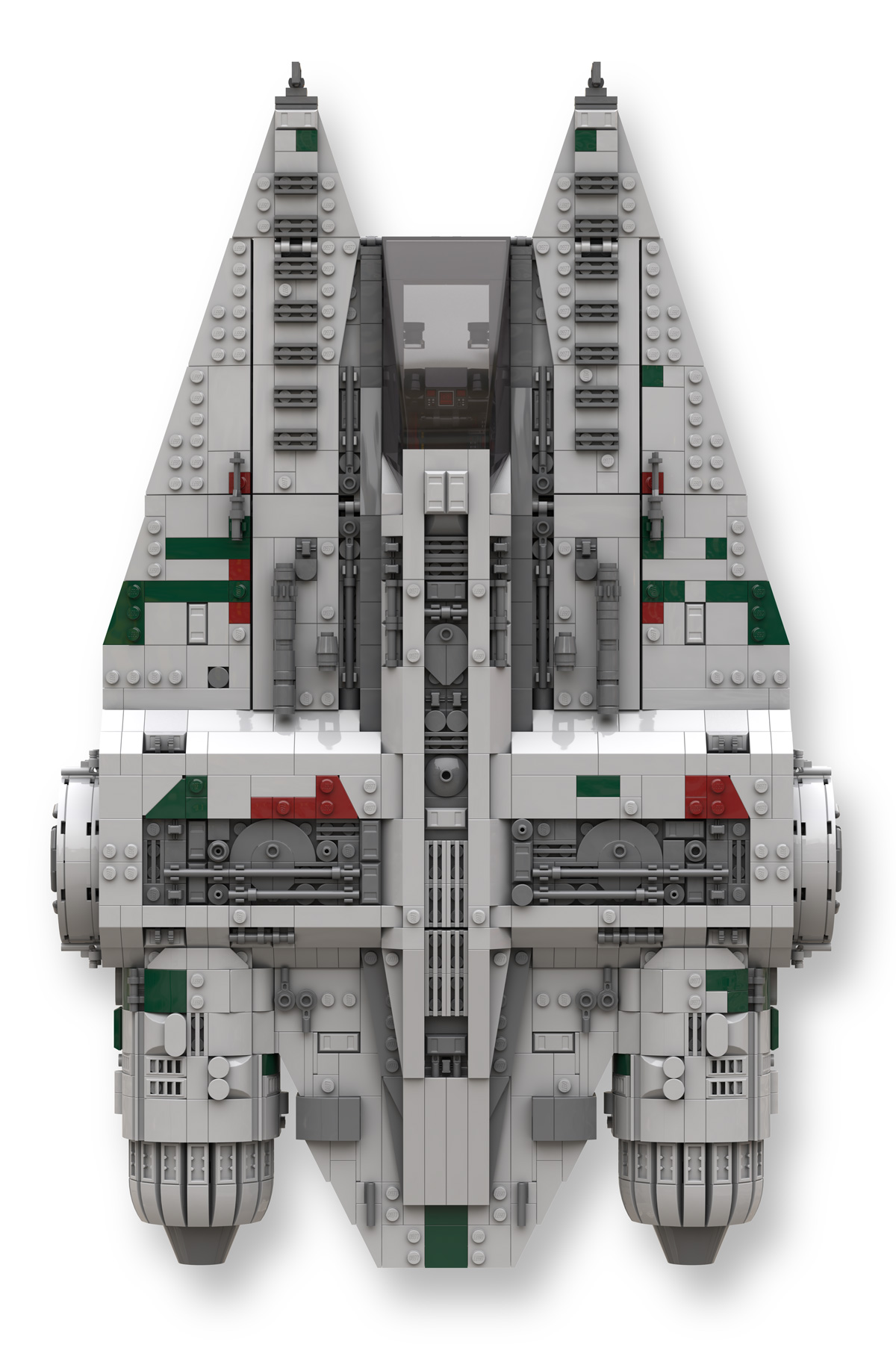
Sometimes the translation runs the other direction. Eric fell in love with a ship by artist Matthew Savage — a sleek, improbably thin vessel that was never built or filmed, existing only as concept art. Savage had posted something close to blueprints, and Eric worked from those, establishing the cockpit first and matching every element to that anchor. He replicated the details that made the design sing: the white outline stripes running into the weathered air intakes, the recognizable character of the wear. When Savage saw the finished build — his concept ship in three dimensions — he loved it.
Eric’s method is consistent. Reference studies in Figma, create measurement planes to establish scale, and choose LEGO elements that work — the cockpit first, usually, because it’s the most parts-constrained element and everything else has to scale to it. Then the algebra — solving for proportions and doing the math. Proportions he felt were right routinely turn out to be off by several studs, and a small early error ripples through the whole design. Underneath it all is one non-negotiable rule: structural integrity. “It’s important to me that I can hold something I built and it doesn’t fall apart in my hands.”
Dioramas and Details
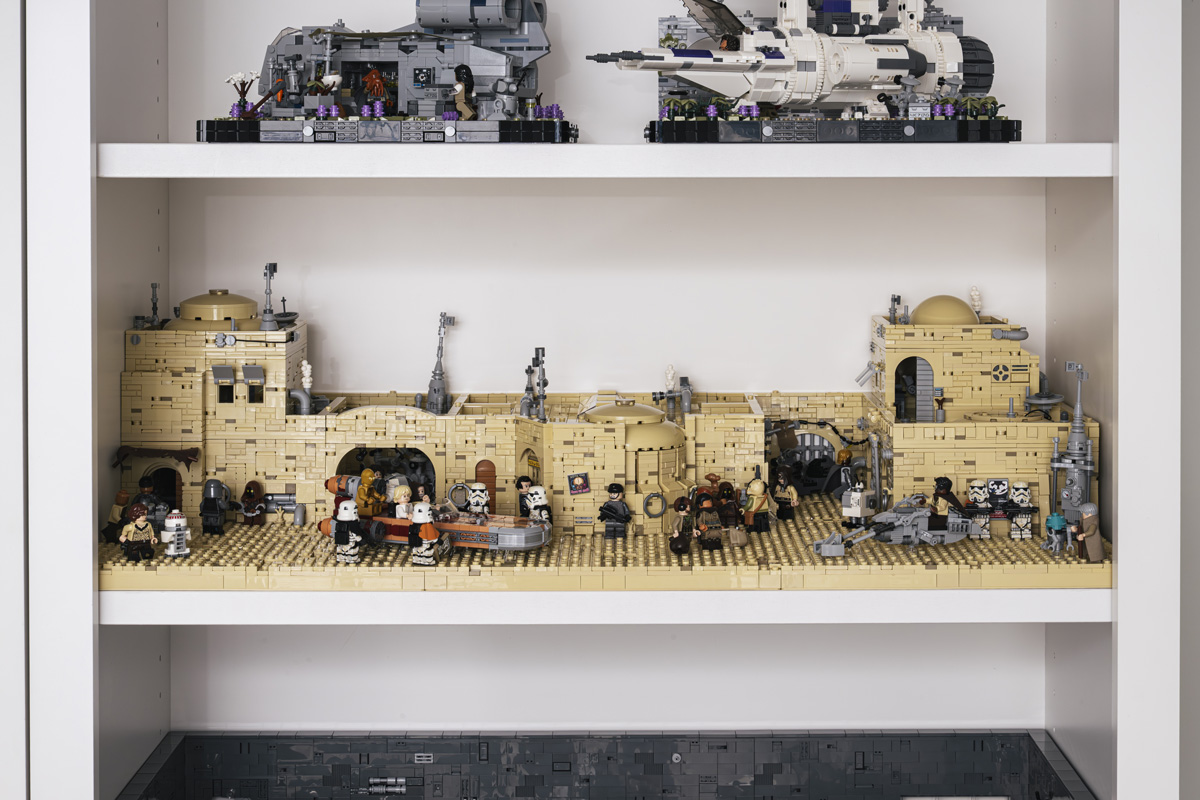
His ships don’t float in a void. He builds them worlds. Eric’s diorama MOCs started with a lucky accident: the bookshelves he installed turned out to be exactly three base plates wide and one and a half deep — a perfect display constraint. One is a Mos Eisley-style build anchored by a repurposed Cantina set, expanded into a full settlement — with a speeder-bike garage, a market, and a back room where the Jawas run a black market, because everyone knows Jawas are shady. That detail alone spins off a story: Imperials are raiding the operation — and there are scenes tucked into every corner of the structure.
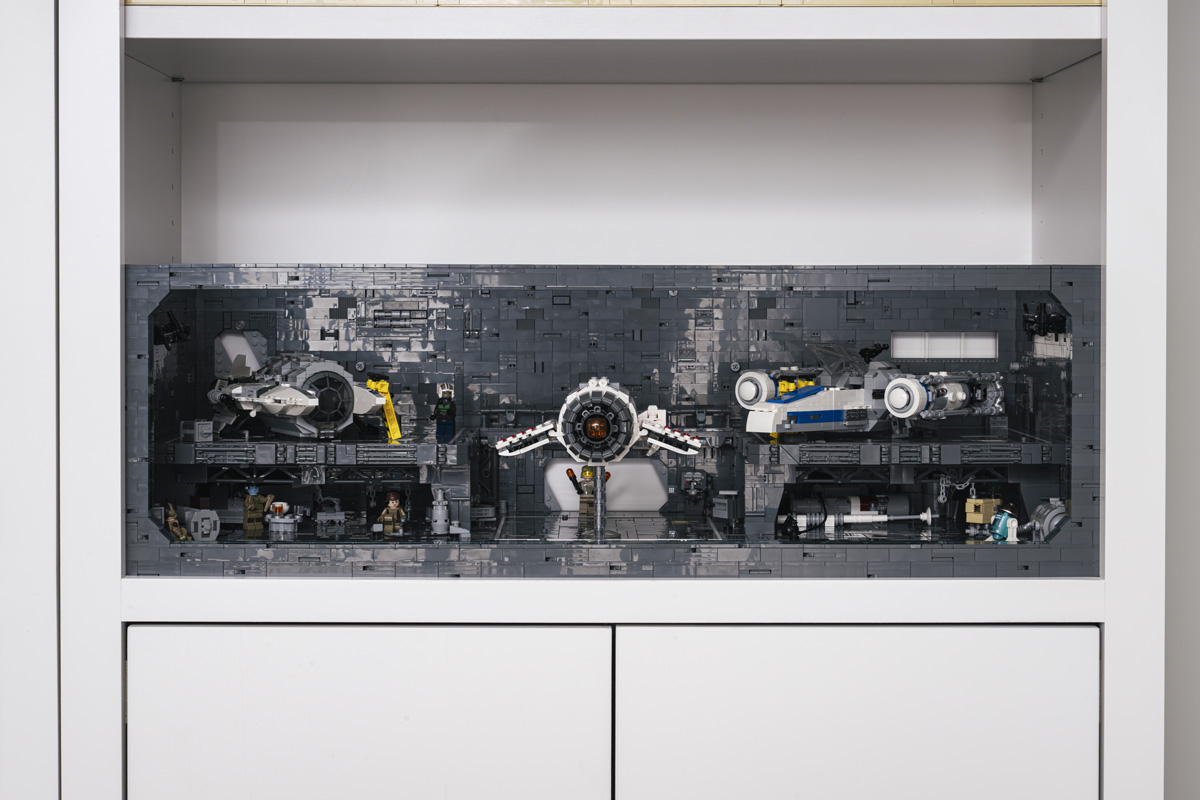
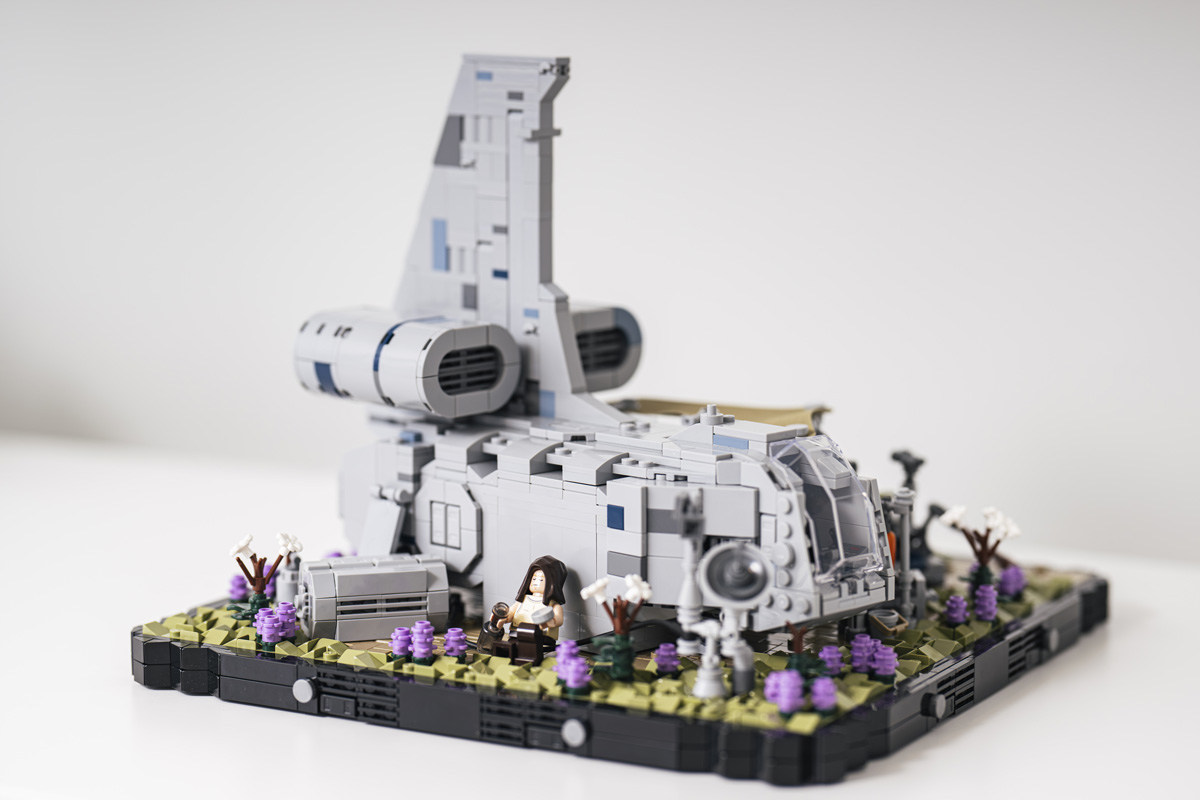
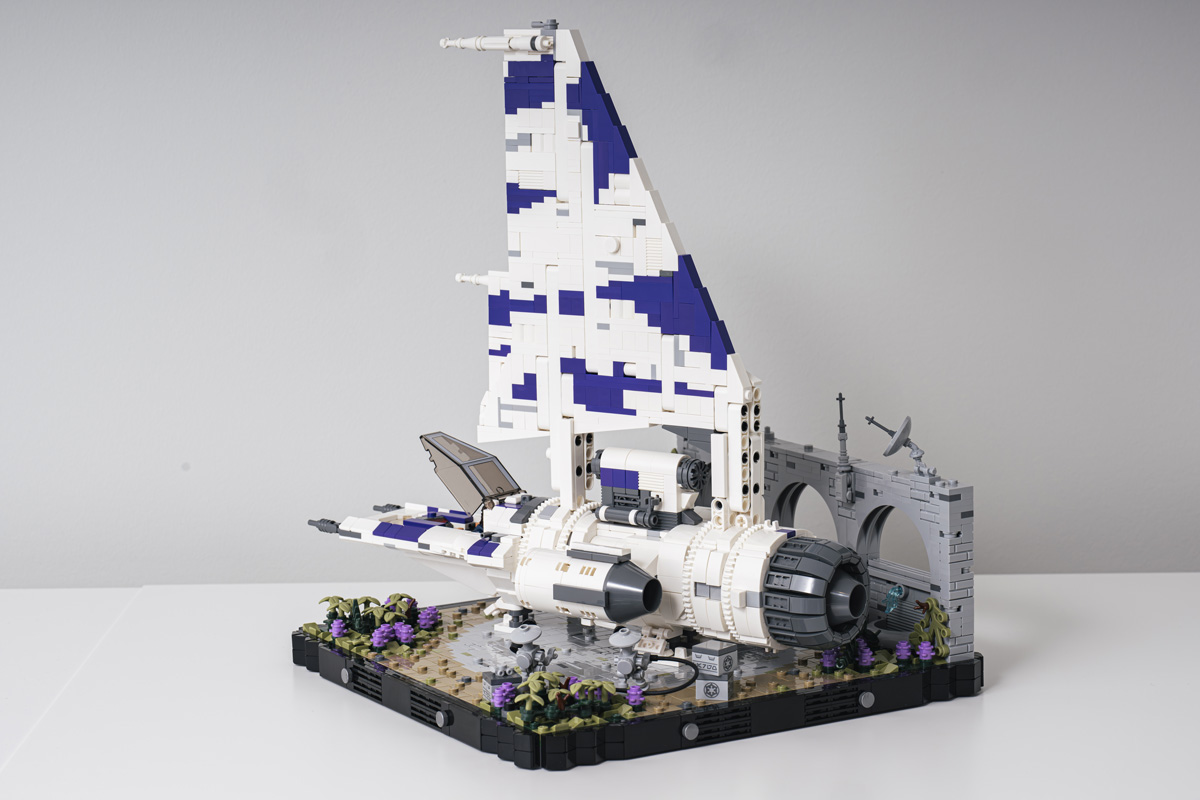
Another is a Clone Wars scene in an invented style — medieval by way of cyberpunk, more vibrant color and trees, a deliberate break from endless tan and gray. Eric had the buildings shaped before he knew what went inside them. Then he received custom tiles printed in Aurebesh, the Star Wars alphabet — and the signs drove the contents. One said Speeders, so that naturally became a speeder shop. One read The Lucky Bantha, so that became a diner. An iconic dancer, so, a club. A droid smith, so, a droid smith, and so on.
What unites Eric’s LEGO dioramas is scope creep — the good kind — which he treats as a creative engine rather than a flaw. A plain backdrop diorama ends up with a fully detailed interior. Every floor lifts off to reveal more lived-in spaces underneath. Every room is furnished all the way. The Book of Boba Fett’s mod-parlor — maybe ten seconds on screen — gets recreated inside a building with a roof, where practically nobody will ever look, but Eric knows someone eventually will.
The detail on the inside is what makes Eric’s work sing in person.
Putting himself out there online — where he’s known as ScruffyBrickHerder — was, first, an exercise in humility. Everyone has an opinion and he now lives for the comments — the wows, the what in the world have you done-s, and everything in between. It’s all fuel for his creativity.
In person, his pieces come alive. At LEGO conventions, people lean in close to inspect the detail on one of his dioramas — and Eric walks up, says nothing, and lifts the roof off. Then the next floor. Whoa. Kids drag their parents back over — or more often, parents drag their kids — just to watch him open it up again. “That’s been so much fun,” he says, “to tear these things apart like that and show people what’s inside.”
Those shows pushed him in a new direction. His shelf dioramas had boring backs and sides, so for exhibitions, he started building 360-degree scenes, finished every angle and view, designed to be walked around. They’re 32 studs square, everything removable, so they survive a pothole-ridden drive to a convention in Vermont without every minifigure rattling loose. Some tell two stories at once — a Vader scene on one side, a corridor looking in on the other — narratives that reveal themselves as you circle the piece. And he uses them to break out of the muted palette, working in vegetation and color to pull people in from across a show floor.
He’s also started sharing his process on Patreon — the prototypes, the discarded builds, and the vignettes that never made a final piece. People constantly ask how he builds these ships and worlds, so sharing his process has become its own reward and a way to build community.
Artist, Designer, Engineer
Eric has had to think hard about what to call himself — and determine where he fits in the LEGO community. He lands on artist and designer, but artist is a loaded word for him. He did two years of art school and several years of architecture before pivoting, taught himself web design, and spent twenty-five years in UX. The word artist, to him, conjures a thing that hangs on a wall behind a rope, with a fancy placard, that nobody can get close to. What he makes is the opposite: tactile, gritty, holdable, buildable — simple elements assembled into complex scenes.
He clarifies further: it’s a union of skills. Engineering, for the structural integrity and the algebra of proportion. Storytelling, for the invented histories. And craft, for the thousands of hours of accumulated skill. Underneath it all, a digital-first workflow that gives him a freedom he can’t get from the physical world — the ability to open a file and build something he doesn’t have the parts for, prototyping a round landing pad or a Death Star lighting panel in minutes.
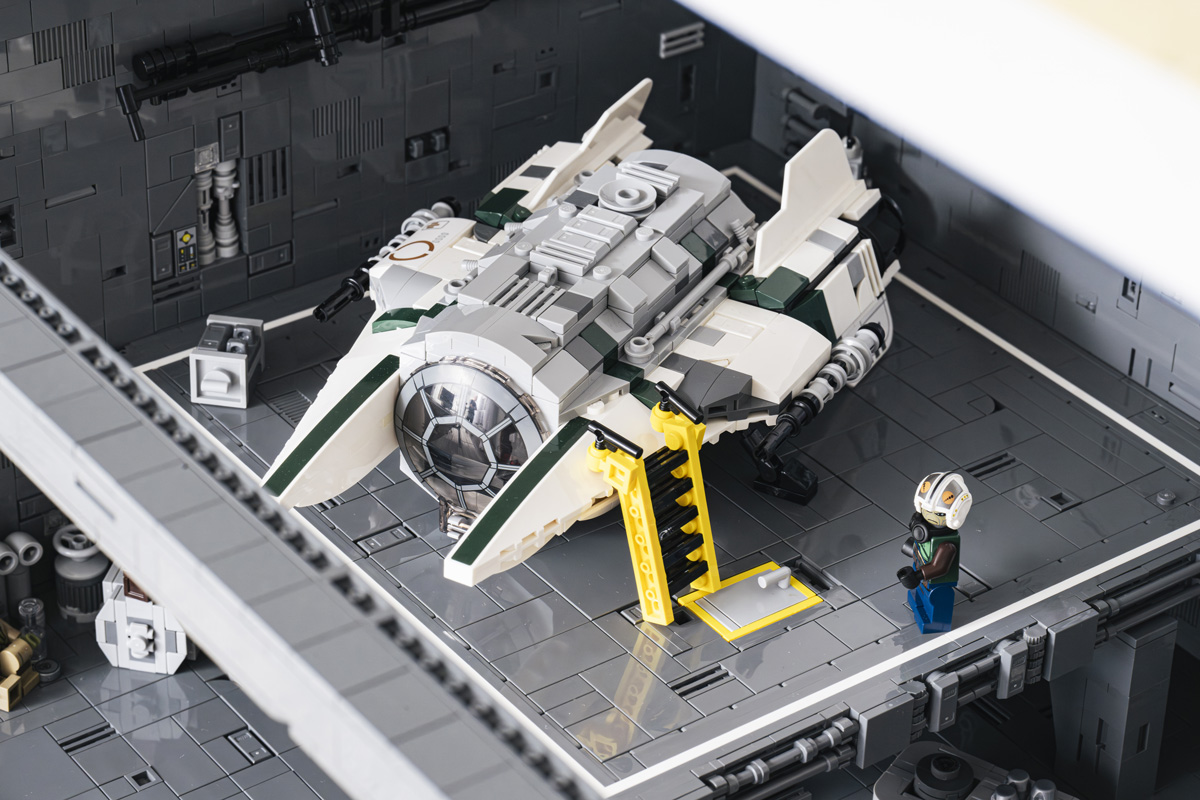
The moment Eric finishes something, he’s already redesigning it in his head. Unlike a painting — unlike almost any other medium — with LEGO, he can act on that impulse. Tear it down, rebuild it better. His docking bay diorama is on its third version. Every teardown makes it more. There’s always a next thing — the integrated lighting he keeps circling, a towering cyberpunk piece, and more Uglies, always more Uglies. He has dozens designed and unbuilt, and really wants to know what a hundred looks like all together.
Out past the last of the settlements, the shipwright is still in his element. Still walking the rows of salvage in his mind. Still taking the bones of what everyone else threw away — the crashed fighters, the background blurs, the ships that flashed across the screen for five seconds and were forgotten — and bolting them into something nobody else could imagine. Someone arrives with an impossible mission, and he crouches down in the dust and starts to sketch, because he already knows what they don’t:
It’s all in the design.